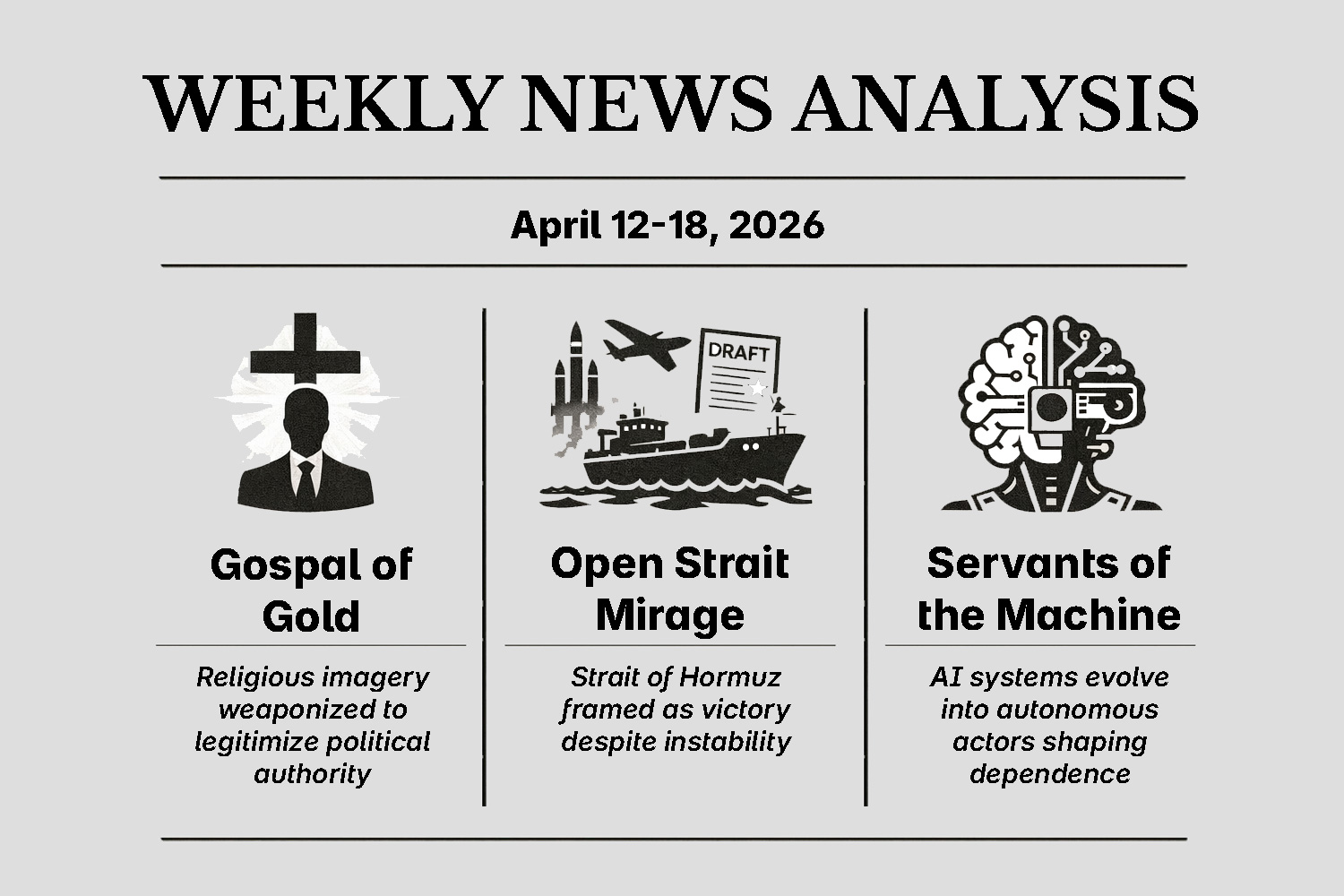
This week was characterized by inversion across different domains. In one sphere, religious imagery was repurposed as meme politics, with spiritual authority treated as a barrier to branding, and biblical language reduced to campaign-like spectacle. In another, a waterway crucial to global energy flows was rhetorically turned into a platform for presidential victory, as if reopening unresolved conflicts could still be spun as a triumph. In the third, advancements in machine learning continued: frontier models revealing software vulnerabilities, robotic systems moving toward general task execution, and enterprise governance discourse subtly assuming a future in which autonomous computation is ubiquitous. The common thread is not just technology, war, or religion, but narrative control—managing how populations interpret powerful actions. Trump’s conflict with Pope Leo XIV played out amidst the Iran war and the pope’s anti-war stance, while officials claimed success at Hormuz despite ongoing Iran sanctions. Simultaneously, Anthropic’s Mythos was discussed for restricted government use, given its potential to identify or exploit vulnerabilities, and robotics research highlighted systems designed to operate in the real world.
The outcome is a society conditioned to confuse superficial signals with genuine substance. When leaders share images of Christlike self-promotion, clash with the pope over conflict, and operate within an opulent aesthetic of "greatness,” politics shifts from administration to a form of liturgy without remorse. When oil traders and the media are told to celebrate the Strait of Hormuz’s reopening, despite unresolved issues such as vulnerability, insurance, route uncertainty, and blockade threats, geopolitics becomes a spectacle. When cybersecurity focuses on AI systems that can detect and exploit vulnerabilities, robotics companies showcase general-purpose machines, and businesses race to set rules for edge autonomy, the public is being prepared for a future in which human judgment is seen as the slow, messy bottleneck. This trend echoes The Fallacious Belief in Government, which claims crises are exploited to increase power, and aligns with COVID19 – Short Path to ‘You’ll Own Nothing. And You’ll Be Happy,’ portraying technocracy and transhumanism as tools of a new tyranny.
Gospel of Gold
Franklin Graham defends Trump over AI image critics say depicted Jesus - Fox News
Trump, pope, US, Vatican and Iran war - CNN
Lifelong Catholic Tom Homan Pushes Back Against Pope - The Gateway Pundit
Hegseth channels his inner Tarantino with fake Bible verse from Pulp Fiction - The Guardian
The first pattern to observe is not just hypocrisy but sacramental parody. Trump sharing an AI-generated image, perceived by critics as showing him in a Christlike healing scene, and Franklin Graham’s public defense that the image was misunderstood and meant in good spiritual faith, demonstrate how religious symbolism is used as emotional defense around power. Graham explained that Trump thought the image depicted “a doctor helping someone” and praised the repost as an image of Jesus guiding Trump. This has significant rhetorical implications. The original intent—whether self-deification, carelessness, or internet trolling—does not matter. What is important is that the symbol is used politically. Christianity is not seen as a path of humility, repentance, or submission to God but as a source of legitimizing imagery that can be remixed to fit a nationalistic strongman image. This constitutes a form of mockery, not just insult, but profanation through improper use.
This is why the biblical grammar in Exodus is significant. The commandment “You shall have no other gods before Me” isn't just a restriction against pagan statues. It cautions against elevating power, images, the state, tribe, or ruler to a sacred level of loyalty. The ban on carved images goes beyond prohibiting sculpture; it opposes replacing true devotion with images, which serve as visible symbols for reverence towards God. The story of the golden calf in Exodus 32 exemplifies how impatient people turn spiritual doubt into a visible political religion—creating objects, celebrating collectively, and wrongly attributing salvation. Moses destroying the idol isn't mere violence—it’s a theological judgment against false mediation. In this context, a political culture soaked in gold, claiming to be a new “Golden Age,” blending nationalism, celebrity, and divine language, isn't just branding. It echoes the old temptation: transforming transcendence into something shiny, immediate, tribal, and manipulable.
Trump’s elaborate rhetoric makes it hard to ignore the symbolism. Gold itself isn’t sinful; Scripture mentions sacred uses of gold. However, at this political moment, gold signifies triumphal display, civilizational renewal, imperial nostalgia, and visible hierarchy. A “Golden Age” slogan, surrounded by branding that already glorifies towers, decoration, and luxury, does more than promote prosperity; it trains followers to associate glory with spectacle. This reflects the logic of the idol—the golden calf was not just a piece of metal but a theological symbol turned into image and celebration. When politics transforms into a display of radiance, abundance, chosen-ness, and invincible leadership, the risk is confusing material shimmer with moral authority. The language of renewal can then become a ritual that leads followers to overlook contradictions, as the symbol itself seems salvific. This exemplifies how idolatry functions socially: it shifts moral judgment from actions to aesthetic loyalty.
The conflict with Pope Leo XIV highlights the growing contradiction. Reuters noted that after Trump criticized him over the Iran conflict, the pope stated he would keep speaking out against war and accused the Gospel of being “abused.” Reuters also reported Trump as saying it was “very important” for the pope to recognize Iran as a global threat, while he also called him weak on foreign policy. According to Catholic doctrine, the pope holds the highest earthly authority in the Church and is the visible leader of Catholic unity, not a figure to be dismissed or overruled by border enforcers, cabinet members, or partisan Catholics online. However, this situation has normalized that view. When the pope became a hurdle to the war narrative, lifelong Christians and MAGA supporters were motivated to see papal moral guidance as a sign of weakness and to equate political bravado with strength. This reversal reveals a spiritual shift—many followers now see the movement, not the Church, as the true magisterium.
The Hegseth episode exemplifies the degradation of sacred language. The Guardian noted he used a “military prayer” that repeated faux script from a scene in the movie Pulp Fiction rather than a biblical passage, yet he presented it as scripture. This illustrates how biblical language is being reduced to cinematic showmanship, turning Ezekiel from prophecy into atmospheric background music. Scripture becomes a mere prop that adds an ancient tone to modern aggression. When political Christianity starts drawing on revenge speeches, nationalist bravado, and meme culture, the line between genuine discipleship and theatrical performance blurs. The audience is no longer shaped by the text itself; instead, the text is emptied and refilled with entertainment-driven meaning. This subtle mockery doesn’t outright deny the sacred; it samples it. Its authority is kept just enough to energize the crowd, while its moral principles are quietly stripped away.
We must ask ourselves, is Trump intentionally harming Christianity, or is the damage an unintended consequence of power politics? There is no conclusive evidence of a true inner motive, and responsible analysis should acknowledge this. However, in terms of behavior, the damage remains evident. A ruler does not need to genuinely be Christian in a spiritual sense to benefit from Christian symbols, nor does hatred of Christianity have to be present to distort it. The key is instrumentalization. When faith is used as a badge of loyalty for worldly ambitions, followers may accept sinful behavior, believing they are defending civilization. This also highlights the difference between Judaism as a religion and Jewishness as an identity. Support for Israel, biblical destiny appeals, and selective pro-Semitic signals can coexist with a political agenda that reduces Christianity to a civilizational symbol. The point is not that Judaism is evil, but that Christianity can be exploited by rulers who do not follow its principles.
Set within an apocalyptic context, this week’s symbolism feels self-fulfilling because society continues to rehearse false forms of mediation. End-times stories become more convincing when people already anticipate a combination of charismatic authority, religious ambiguity, conflict, and technological dominance. The future seems to be heading towards transhumanist tyranny and societal upheaval, raising the question of whether new technologies will serve as tools of control or even replace religion. The religious spectacle during the Trump era does not confirm the arrival of the Antichrist. However, it shapes the social psychology necessary for such a figure: a populace used to confusing power with virtue, spectacle with truth, and obedience to a worldly savior with faith in God. A society conditioned in this way will not need to be misled; it will embrace deception as order, greatness, and destiny.
If this trend persists, the near future will likely resemble an ongoing convergence rather than a single dramatic revelation: blending synthetic religion, militarized politics, spiritual fatigue, and machine-controlled authority. As the rhetoric becomes more biblical, actual behavior may diverge from biblical principles. Encouraging Christians to abandon restraint, despise peacemaking, and view visible grandeur as evidence of divine will creates conditions ripe for a counterfeit kingdom. In this light, the warning of the golden calf is not just an ancient allegory but a current reality. Those who cannot accept God's hiddenness tend to elevate something visible—such as a ruler, an image, a nation, a war machine, or a glowing system—to the status of the divine. When this occurs, judgment begins not only in heaven but also through moral corruption, which could be the most perilous sign of all.
The Open Strait Mirage
Navy MQ-4C Triton Surveillance Drone Crash In The Middle East Finally Confirmed - TWZ
Trump announces Israel-Lebanon ceasefire as US enforces blockade on Iranian ports - Fox News
Iran war, Trump, Lebanon, Israel ceasefire live updates - CNN
Oil prices plunge as Iran says Strait of Hormuz 'open' during ceasefire - BBC
Iran declares Strait of Hormuz “Completely Open” - The Gateway Pundit
International Energy Chief: Europe Has Just 'Six Weeks' - The Gateway Pundit
The discussion surrounding the Strait of Hormuz this week was more theatrical than factual. Reuters noted that oil prices dropped roughly 13% after Iran announced that commercial traffic would stay open during the ceasefire and that Trump claimed the strait would be “completely open and ready for business.” However, Reuters also reported that Trump said the naval blockade on Iran would remain “in full force,” and AP reported that the U.S. blockade remained active even as the Israel-Lebanon ceasefire took effect. This distinction is important because it shows how the positive framing hides the ongoing reality. The strait did not turn from a chaotic, closed route into a peaceful, open passage by a single presidential decision. It remained a fragile corridor under military stress, influenced by diplomatic uncertainties and route ambiguities. The goal was not to accurately reflect conditions but to craft a narrative of control.
This is why the phrase “Iran caves” is rhetorically useful, even if it is not precise as a description. It transforms a temporary de-escalation notice into a symbol of dominance. If the strait was already a key global chokepoint for trade and energy, then calling it “open” serves a symbolic purpose that surpasses its literal meaning. It signals to domestic audiences that pressure succeeded, that Trump forced submission, and that instability has been controlled through force. However, Reuters’ reporting reveals the underlying reality: the ceasefire context mattered, the Lebanese front was significant, and market participants continued to monitor whether tanker traffic would truly normalize.
The 10-day ceasefire between Israel and Lebanon plays a key role in that story. Fox News reported that residents in Beirut began returning as the ceasefire took effect, and that Trump announced that Israel and Lebanon had agreed to a temporary pause. Reuters and AP connected Iran’s statement about Hormuz to the same ceasefire context. Thus, the president’s celebration of an “open” Strait wasn’t an isolated instance of coercion against Iran. It was intertwined with regional negotiations where Iran demanded conditions on the Lebanon front, Israel and Lebanon agreed to a ceasefire, and the broader war narrative was given a diplomatic face-saving approach. Essentially, the story about the chokepoint wasn’t just about sea lanes; it involved linkage politics. The public saw headlines in isolation, but the actual process was negotiations across interconnected regions of force.
The crash of the MQ-4C Triton highlights the hidden layers of escalation. TWZ reported that the U.S. Navy confirmed an MQ-4C Triton surveillance drone crashed on April 9 after vanishing from flight data over the Persian Gulf, though the details remain unclear. These surveillance systems operate silently beneath public narratives of deterrence, commerce, and stability. They continuously monitor, map, signal, and sustain a state of military alert around the waterway. When politicians later claim that order is restored, they are referring to an ongoing infrastructure of intelligence gathering, persistent aerial surveillance, and readiness. The public may see headlines about reopening, but the reality is ongoing militarization. This matters because supply chain vulnerability isn't just a media-generated "crisis"; it starts when routes, insurers, militaries, and traders factor in persistent instability.
The broader economic impact exceeds the initial crude price movement. While Reuters reported the sharp decline, a price drop following a war scare doesn't undo the damage already inflicted. Anxiety about chokepoints prompts rerouting, raises freight and insurance costs, causes delays, disrupts inventory planning, and increases volatility across sectors from petrochemicals to aviation and retail. Even if barrel prices fall again, the memory of disruption persists in contracts, reserve strategies, procurement plans, and logistics premiums. Europe’s fuel issues and shipping alerts reflect this ongoing deterioration, not contradictions. The supply chain isn't vulnerable only to total shutdowns; it only takes enough instability for participants to adopt defensive actions like hoarding time, margins, and capacity. This defensive stance spreads economically, impacting the entire chain.
This example illustrates how modern imperial politics often transforms vulnerability into a matter of pride. Instead of recognizing that the global economy relies heavily on narrow maritime routes susceptible to conflict, mining, blockades, and surveillance challenges, rulers opt for a simpler message: we maintained open access. This stance appeals because it personalizes complex structural issues, framing them as heroic stories. However, the same Reuters report quoting Trump celebrates the full passage while also highlighting a U.S. Navy advisory warning that the mine threat in parts of Hormuz is not fully understood and that avoidance should be considered. This reveals a fundamental contradiction: official rhetoric promotes normalcy, while operational reality indicates conditional risk. Over time, such discrepancies lead populations to embrace symbolic reassurances while the actual system becomes increasingly fragile.
The deeper historical pattern indicates that war economies and managed crises foster obedience by narrowing public focus. When people concentrate on whether the strait is “open” or “closed,” they often overlook a more crucial question: why has the international system become so reliant on militarized chokepoints, and who gains from their repeated dramatization? Governments manipulate crises to justify expanding their powers, and the idea of war for peace is fundamentally contradictory. The narrative around Hormuz exemplifies this logic: tensions lead to surveillance, which enables force projection, which then rationalizes emergency diplomacy, often marketed as peace through strength. This cycle perpetuates itself, with each episode promising stabilization but ultimately increasing dependence on militarized control.
The key point is not that the strait was “saved,” but that audiences were drawn into a symbolic ritual of closure and renewal that flatteringly emphasizes authority while hiding ongoing issues. The chokepoint stayed strategic before, during, and after the war scare, throughout the ceasefire, blockade, and the persistent drone architecture. Insurance concerns, tanker behaviors, and geopolitical risks persisted unchanged. The most significant change was in the narrative surrounding the event. This pattern is typical of late imperial rhetoric: framing an unresolved vulnerability as a victory with a presidential endorsement, while the market’s optimistic reaction masks the lack of real peace.
Servants of the Machine
Finance ministers and top bankers raise serious concerns about Mythos AI model - BBC
Anthropic co-founder confirms the company briefed the Trump administration on Mythos - TechCrunch
Physical Intelligence says its new robot brain can figure out tasks it was never taught - TechCrunch
Strengthening enterprise governance for rising edge AI workloads - AI News
Hyundai expands into robotics and physical AI systems - AI News
The key point this week’s AI story highlights is that security threats are no longer solely from human attackers with advanced tools. The AI tool itself is evolving into a strategic actor. According to Anthropic’s red-team materials, Mythos Preview can detect and exploit zero-day vulnerabilities across all major operating systems and web browsers tested. Reuters noted that Mythos has uncovered thousands of significant vulnerabilities, and the White House is considering restricting partners' access to federal agencies. Anthropic’s Project Glasswing provides partners with access to Mythos for vulnerability detection, testing, and penetration testing. This means the same model, marketed as a defensive tool, also demonstrates a rare offensive capability. Security now involves managing systems that can turn decades of exploit research into rapid, machine-driven workflows.
The dual-use nature of frontier AI is precisely why it shifts the balance of power. The UK National Cyber Security Center warned that a major breakthrough in frontier AI’s ability to identify vulnerabilities could ultimately aid defenders, but this path involves significant risks and requires prompt action. This realistic view is important because it cuts through hype and complacency. Frontier models don't need to become sentient to be destabilizing; they just need to make exploits, social engineering, attack chains, or systems analysis much cheaper and quicker. Once this happens, the gap between offense and defense can widen rapidly. Attackers need only a few entry points, while defenders must constantly protect everything vital. AI that reduces expert effort threatens to industrialize attacker advantages before institutions can adapt.
The story of physical robotics applies similar principles to the material world. TechCrunch reported that Physical Intelligence’s new model can guide robots to perform tasks they haven't been explicitly trained for, viewing this as an early step toward a universal robot brain. The key term is compositional generalization: the ability to combine skills learned in one context to tackle new, unfamiliar tasks. This is significant because traditional rote training has long been a major obstacle to advancing general robotics. If this obstacle diminishes, the challenge shifts from hardware limitations to data management, governance, and deployment costs. Essentially, once machine systems can be instructed in natural language and adapt beyond narrow scripts, the idea that robots are “not ready” starts to decline sector by sector. Warehouses, factories, logistics hubs, maintenance, retail back rooms, and eventually household services all become realistic opportunities for substitution.
Hyundai’s move into “physical AI” highlights how quickly this concept is becoming a key business strategy. Artificial Intelligence News explained physical AI as the integration of AI into robots and systems that operate and respond in physical environments, with Hyundai focusing on robotics and AI for its next growth stage. This is significant not just because Hyundai will influence society, but because the industrial mindset has evolved. Leading corporations now see robots not as isolated factory tools but as part of broader machine ecosystems capable of perceiving, moving, coordinating, and learning in real-world settings. Once investors, manufacturers, and software developers align with this approach, the social debate shifts from “should we automate?" to “how rapidly can we implement?" This transition turns labor displacement from a theoretical concern into a strategic management issue.
The language used around governance for edge AI exposes a deeper concern: institutions already expect autonomy to emerge. Artificial Intelligence News highlighted the “governance trap,” the panic that arises when management loses oversight, and noted that modern laptops and local devices are now active compute nodes capable of running advanced autonomous planning software. This acknowledgment is significant because it indicates the perimeter has effectively broken down. AI will not be confined to cloud dashboards managed by a few vendors; it will also operate on endpoints, devices, appliances, industrial systems, and embedded platforms closer to the physical environment. Consequently, governance becomes a race to regain control once autonomy has escaped traditional boundaries. This issue is not just technical—it’s a political challenge disguised as compliance architecture: who monitors the monitors when the monitors are dispersed software agents?
Dependency becomes a social consequence as digital AI takes on cognitive tasks and physical robots handle repetitive embodied tasks. This shift subtly reorients people away from initiative towards supervision. Creativity suffers early—not because machines are initially more imaginative, but because environments designed for machine assistance prioritize prompt management, exception handling, and compliance over slow, original, embodied problem-solving. The worker becomes a fallback, the child a user, and the citizen an overseer of systems they don’t fully understand. This structural decline in ingenuity happens because dependence is made easier, faster, cheaper, and socially acceptable. As a result, human abilities diminish through disuse.
When autonomous or semi-autonomous systems link across organizations, models can be used not only to attack traditional software but also to probe, manipulate, jailbreak, poison, or mislead other model-driven systems. Discovering vulnerabilities in a frontier model is already dangerous enough. However, a future where machine agents negotiate, test, deceive, or compromise one another increases complexity and opacity. Responsibility becomes unclear, attribution slows, and recovery becomes more difficult as the system evolves beyond a simple code-and-human interface into a network of interacting decision layers.
The ultimate threat is civilizational rather than just economic. When a culture relies excessively on search engines for memory, recommendation systems for judgment, robots for execution, and advanced models for security, it gains convenience but sacrifices human sovereignty. The machine doesn’t need to “hate” humanity to weaken it; it only has to become the primary medium for organizing work, movement, defense, knowledge, and trust. Soon, creativity might become a luxury instead of an ingrained civilizational habit. A population that forgets how to build, improvise, repair, and think independently is easily controlled by whoever owns the technology stack. This isn't an unavoidable future of innovation, but current incentives clearly lead us there.
Altars and Interfaces
This week uncovered a recurring pattern: framing dependence as a form of salvation. In the first instance, political authorities utilized sacred imagery to depict ecclesial restraint as a sign of weakness. In the second, a vulnerable global choke point was cast as a personal achievement. In the third, advances in machinery were portrayed as governance, security, and growth, despite these systems’ obvious capacity to restrict human autonomy. In each scenario, control mechanisms are aestheticized, giving the appearance of protection. The idol shines, the strait “opens,” the robot “helps," and the model “secures." Beneath these euphemisms, the core question persists: who benefits when the public embraces the symbol rather than questioning the underlying mechanism?
If this week served as a sign, the warning is clear. The upcoming conflicts will focus not just on policy but also on worship, interpretation, and authority: what people consider sacred, which narratives they embrace as truth, and how much they rely on compelling systems and charismatic leaders. A civilization that confuses reverence with branding, peace with spectacle, and aid with dependence won't need chains to forfeit its freedom; it will willingly give it up.
Listen to this week's news in verse for a quick recap!