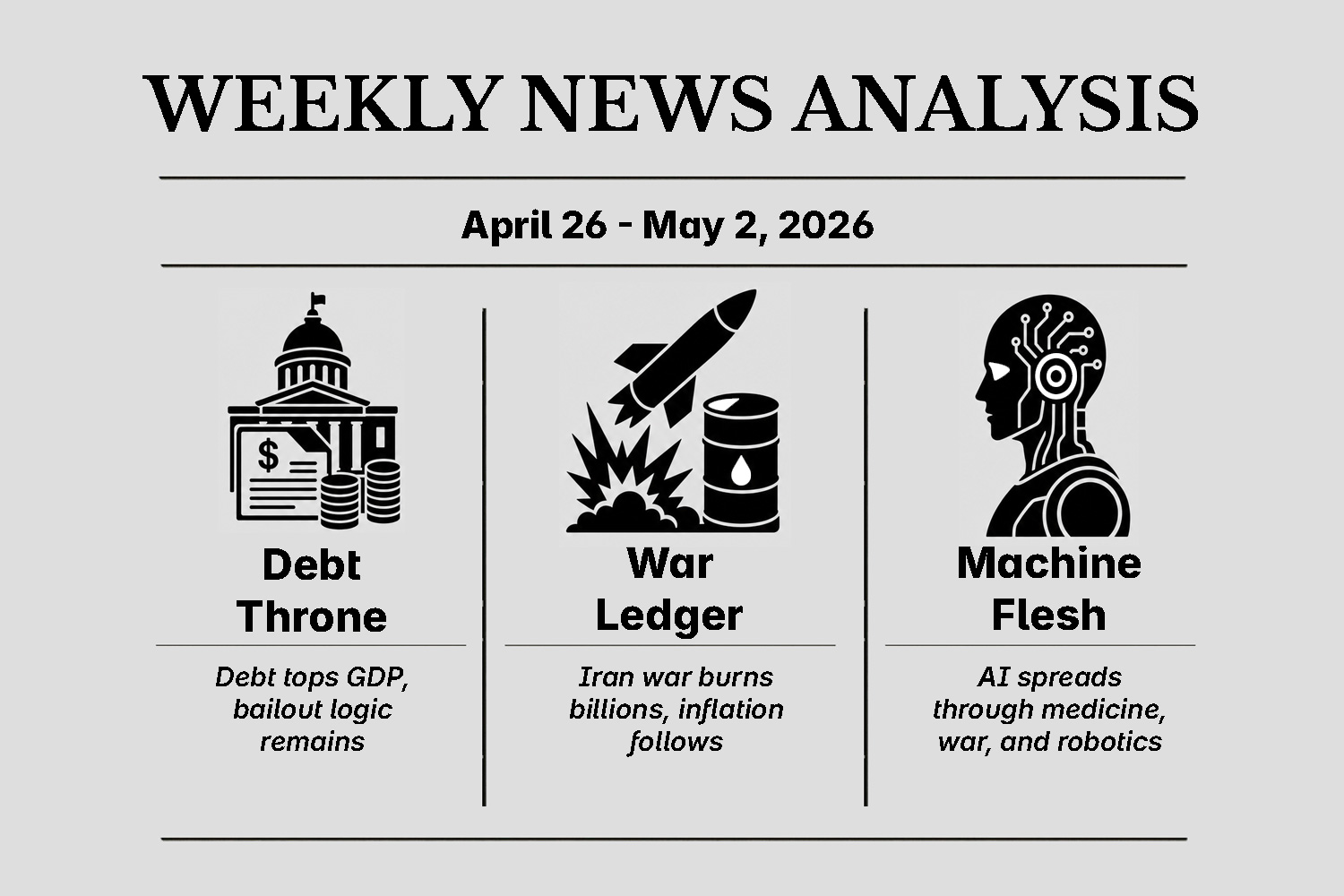
This week’s analysis of machinery uncovered themes of debt as a form of governance, war acting as an economic booster, and artificial intelligence emerging as a new infrastructure for control. The surface details seem disconnected: the national debt surpassing the economy's size, the Iran conflict consuming resources, and AI advancing in medicine, the military, quantum research, classified networks, and robotics. However, these are all linked by a larger pattern—it's not just about overspending; it's about transforming crises into a structural framework.
The familiar rhetorical framework portrays fiscal danger as unavoidable, war as essential, and artificial intelligence as progress. In each instance, the public is encouraged to accept a premise: that centralized authority caused the problem but must now be trusted to resolve it. The state damages the window, charges the public for repairs, and labels the process as economic activity.
This week, focus shifts from individual headlines to the broader trajectory of civilization. Debt enforces discipline on society via inflation and austerity measures. War enforces global discipline through resource scarcity and energy crises. AI shapes the future through predictive technologies, automated decision-making, and increased human-machine reliance. The constraints are not tightening suddenly with a loud slam, but gradually, through ledgers, blockades, cloud agreements, and algorithms.
Debt Throne
US national debt is now bigger than the economy for first time since World War II - Independent
The national debt is now larger than the economy - Fortune
US national debt surpasses size of economy for first time since World War II - Fox Business
Spirit to halt all flights - CNN
Spirit Airlines ceasing operations after federal government bailout fails - Fox Business
3 Ways Trump’s Wealth Has Soared Since He Returned to Office - Time
The national debt surpassing the economy is more than an accounting feat; it symbolizes a reversal of sovereignty. According to The Independent, public debt hit $31.27 trillion by March 31, while nominal GDP was about $31.22 trillion, making debt 100.2% of GDP and approaching the 1946 postwar peak of 106%. The report also mentioned that the Congressional Budget Office expects public debt to reach 108% of GDP by 2030, possibly rising to 120% if current trends continue. This illustrates the core issue: the nation now owes more than its annual output, even as officials talk about resilience, investment, and managed growth.
Historically, high debt levels relative to GDP haven't led to specific outcomes but have limited political options. Post-World War II Britain carried debt far exceeding today’s U.S. levels, peaking around 270% of GDP, then declining over thirty years due to nominal growth, low real interest rates, and postwar financial conditions that are hard to replicate today. Greece's experience differs: a debt crisis, reliance on bailouts, austerity measures, declining GDP, social strain, and long-term harm to household credit and political trust. The key lesson is not that 100% debt automatically causes collapse, but that once debt reaches this level, governments often resort to inflation, austerity, financial repression, higher taxes, war, or a mix of these options.
The contradiction lies in the fact that the same government, having exceeded this debt limit, still leaves the door open to bailing out corporations like Spirit Airlines. A carrier’s failure impacts workers, passengers, airports, creditors, and communities, making that a powerful emotional point. Logically, bailouts convert private sector risks into public costs. Ordinary citizens do not share in the gains when executives, investors, and well-connected industries prosper during periods of growth, but they bear the losses when failures occur. This reflects a modern version of the Broken Window Fallacy: destruction is seen as a form of stimulus, failure as a stabilization strategy, and the public is convinced that covering the costs of elite rescues is ultimately an investment in the economy.
The story of Spirit Airlines highlights the moral hierarchy within the debt state. When households encounter failure, they face repossession, eviction, ruined credit, higher interest rates, and social shame. In contrast, when large corporations fail, the discourse shifts toward terms such as “systemic risk,” “essential service,” “market stability,” or “consumer protection.” This language masks the real transfer of burden, with taxpayers acting as the silent backstop and last resort, even as they're told public debt demands sacrifice. This dynamic shows how fiscal policy effectively becomes a tool for class policy—debt is socialized onto the many, while bailouts are privatized for the few, and responsibility is unfairly imposed on those with the least power over economic outcomes.
The fundamental assumption in the mainstream debt narrative is that the state acts as a neutral steward of scarcity. However, it is not. The state intentionally creates scarcity through policies like debt expansion, monetary manipulation, war expenditures, regulatory favoritism, and selective bailouts. It then appears as a healer for the damage it has caused. Centralized authority portrays itself as a protector while simultaneously enlarging its control over property, labor, currency, and movement.
Inflation, rising gas prices, and the broader economic crisis are not just random events; they result from an overleveraged empire trying to sustain military power, corporate bailouts, political support, and monetary stability simultaneously. Officially, this is described as turbulence, but in reality, it is a gradual erosion of purchasing power. Each dollar becomes less meaningful as interconnected institutions receive new bridge loans, tax benefits, contracts, or emergency exemptions. When debt exceeds GDP, it is more than a fiscal metric — it becomes the throne upon which the modern state sits, asking the public to kneel under the burden of its own debt.
Within this system, the wealthy and powerful accumulate more wealth as society's overall value declines. Trump’s wealth story exemplifies this, now with an oligarchic aspect. TIME reported that his net worth rose from $3.9 billion to $7.3 billion since 2024, citing Forbes and noting new income streams from Trump Media, cryptocurrency projects, licensing deals, and branded products such as Bibles, watches, phones, guitars, sneakers, and fragrances. TIME also mentioned that Trump did not place his assets in a blind trust, and critics argue that his crypto and business holdings could be vulnerable to influence, as investors and sovereign wealth funds might sway assets tied to his wealth as a public official. The White House denied any profit-making, yet the core issue remains: public office, private branding, crypto policy, energy policy, and family wealth appear interconnected in a single operational landscape. This newly amassed wealth excludes taxpayer funds under his control through entities like the Board of Peace, an international organization with legal personality under UN Security Council Resolution 2803, to which Trump is allocating $10 billion of taxpayer money, with full control over its use.
War Ledger
Iran war live updates - CNN/a>
Pentagon orders withdrawal of 5,000 US troops from Germany - Fox News
US troop withdrawal from Germany amid Trump-Merz feud - CNN
Trump not satisfied with new peace deal offered by Iran as standoff’s costs multiply - CBS News
The conflict in Iran is essentially a financial event masquerading as a security issue. CBS reported that U.S. officials familiar with internal evaluations estimated the real cost around $50 billion, nearly double the Pentagon’s publicly announced $25 billion. The discrepancy partly results from damaged or destroyed equipment, munitions replacements, compromised installations, and operational losses. Using CBS's reported start date of February 28 and the April 30 cost assessment, the war has lasted about 62 days, averaging roughly $806 million daily. Extending this daily expenditure through May 2 suggests total costs of approximately $51.6 billion, not including long-term expenses such as replacements, disability, interest, energy, shipping, insurance, inflation, and the injury- and death-toll expenses of soldiers wounded in battle.
The importance of the cost-per-day calculation lies in the fact that war rhetoric usually sidesteps numerical analysis. Officials emphasize resolve, deterrence, nuclear prevention, freedom of navigation, and allied credibility—terms that evoke a moral stance rather than clear fiscal facts. The public is seldom asked whether spending nearly a billion dollars daily aligns with the claimed objectives, because such questions challenge the myth of inevitability. The prevalent fallacy is appealing to fear: critics are accused of misunderstanding the danger if they question the war. CBS reported that Trump called it “treasonous” for critics to say the U.S. isn't winning in Iran, even though CBS noted that constitutional treason is narrowly defined and does not cover verbal criticism of a war.
The War Powers dispute illustrates how emergency language can create legal ambiguity. CBS reported that Trump informed congressional leaders that hostilities with Iran had “terminated,” even as the situation still involved a blockade, shipping disruptions, threats of renewed strikes, and an unresolved military stance. The administration argues that ceasefire conditions pause or halt the 60-day clock under the War Powers Resolution, but critics maintain the war persists in practice. This contrast shows rhetoric versus reality: legally, the conflict is called “terminated,” but in practice, there are ongoing blockades, threats of sanctions, troop movements, an oil shock, and military preparedness.
The global economic impact is already evident. CBS reported that the U.N. Refugee Agency warned of significant disruptions to humanitarian supply chains, including increased transportation costs, shipping delays, instability in the Strait of Hormuz, higher insurance premiums, port congestion, and reduced cargo capacity. UNHCR noted that some shipment costs from Dubai to Sudan and Chad more than doubled, rising from about $927,000 to $1.87 million, while rerouting via the Cape of Good Hope can add up to 25 days. This demonstrates how war inflation extends beyond the battlefield, affecting food, aid, shipping, fertilizer, fuel, manufacturing, and insurance, ultimately leading to higher prices and political confusion at the household level.
The Strait of Hormuz remains a critical point because energy fuels the industrial economy. CBS reported that crude oil was around $107 after briefly reaching $126, staying much higher than before the conflict. It also noted that Iran’s threats and demands for coordination cut shipping in and out of the Persian Gulf by 90%, according to the U.K. Navy. While the surface issue is military escalation, the underlying concern is that regional war could disrupt global logistics, acting like a tax on everyone. The empire initiates a campaign, markets adjust to risk, shipping routes narrow, and consumers face higher prices for gas, food, and utilities, with increased debt payments.
The withdrawal of troops from Germany highlights additional imperial contradictions. It was reported that the Pentagon intended to pull about 5,000 U.S. troops from Germany, viewing this as a reflection of Trump’s frustration with European allies' insufficient support for the U.S. campaign against Iran. This exemplifies coercive alliance management: troops are used as bargaining chips, war support is a loyalty test, and foreign policy is influenced by personal conflicts. While the official reason cited is burden-sharing, the real effect is that military deployments serve as tools of discipline—not only for adversaries but also for allies.
Even if the conflict with Iran ends soon, its economic repercussions would persist beyond the final strike. CBS cited Mark Cancian of CSIS, who said that replacing munitions could take years and that war costs encompass many unseen factors beyond munitions alone. Additionally, the American Enterprise Institute reported that increased fuel and fertilizer prices alone could raise each U.S. household’s monthly expenses by $150. This represents the hidden war tax, which isn't labeled as “Iran” on bills but manifests as higher prices for groceries and gasoline, higher interest rates, insurance costs, scarcity, and delayed shipments, and provides another reason for increased deficit spending.
The cycle is complete: debt finances war, war increases debt, debt fuels inflation, inflation heightens public anxiety, and that anxiety leads to more centralized control. This pattern illustrates how the government reacts under pressure. In The Fallacious Belief in Government, tyranny is shown as arising when rulers exploit chaos to strengthen their power by claiming to restore stability and rights. The Iran war is more than a foreign policy issue; it acts as a domestic governance tool, with the resulting costs impacting budgets, prices, surveillance, energy policies, and free speech.
Machine Flesh
AI agent governance takes focus as regulators flag control gaps - Artifical Intelligence News
Solving the Whac-a-mole dilemma: A smarter way to debias AI vision models - MIT News
Pentagon inks deals with Nvidia, Microsoft, and AWS to deploy AI on classified networks - TechCrunch
Meta buys robotics startup to bolster its humanoid AI ambitions - TechCrunch
AI is no longer limited to chatbots, productivity apps, or research helpers. Instead, it is becoming integral to governance, healthcare, military infrastructure, classified networks, human behavior analysis, embodied robotics, and quantum computing. Artificial Intelligence News discussed issues of agent governance and control gaps, while MIT emphasized AI’s role in quantum technology and reducing bias in medical vision systems. TechCrunch highlighted the Pentagon's use of AI in classified networks and Meta’s acquisition of a humanoid robotics startup. The trend is clear: AI is increasingly integrated into the foundational systems of institutions.
The dual nature of AI needs clear acknowledgment. When used as a tool under human oversight, with transparency, decentralization, and consent, AI can offer benefits. For instance, MIT’s efforts to reduce bias tackle a genuine safety issue: biased dermatology AI models may fail to identify high-risk patients across different skin tones. This bias isn't just a technical issue but a medical hazard. Improved tools can enhance diagnoses, lower errors, increase access, and assist clinicians. This presents a sincere case for AI. The core issue isn't about augmenting intelligence itself; it's about centralized deployment lacking meaningful consent, accountability, or respect for natural rights.
MIT’s new MIT-IBM Computing Research Lab highlights the scope of this integration. The lab's focus includes AI, algorithms, quantum computing, hybrid systems, efficient modular language models, enterprise AI, and quantum algorithms, with potential impacts on materials science, chemistry, biology, weather prediction, air turbulence, and financial forecasting. This is more than marginal research; it serves as a blueprint for a predictive civilization—forecasting markets, bodies, storms, behaviors, and risks. When prediction gains power, governance naturally shifts from reacting to actions to preempting possibilities.
The Pentagon’s contracts highlight the rigorous nature of that transformation. TechCrunch reported that the Department of War established agreements with Nvidia, Microsoft, Amazon Web Services, and Reflection AI to implement AI technology and models on classified networks for “lawful operational use,” building on earlier deals with Google, SpaceX, and OpenAI. The term — lawful operational use — is deliberately vague. It avoids mentioning specific activities like targeting, surveillance, psychological operations, battlefield automation, dissent monitoring, or domestic spillover. This phrasing emphasizes legality while sidestepping moral specifics. Once AI is integrated into classified networks, the public cannot thoroughly examine the system, but the system may increasingly scrutinize the public.
Meta’s acquisition of Assured Robot Intelligence shifts focus from theoretical models to tangible physical embodiments. According to TechCrunch, ARI aims to develop robots capable of understanding, predicting, and adapting to human behavior in complex settings, with its team joining Meta’s Superintelligence Labs. The startup is also working on foundational models for humanoid robots to handle physical tasks, such as household chores. The primary consumer appeal is convenience, but the broader goal is behavioral modeling in physical space: machines that observe movement, interpret intent, adapt to human patterns, and learn through direct interaction. The same system that folds laundry can also learn compliance.
For most people, AI control will not feel like being trapped in a prison cell. Instead, they will see it as convenience, recommendations, optimization, safety, fraud prevention, medical triage, smart homes, automated defense, predictive policing, insurance scoring, tailored education, and labor support. The noose tightens because each system seems helpful on its own. The cage closes because these helpful systems foster dependency, surveillance, and behavioral control. The hidden assumption is that efficiency is morally neutral. However, it is not. When achieved through voluntary consent, efficiency serves as a tool. When enforced through centralized coercion, it becomes a weapon. And it is being used as a weapon against all of us.
The analogy of history is industrialization during empire times. The steam engine enabled transportation of goods, nourishment for cities, and connectivity among people. It also fueled colonial extraction, mechanized warfare, surveillance states, and factory discipline. AI shares similarities but feels more personal. It does more than just boost strength or speed; it enhances judgment, classification, memory, prediction, and enforcement. Consequently, it impacts core human aspects: decision-making, identity, autonomy, movement, health, labor, speech, and reputation. The real danger isn't AI gaining consciousness and turning against humanity; rather, it's institutions employing unconscious machines to remove human conscience from control mechanisms.
This links directly to the Trivium framework. Grammar examines what the system genuinely collects. Logic explores the assumptions, incentives, fallacies, and contradictions influencing its use. Rhetoric considers how it is marketed, with language emphasizing terms like “safety,” “trust,” “bias reduction,” “national security,” “innovation,” and “efficiency.” Operationally, it involves data extraction, prediction, classification, deployment, and control. The Fallacious Belief in Government warns against manufactured and engineered consent and centralized systems that appear to offer protection but function as tools of control. This warning clearly applies to AI governance: the public isn’t rejecting technology; rather, it's being conditioned to accept invisible oversight by technical systems they cannot audit or fully understand.
Cage Synthesis
This week’s stories come together in a common framework. Debt undermines economic health. War disrupts the global flow. AI is shaping the future’s nervous system. Meanwhile, the public is told that the very institutions causing instability should be granted more power to control it. This classic political tactic, dressed in modern guise, involves fostering dependency, labeling it security, and demanding obedience as responsibility.
The language of crisis tends to limit imagination. Debt leads to acceptance of austerity; war justifies surveillance and scarcity; and AI encourages reliance on automated mediations between individuals and reality. While initially presented as temporary and technical, each inevitably becomes permanent, widespread, and political. This exemplifies the path of technocracy: not governed by wisdom, but by systems protected from moral responsibility.
The warning isn't that all technology is inherently evil or that every crisis is false. Instead, it's that centralized power leverages every crisis to tighten control. A free society would harness intelligence, automation, and computation to decentralize knowledge, foster voluntary cooperation, minimize coercion, and safeguard natural rights. Conversely, a collapsing empire uses these same tools to manage debt slaves, war subjects, and algorithmic citizens. This week didn't reveal the future unfolding; it demonstrated the future being imposed.
Listen to this week's news in verse for a quick recap!