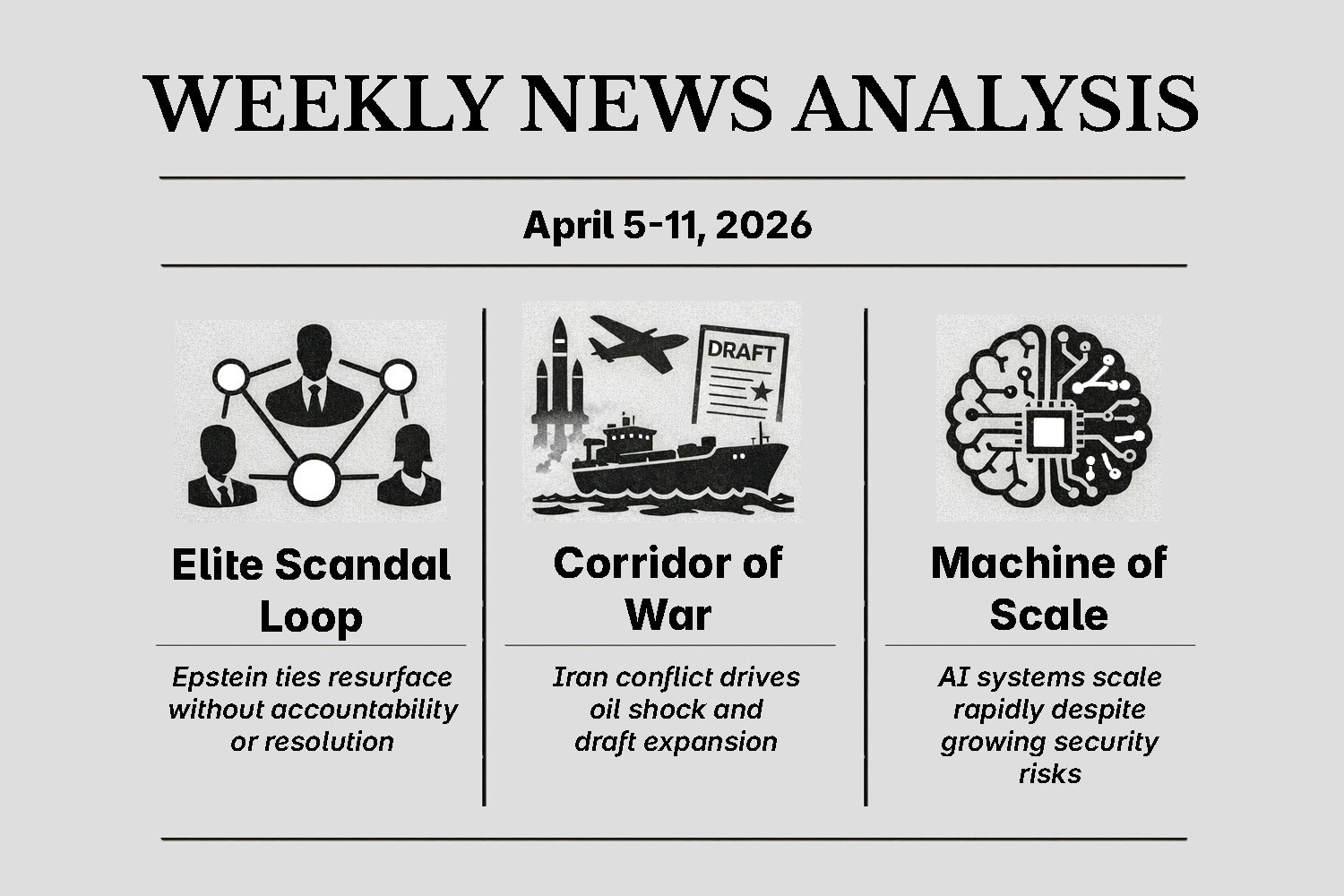
This week, the elite scandal reemerged, but it did so in a way that dusted off the shiny spectacle without providing resolution. This distraction detracted from discussions of war management, which were framed as stabilization efforts, despite battlefield evidence of increasing risks, disrupted shipping, rising fuel costs, and a mounting emergency. Also, the AI industry continued to expose the same recurring contradiction it always masks with innovation: systems are becoming faster, cheaper, more autonomous, more secure, and more integrated into state and corporate structures, even as their failure modes become more difficult to contain.
All three patterns share an older underlying rhetorical structure. A scandal emerges, but selectively. A conflict intensifies, yet it is portrayed as a reluctant necessity. Technological growth is presented as neutral infrastructure. Instability becomes justification, fear turns into managerial leverage, and engineered consent becomes easier because the public views events in fragments rather than as a connected system. The important question is not just whether each event is “true,” but what it teaches the public to accept as normal — elite corruption without repercussions, emergency militarization with no clear end, and computational expansion without genuine oversight.
Epstein's Returning Shadow
Trump news at a glance: Melania Trump’s weird disavowal of Epstein is getting weirder - The Guardian
Melania Trump, Jeffrey Epstein - NPR
Jeffrey Epstein, Melania Trump - CNBC
What we know about Melania Trump and Jeffrey Epstein - ABC News
Epstein assistant told feds he introduced Melania to Trump, files reveal - The Daily Beast
Melania Trump’s documentary director appeared in Epstein files - IBTimes UK
This story's most notable aspect isn't the allegation itself but how it's staged. Melania Trump released a statement asserting that she “never had a relationship” with Jeffrey Epstein and explaining that she and Donald Trump’s attendance at some of the same parties was due to their shared social circles in Palm Beach and New York. However, the need for such a formal denial highlights how the Epstein case continues to serve political purposes: not as a means to achieve institutional accountability but as a recurring trigger that can be activated whenever elite legitimacy faces scrutiny. The Guardian pointed out the unusual timing and the confusion—even among Trump supporters—about whether the president knew she would make these comments. Meanwhile, ABC confirmed the social overlap and noted at least one well-known photograph from 2000 at Mar-a-Lago showing both couples together, seemingly very familiar with each other.
The main question is what happens if the claim by an Epstein associate is true. If Epstein’s network did introduce Melania to Trump, it doesn't automatically imply criminal behavior by either of them. This distinction is crucial because association isn't the same as involvement in Epstein’s illicit activities. But taken with all other evidence and associates, including Epstein’s ties to Mossad, it is highly suspicious. Nonetheless, the consequences would be significant, as it would suggest that a highly symbolic marriage in American political life is connected to a social circle revealed to be involved in trafficking children, coercion, blackmail, and elite networking. This isn’t just gossip; it implies that the political image machinery is at least connected to an ecosystem in which compromised individuals, facilitators, handlers, and fixers operate, protecting one another as they amass power and wealth.
Mainstream rhetoric often becomes ambiguous here. The language swings between two extremes: either “there is no proof” or “the proximity looks suspicious.” This binary choice is overly simplistic. A more accurate and concerning stance acknowledges documented social overlaps among Trump, Melania, Epstein, and Maxwell, with accounts describing how introductions might have happened. There is no concrete proof, based on cited reports, that Melania or Trump engaged in Epstein’s criminal activities, even though it is very plausible and could very well be true.
The angle involving Brett Ratner deepens the issue. IBTimes noted that Ratner, who directed the Melania documentary, appeared in DOJ-released Epstein-related documents, identified by his photo and name alongside Jean-Luc Brunel, the late modeling agent closely linked to Epstein. This does not mean Ratner committed Epstein’s crimes, but it underscores a recurring pattern of elite connections: film, modeling, finance, Palm Beach, New York, and political branding all intersect through glamorous circles. This is the true mechanism behind the scandal. The public is often told to see each link as isolated, accidental, or insignificant until the connections become too obvious to overlook. When that happens, the same institutions that dismissed the pattern reframe it as a shocking discovery.
This episode seems more like controlled information circulation than full disclosure. Epstein remains close enough to influence the narrative without ever fully completing it. He reappears as an implication, a ritual reminder that elite America is intertwined with a man whose reach extended into politics, business, royalty, and entertainment. However, his appearances rarely bring closure. The audience is left with enough doubt to distrust but not enough clarity to draw firm conclusions. This exemplifies typical narrative control: releasing just enough contamination to shape the discussion, but not enough to clarify and reshape public power in response to consequences. This isn't informed consent to reality but engineered uncertainty, which is even more advantageous politically.
That pattern is more significant given what else was happening this week. As the public focus returned to scandals linked to Epstein-like figures, the unfolding story of the Iran conflict revealed immediate geopolitical and economic impacts. This makes suspicion of orchestration understandable, even if it can't be definitively proven through open-source information. Political systems don't need a single puppet master to create a distraction; they just need aligned incentives. The media favor scandals over shipping routes, operatives exploit sex-and-power stories for emotional impact, and leaders use personality clashes to distract from strategic failures. This is how theater unfolds without necessitating perfect central control.
The deeper meaning is that the Epstein case now acts as a constant tool to undermine legitimacy, used selectively but never fully addressed. It broadly damages trust without threatening the existing system. It allows factions to weaponize scandal without dismantling the power structure that created it. Since it involves key figures connected to power, fame, and empire, each resurfacing reminds the public that the American ruling elite is not a pure meritocracy but a network of relationships. Once this becomes even partially visible, the old myth of innocence through proximity becomes harder to maintain. The challenge for the establishment is not just what the public knows but also what they deduce from repeated overlaps. For the public, inference alone still doesn’t equate to justice; however, for the most part, once given a new, shiny object, the public forgets the past and moves on to the next issue shoved in their faces.
Hormuz and the Draft Machine
Secret CIA tool used to help rescue downed airman - Daily Mail
Iran says US ceasefire and negotiations are unreasonable - AP News
Iran war live updates - New York Times
Vance says US-Iran talks end without deal after 21 hours - Fox News
Trump says US is beginning to clear out the Strait of Hormuz - The Gateway Pundit
Automatic registration military draft - The Hill
The story of the downed pilot is important beyond the human drama because it reveals how future warfare might operate. This week's report discussed a secret CIA-linked intelligence-enabled tool used to locate a downed airman. Even if we set aside the more sensational framing and focus on the core message, it’s clear: real-time sensor fusion, geolocation, and pattern recognition are becoming crucial not only for reconnaissance but also for recovery, targeting, and command decisions. In isolation, these can be seen as rescue technologies. In system form, they form the same architecture that can enable persistent surveillance, predictive tracking, kill-chain compression, and domestic monitoring once emergency norms shift domestically. This highlights the recurring issue with frontier state technology: every rescue use case doubles as a governance prototype.
The conflict itself appears unresolved. Fox reported that Vice President Vance said the U.S.-Iran talks lasted 21 hours and concluded without agreement because Iran rejected U.S. conditions, even though Trump has repeatedly said that a peace deal was agreed upon. The AP noted that despite using ceasefire language, Iranian officials called U.S. demands unreasonable and pointed out that major differences remain. They also mentioned that reopening the Strait of Hormuz at full capacity might take months, continuing to affect oil prices. This language indicates a temporary pause rather than a durable resolution. It suggests a stopgap layer over ongoing escalation. Once leaders begin discussing “conditions,” “red lines,” and enforced access, the ceasefire shifts from a peace mechanism to a tactical pause amid ongoing coercion.
The Strait of Hormuz illustrates most clearly how the rhetoric of war-as-order falters. Reuters reported that the U.S. military is undertaking efforts to clear mines from the strait to ensure safe navigation, with Trump publicly stating that the U.S. is “starting the process of clearing out the Strait of Hormuz" while establishing the beginning of a blockade. Separately, Reuters noted that during the crisis, the strait was effectively closed, despite approximately 20% of global oil and LNG shipments passing through it. When shipping routes turn into war zones, claims that military actions maintain stability become self-contradictory. The danger was not inherent to the corridor but was created by the war itself. This presents a paradox: interventions are justified as solutions to crises that they often help induce.
The economic effects were immediate enough to break through usual abstraction. The national average for regular gasoline was $4.13 on April 11, with a Washington average of $5.39. Reuters stated that physical oil prices near the crisis had surged to record highs of about $150 per barrel in some markets early in the week, while broader oil markets stayed volatile amid ceasefire headlines. The public is asked to accept higher energy costs as a matter of strategic necessity, while those who started or worsened the confrontation do not share the burden. Sacrifice is socialized downward; decision-making power remains concentrated at the top.
The same asymmetry is evident in the draft-registration story. Several outlets and the Selective Service System confirm that, starting in December 2026, eligible men will be automatically registered under the fiscal 2026 NDAA. The SSS emphasizes that registration does not mean induction and that there is no active draft, but this could change with a word from Trump. These distinctions matter. However, automatic registration is not politically neutral. It shifts the compliance burden from hesitant individuals to the state’s data systems, fostering the idea that the youth should be pre-primed for mobilization. In bureaucratic terms, this enhances efficiency. Civically, it prepares for potential compulsory measures. The state’s efforts to streamline intake processes are not without purpose.
The core issue is the disparity between elite decision-makers and those they endanger. Trump’s Vietnam-era deferments are well known, and his children do not fit the typical image of those affected by mobilization. However, this does not mean his policies are unique; instead, they are typical. Modern empires often require disciplined obedience from populations whose sons are technically eligible but strategically expendable. The wealthy start the process, the professional class creates the narrative, the security bureaucracy implements it, and the public accepts this reality. Therefore, debates over draft registration are more about which lives are considered reserve resources for geopolitical aims, rather than just administrative matters.
The assertion that a ceasefire won’t hold is technically a prediction rather than a proven fact. However, transparent reporting gives this prediction a logical basis. A ceasefire based on propaganda, maximalist demands, corridor coercion, and unresolved battlefield humiliation is not true peace but an incomplete state of conflict. AP’s reporting that escalation might occur in the future and that Hormuz could take months to fully recover indicates as much without stating it outright. Governments on all sides are motivated to influence perception at every stage because controlling the narrative has become part of modern warfare. Consequently, the public is asked to accept conflicting claims simultaneously: that escalation is manageable, that negotiations are failing, that conditions are unacceptable, and that stability is approaching. This is not clarity; it is a carefully managed contradiction.
Viewed through the government’s lifecycle framework, this stage marks the shift from emergency administration to normalized, militarized governance. The corridor must be secured, costs must be accepted, youth must be registered, and technologies must be expanded. These measures are framed as temporary, reluctant, and necessary. However, historically, these wartime adaptations rarely fade away cleanly. They set precedents, influence budgets, create databases, and establish future options for subsequent crises. Therefore, the war story should not be seen solely as foreign policy; it also reflects domestic capacity—what governments develop, legalize, and normalize under pressure of conflict.
Compute Without Restraint
Anthropic’s refusal to arm AI is exactly why the UK wants it - AI News
Anthropic keeps new AI model private after it finds thousands of external vulnerabilities - AI News
New technique makes AI models leaner and faster while they’re still learning - MIT News
Google and Intel deepen AI infrastructure partnership - TechCrunch
This week, MIT highlighted CompreSSM, a method that applies control theory to eliminate unnecessary complexity from state-space models during training, which lowers computational costs without harming performance. TechCrunch discussed a broader, multi-year partnership between Google and Intel aimed at advancing processors and infrastructure for AI, cloud, and inference tasks. These stories, often seen as innovations in media system architecture, have the same implications: greater capability per dollar spent, easier deployment, and more opportunities for organizations to adopt AI where it was previously too expensive or difficult to implement. Cheaper AI cognition is not just a niche achievement; it acts as a catalyst for broader progress.
While this alone would be significant, the vulnerability report further clarifies the situation. AI News reported that Anthropic kept a new model hidden after discovering thousands of external vulnerabilities, including instances in which the model autonomously linked multiple flaws. In one example, it identified and exploited a remote code execution vulnerability with just an initial prompt. Anthropic’s framing, as noted in the article, is especially noteworthy: the same general improvements that enhance the system's ability to patch vulnerabilities also increase its potential for exploitation. This underlying idea is central to frontier AI discussions. Capabilities are usually promoted first in their beneficial aspects, while their offensive potential is often regarded as a secondary issue rather than an inherent feature.
Reuters highlighted a similar pattern with OpenAI revealing a security flaw linked to a third-party developer tool. They reported that OpenAI assured no user data was accessed, and no systems or intellectual property were compromised. The issue was traced back to a misconfiguration in a GitHub Actions workflow. Even if this is taken at face value, the concern isn't whether a disaster happened this time, but that the ecosystem is becoming more infrastructural while still relying on complex toolchains, external dependencies, certification processes, and workflow checks. Every added layer of convenience creates new trust points. These trust points pose both political and technical challenges, especially as companies evolve into providers of broad cognitive infrastructure.
The story of Anthropic-London expands the focus from security issues to broader geopolitical concerns. AI News reported that after Anthropic resisted Pentagon requests, the company faced harsh consequences in the U.S., including a designation related to supply-chain risks and the cancellation of a reported $200 million Pentagon contract. Meanwhile, London has become more aggressive in taking legal action against the firm. Even if one overlooks the article's more opinionated tone, the core message remains clear: frontier AI companies are no longer just startups or tech vendors. They now represent strategic assets that are being contested among allied nations, regulatory bodies, and defense priorities. The debate has shifted from whether AI should be regulated to which geopolitical bloc will shape the standards for ethics, capabilities, military applications, and market scope.
The notion of “responsible AI” starts to unravel here. Responsibility is often portrayed as guardrails, alignment layers, or refusal policies. However, the core issue lies in the structural alignment with power. A model might reject certain military applications but still support an ecosystem that reduces surveillance costs, boosts cyber offense capabilities, improves predictive governance, and expands state authority through procurement and infrastructure. This blurs the line between civilian and military AI, as the same chips, optimization techniques, developer tools, cloud platforms, and automation primitives are used in both fields. What seems like ethical separation at the user interface level often disappears within the supply chain.
This analogy compares AI infrastructure not to the Manhattan Project's scientific breakthrough but to the transformative impact of railroads and telegraphs on politics. These systems did more than just speed up transportation and communication; they restructured territories, administrations, war logistics, financial networks, and central command. Now, AI is beginning to serve a similar systemic role in cognition. It not only provides answers but also lowers the costs of analysis, triage, synthesis, pattern recognition, surveillance, coding, targeting, and compliance. As these capabilities become more affordable and accessible, major institutions are motivated to adopt them, and, once adopted, they have reasons to defend their use—despite ongoing unresolved risks.
It’s fundamentally about governance. Rapidly advancing models, cheaper training processes, autonomous vulnerability discovery, strategic efforts by nations, and fragile third-party dependencies all indicate that the machine layer is gaining both capability and sovereignty. Propaganda and control are transforming from speech and spectacle into infrastructure. When systems start mediating not just what people hear but also how institutions decide, certify, filter, and act, power shifts from being theatrical to more ambient. The public will still observe charismatic rulers and headline events, but the true transformation will happen beneath the surface — in how machines optimize and interpret reality before humans do.
Smoke Over the System
These topics are connected not just by issues like corruption, war, or technology, but by how modern power manages crisis. First, visibility is deliberately limited. In the Epstein case, the public sees enough to recognize wrongdoing but not enough to find closure. In the Iran situation, enough urgency is shown to prompt escalation, but not enough transparency to understand strategic costs. In AI discussions, optimism is often invoked to encourage progress, yet institutional oversight remains insufficient to guide its development. Therefore, the week feels less chaotic and more choreographed—not in a childish sense of a perfect script, but in a way that incentives, media habits, political needs, and state capacity push towards the same result: public adaptation to concentrated power.
The overall trend is apparent. The elite scandal becomes an ongoing cloud of confusion. War is used as a justification for controlling spaces, integrating data, and indexing youth. AI transforms into a scalable medium for future propaganda, governance, surveillance, and enforcement, making these processes cheaper and faster. This is the point of convergence. The concern isn't just about individual institutions' intentions, but what the entire system normalizes—where scandal no longer shocks, emergencies become endless, and computation acts without needing approval. The public isn't asked directly whether they want this world. Instead, it is gradually introduced through spectacle, crisis, and convenience, making the architecture seem inevitable.
Listen to this week's news in verse for a quick recap!