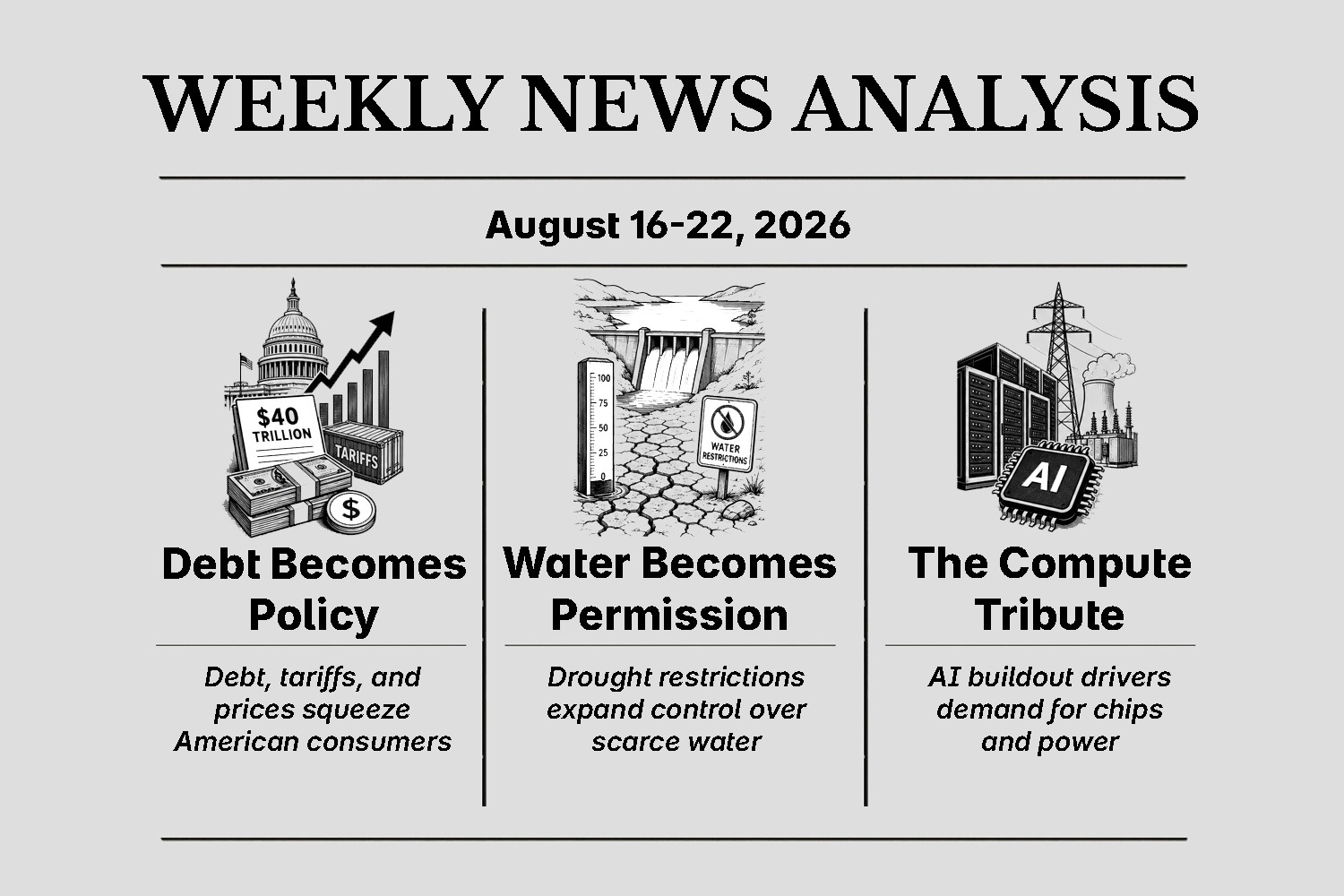
On the surface, this week’s three stories appear unrelated. Underneath them sits the same fundamental question: who controls access when an essential resource becomes scarce? Purchasing power is the economic resource, squeezed by a $40 trillion national debt, interest costs, tariffs, and still-elevated household prices. Usable water is the physical resource, with governments imposing restrictions and allocation regimes across the American West as drought exposes decades of destructive water-management decisions in Europe. Electricity and infrastructure form the technological resource, as artificial intelligence developers compete for chips, utility capacity, land, capital, cooling, and dedicated power generation. Each story ultimately returns to allocation. Scarcity—whether natural, policy-created, market-created, or some combination—does more than limit supply; it justifies someone deciding who receives what.
That distinction is critical because two competing forms of rhetoric can distort the same reality. Government and corporate institutions benefit from portraying intervention as the unavoidable management of conditions beyond their control. Critics can commit the opposite error, assuming every shortage was deliberately manufactured. This week's evidence supports neither extreme. The Colorado River really is depleted. Hungary really did drain enormous quantities of water from its landscape for generations. The American cattle herd really is at historic lows. AI infrastructure really is redirecting investment toward chips, electricity, nuclear generation, and enormous data-center projects. Those realities exist. The political question begins with what happens next: who receives priority, who is forced to absorb the costs, and which emergency measures survive the emergency. That is where the more consequential analysis of power begins.
The Trivium demands that Grammar precede Logic and Rhetoric: first establish what happened, distinguish evidence from inference, identify contradictions, and only then construct the argument. The Fallacious Belief in Government develops this framework because crisis rhetoric can move societies through a recurring cycle of problem, intervention, dependence, and consolidation. The most revealing lesson this week is not that every crisis is fabricated. It is that genuine problems can collide with poorly designed systems, political opportunism, and concentrated corporate power in ways that steadily increase dependence on institutions individuals do not control. Debt, water, and computation may look like separate issues, but each is becoming another front in the same struggle over autonomy.
Debt Becomes Policy
National debt tops $40 trillion after doubling in less than a decade, Treasury data shows - CBS News
US Canada trade war reignites as talks fail at last minute - CNN
Trump Announces Deal to Substantially Lower the Price of Ground Beef - The Gateway Pundit
Gross national debt in the United States passed $40 trillion on August 18, reaching approximately $40.05 trillion after more than doubling from its 2017 level. That number, by itself, does not establish that economic collapse is imminent, but it is one indication that collapse is approaching. Sovereign debt does not operate like a household credit card, and the United States retains enormous productive capacity, taxing authority, and monetary power. The opposite conclusion is equally flawed: the absence of collapse does not make the milestone meaningless. Decades of persistent deficits continue compounding the principal, while interest costs have grown large enough that the federal government now spends more servicing debt than it spends on either national defense or Medicare. CBS reports that analysts see the problem as cumulative rather than attributable to one president, with tax reductions, demographic pressures, military expenditures, pandemic spending, and other federal commitments all contributing. The question is no longer whether Washington can borrow another dollar tomorrow, but how much future economic activity must finance yesterday’s political decisions.
A similar contradiction appears in tariff policy. The rhetoric presents tariffs as money extracted from foreigners, yet the mechanism operates as a tax collected from domestic importers. When U.S.–Canada negotiations collapsed Friday night, 50% duties took effect on approximately $20 billion of Canadian goods, and Canada announced retaliatory measures. The Associated Press explicitly describes the duties as being paid by American importers, who may then attempt to pass those costs to consumers through higher prices. CNN notes that this particular tranche covers only about 5% of U.S. goods imports from Canada and therefore may not, by itself, dramatically change the consumer price level. That limitation does not erase the broader mechanism. Import taxes alter supply chains, purchasing decisions, input costs, investment planning, retaliation strategies, and the price structure across interconnected markets. Calling the tax a punishment imposed on another country simply hides the American firms that actually remit it.
The contradiction becomes sharper when tariff policy is placed beside the administration’s response to food prices. Trump has repeatedly cited falling prices as proof that his economic program is working, yet on August 21 he announced that up to 300,000 metric tons of additional ground-beef product could enter the United States without the normal out-of-quota tariff for 90 days. The administration also said it would commit to selling that imported product at 25% below current market prices. Removing a tariff to lower the cost of an imported product is functionally an admission of the same price mechanism denied when tariffs are imposed. Protectionist rhetoric therefore becomes selective: tariffs are framed as economic weapons when directed outward, while tariff removal becomes consumer relief when domestic prices become politically inconvenient. Temporary supply relief may be defensible as policy, but the underlying price mechanism cannot logically reverse itself depending on whether the administration imposes or suspends the tax.
The beef announcement also raises a significant provenance question, but the analysis must remain precise. Trump did not identify which countries would provide the additional 300,000 metric tons. Fox Business reports only that he said there were “a few” supplying countries and characterized the product as high quality. Industry groups raised their own food-safety concerns and warned that the measure could harm domestic ranchers. Those concerns justify asking where the imported meat originates, which inspection regime applies, what animal-health controls are in place, and whether labeling allows consumers to make a meaningful choice. What cannot presently be stated as fact is that this particular beef will originate from an operation connected to someone like Bill Gates. Remember, he wants everyone to eat his lab-grown meat and is the largest private farmland owner in the U.S. However, none of the reporting establishes that connection, and these questions should be asked and answered. Suspicion cannot substitute for evidence, and attaching a famous investor to an unidentified supply chain without documentation would violate the same Grammar standard demanded of government and corporate media.
No single political explanation adequately accounts for the beef shortage. America’s cattle herd has fallen to its lowest level in roughly 75 years, while drought, high operating costs, disease restrictions involving Mexican cattle, the long biological cycle required to rebuild herds, and strong consumer demand have all pushed prices higher. Ranching groups argue that below-market imported beef could weaken the domestic producers expected to rebuild that supply. That tension exposes the “America First” contradiction. In one sector, government uses tariffs to compel domestic production; in another, it uses tariff-free imports to suppress prices. The political incentive is easy to understand. Consumers confront a grocery price today, while rebuilding a cattle herd takes years. Government therefore selects the lever most capable of creating an immediate visible response, even when that response may undermine its stated longer-term objective. The result is policy shaped by a short electoral time horizon rather than a coherent economic principle.
Another allegation requires the same discipline. Following the Supreme Court’s rejection of earlier Trump tariff authority, the Associated Press reports that the ruling set the stage for refunds to importers. The asymmetry is significant: firms that legally paid tariffs may receive money back after courts invalidate those duties, even though earlier price increases may already have passed through supply chains. Tariff revenue is extracted through private commercial transactions, prices can change before legal disputes are settled, and a later refund to the importing entity does not automatically create a corresponding refund mechanism for the retail customer who previously paid a higher price. Ultimately, consumers end up paying the full cost while corporations get refunds.
The economic framework developed in The Fallacious Belief in Government and COVID19 – Short Path to ‘You'll Own Nothing. And You'll Be Happy.’ is useful here because it focuses on mechanisms rather than spectacle. The books describe inflation, taxation, debt, subsidies, and state-corporate interdependence as forces that can erode independent ownership while increasing reliance upon large institutions. The latter book interprets “you’ll own nothing” through the broader development of stakeholder capitalism and corporate gatekeeping, as defined through the Great Reset, rather than as a literal prediction that every private possession will disappear. Confiscation is not required. Households may retain nominal ownership while debt service, taxes, utility payments, insurance, subscriptions, interest, and inflated necessities steadily increase the cost of keeping what they supposedly own. That quieter process is easier to normalize precisely because title and deed remain intact. Economic independence can disappear gradually long before legal ownership technically changes hands.
The historical warning is already built into this week’s trade story. Section 338 comes from the Tariff Act of 1930, the same legislative era associated with Smoot-Hawley and the destructive escalation of international protectionism during the Great Depression. That does not mean the current tariffs will reproduce the Depression; historical analogies become fallacies when treated as deterministic predictions. It does show that political systems repeatedly reach for trade barriers during periods of economic insecurity, only to discover that other governments possess retaliatory tools of their own. Meanwhile, debt continues compounding regardless of which party controls Washington. The more plausible trajectory may therefore be less a sudden morning when “the economy collapses,” than an extended ratchet of higher interest burdens, increasingly interventionist trade policy, emergency subsidies, politically managed prices, and a population paying progressively more. Slow normalization may prove more consequential than a dramatic crash.
Water Becomes Permission
As Colorado River reservoirs plummet the Trump administration orders water cuts - Los Angeles Times
Millions in Cuba face water shortages as oil crisis deepens - France 24
Central Florida faces ongoing water shortages despite recent storm relief - WFTV
Earth may contain enormous quantities of water, but planetary abundance does not eliminate local scarcity because abundance and accessibility are not the same thing. Most planetary water is saline, geographically distant, frozen, contaminated, seasonally variable, or expensive to capture, purify, transport, and store. A community does not drink “Earth’s water”; it depends on a specific watershed, aquifer, reservoir, treatment system, electrical grid, pumping network, and distribution infrastructure. This reality does not excuse government planning and mismanagement. It does make political decisions more consequential because whoever controls those systems controls practical access. The stronger criticism is not that physical scarcity is impossible, but that environmental conditions and human design frequently interact to intensify it. Water can be genuinely limited in a location while bureaucratic allocation, agricultural policy, urban growth, industrial consumption, drainage systems, infrastructure neglect, and political priorities make the shortage substantially worse. Treating natural limits and human decisions as mutually exclusive prevents serious analysis.
The Colorado River makes that interaction unusually clear. Lake Mead and Lake Powell are at record-low levels, and the Interior Department has ordered the Lower Basin states to reduce annual deliveries by 1.25 million acre-feet for 2027 and 2028. Under the negotiated distribution, Arizona would lose roughly 760,000 acre-feet, California approximately 440,000, and Nevada 50,000. The system supports tens of millions of people, tribal communities, major metropolitan areas, agriculture, industry, and hydroelectric generation. The allocation crisis is real, not merely rhetorical. It is also political because federal officials set the operating regime, states negotiate the burden, specific user classes receive different priorities, and future reductions may become substantially larger. When contractual demand exceeds available supply, government cannot create the missing water through a rule. It can only create a hierarchy of permitted access. The deeper question is who receives protection first when there is not enough water to satisfy every existing claim.
History reveals how much of the present problem was built into the system itself. The Colorado River Compact divided the river in 1922 using assumptions that ultimately promised more water than the system could reliably provide. The Los Angeles Times notes that roughly three-quarters of diverted Colorado River water flows to agriculture and that the river has been so heavily diverted for decades that it seldom reaches the sea in Mexico. Climate change cannot be the only explanation for the present shortage, but neither can it be removed from the causal chain. Worsening cyclical hydrological conditions collided with a century-old allocation architecture, population growth, agriculture, and sprawling development built around expectations that proved unsustainable. Crisis rhetoric often implies that contemporary officials merely inherited a natural emergency. The record shows something more complicated: government helped construct the allocation system now failing. Emergency management today is partly the delayed consequence of political assumptions made yesterday.
Hungary may be this week’s clearest demonstration of how policy can create severe water vulnerability without proving that a drought was deliberately engineered as a control operation. The Associated Press reports that more than a quarter of Hungary is low-lying land naturally capable of retaining precipitation, yet the country lost more than 80% of its historical wetlands and built more than 40,000 kilometers of drainage canals. Generations of deliberate drainage redirected water away from wetlands, fields, and soils so the land could be used for agriculture and development. Experts now link those choices to lower water tables, drier soils, weaker natural retention, and far greater vulnerability once hotter, drier conditions arrived. The distinction cannot be ignored: bad design can manufacture vulnerability without anyone having manufactured the drought. Systemic failure does not require intentional conspiracy. Institutions can successfully pursue one century’s priorities while building the conditions for the next century’s emergency.
Central Florida remains under Phase III restrictions because rainfall deficits accumulated over the previous year, and groundwater and river systems have not recovered despite recent storms. Cuba’s problem is intertwined with an energy crisis: electricity shortages hinder pumping and distribution, showing how one infrastructure failure can cascade into another. Serbia’s shrinking Sava and the record-low Danube reflect severe drought across Europe, disrupting shipping, agriculture, water supply, and even nuclear generation. Different mechanisms operate across different political and geographic systems. The recurring pattern is not proof that one actor is secretly turning a global valve. It is evidence that modern civilization has built tightly coupled systems in which water, electricity, agriculture, transportation, and government policy depend on one another. Disrupt one node, and the resulting failure can rapidly become a crisis elsewhere. However, a global conspiracy of individuals and groups can’t be discounted, as detailed in COVID19 and The Fallacious Belief in Government, which have identified these potential system failures and seek to exploit them for control and power. It fits with the pattern and lifecycle of government and crisis theater.
Claims involving rainwater collection and data centers require the same evidentiary discipline. Laws governing private rainwater harvesting vary significantly by jurisdiction, with some making it a criminal act. Data centers unquestionably add new electricity and cooling demands, and can cause “toxic runoff”; the environmental effect depends on the cooling technology, water source, treatment process, and discharge system. Large industrial users can legitimately compete with residential and agricultural consumers for limited water, and that concern will grow as AI infrastructure expands. The stronger argument, however, comes from tracing actual withdrawals, permits, subsidies, and utility agreements in each locality rather than treating every dry reservoir as evidence that water was diverted to computation. Skepticism must be applied to counter-narratives with the same rigor demanded of official ones.
The political danger begins when temporary allocation hardens into permanent behavioral management. Restrictions on irrigation during an acute drought can be rational conservation. The transformation occurs when emergency restrictions create permanent administrative systems that decide how much water an individual may use, which activities qualify as essential, what industries receive priority, and what technological monitoring is required to enforce those decisions. Institutions gain more authority during instability because centralized action seems necessary, and surrendering that authority afterward becomes politically difficult. No secret meetings or fabricated rainfall statistics are required. Genuine scarcity is enough. If water becomes chronically constrained, expect increasing pressure for tiered pricing, mandatory conservation, industrial prioritization, infrastructure subsidies, interstate litigation, metering, and more granular control over individual consumption. The central question is whether scarcity produces decentralized resilience or increasingly centralized permission.
Regardless, the U.S. system has fostered significant dependence on the federal government while discouraging the regional innovation needed to determine how to obtain water in different local environments. Every environment presents unique challenges and obstacles, but addressing those conditions locally would make each region less vulnerable to changes elsewhere. Instead, this dependency appears to be pushing the U.S. toward a major water crisis, a danger discussed in the book COVID19. The government only needs to worsen existing conditions and intensify the fear-mongering until those pressures produce a real crisis, with the costs ultimately imposed on those it rules.
The Compute Tribute
TerraPowers nuclear reactor has a secret weapon for powering AI data centers - TechCrunch
Nvidia partners with data center developer Cloverleaf - TechCrunch
Artificial intelligence could push up inflation SNBs Tschudin says - Reuters
Artificial intelligence is marketed through a deliberately weightless mythology. The public sees software interfaces, generated text, synthetic images and promises of limitless digital intelligence, while the physical machinery producing those outputs remains mostly invisible. Yet AI is becoming one of the most infrastructure-intensive industries on Earth. Before a user types a single prompt, models require semiconductors, data centers, transmission lines, transformers, cooling systems, backup generation, land, construction materials, and staggering amounts of capital. This week’s reporting matters because that hidden industrial layer is moving into the foreground. The next stage of the AI race is no longer merely a contest over who owns the best algorithm. It is a contest over who can secure electricity quickly enough to operate computing campuses that existing grids were never designed to support. The supposed cloud is revealing what it always was: somebody else’s industrial complex, connected to somebody else’s utility infrastructure and financed through an increasingly concentrated network of corporations.
That transition becomes explicit in TerraPower’s strategy. The Bill Gates-founded company is preparing to pursue AI data-center power, and Meta has already agreed to buy eight Natrium plants. Rather than simply producing electricity at a fixed rate, TerraPower’s design can generate heat steadily, store excess thermal energy in molten salt, and use that stored heat to increase electrical production when computational loads surge. TechCrunch describes a 345-megawatt reactor architecture designed to combine nuclear baseload characteristics with a more flexible response to changing demand. Nuclear power could offer substantial benefits compared with trying to meet every new load through intermittent generation or natural gas, making the technology itself noteworthy. The larger signal, however, is economic. AI demand is becoming powerful enough to influence which generation technologies receive investment, where new power plants are built, and which customers justify extremely capital-intensive energy projects. Compute is no longer merely consuming the grid. It is beginning to reshape the grid around itself.
Another layer of this transformation appears in Nvidia’s relationship with Cloverleaf. Sitting between utility companies and data-center developers, Cloverleaf assembles the power and infrastructure required to make new sites possible. Nvidia has now taken a minority position in the company, with the investment reportedly worth several hundred million dollars, after Cloverleaf raised $300 million in 2024. TechCrunch also notes Nvidia’s $1.5 billion investment in SB Energy, an OpenAI-linked Ohio data-center project. Follow the capital, and a reinforcing loop becomes visible: Nvidia sells the chips that enable AI computation, earns extraordinary profits from those sales, then directs some of those profits into infrastructure that allows more data centers to be built, which subsequently purchase more Nvidia systems. TechCrunch calls it an AI flywheel. At the systems level, it is also semiconductor supply, capital investment and infrastructure development concentrating inside an increasingly self-reinforcing industrial ecosystem.
At the broader economic level, Reuters provides the macroeconomic bridge that technology coverage frequently misses. Swiss National Bank board member Petra Tschudin warned that AI can generate short- and medium-term inflationary pressure because investment is redirected toward AI infrastructure while supply in critical sectors struggles to adjust. Chips make the mechanism easiest to see: finite semiconductor capacity collides with extraordinary demand, raising component prices before AI-driven productivity has time to reduce costs elsewhere. This does not establish that AI is responsible for all recent inflation or that every utility increase is caused by data centers. Reuters explicitly notes that AI could ultimately reduce some prices through higher productivity. The possible long-term benefit does not eliminate the transition cost. Capital, engineers, electrical equipment, memory, GPUs, generation capacity and construction resources absorbed by this enormous new industry cannot simultaneously serve competing uses. Inflationary pressure can therefore arrive during the buildout years before the public receives the promised productivity dividend.
Household electricity and water costs require the same careful analysis rather than an oversimplified conclusion. A large data center entering a utility territory can require new generation, transmission, substations, and other capital improvements. Whether ordinary customers subsidize that expansion depends on regulatory decisions, rate structures, negotiated contracts, and how infrastructure costs are allocated. Claiming that every data center automatically spikes residential utility bills is inaccurate; it's a risk that must be accounted for. Pretending enormous new industrial loads can be inserted into local infrastructure without distributional consequences is equally irresponsible. Somebody finances the capacity. Somebody absorbs the risk if projected demand does not materialize. Somebody receives priority when generation or water is constrained. If governments provide tax abatements while utilities socialize infrastructure upgrades across a broad rate base, the arrangement can shift part of the buildout cost away from the corporations capturing the AI revenue and onto people who never consented to finance the project.
The historical analog appears in the great infrastructure booms of railroads, electrification, telecommunications, and interstate highways. Each technology generated genuine economic benefits while also concentrating power in the hands of those who controlled the infrastructure layer. Railroad barons did not become powerful merely because trains were innovative; they controlled the routes through which commerce had to move. Telecommunications empires controlled the networks through which information traveled. The emerging AI economy follows the same logic at a more abstract level. Its strategic assets are chips, models, electricity, data centers, and network capacity. When a semiconductor company begins financing the electrical and property infrastructure of customers buying its chips, the boundary between technology supplier and industrial planner starts to blur. This does not prove a coordinated plan to impoverish consumers. It demonstrates a structural incentive for the most profitable actors in the AI ecosystem to secure scarce physical resources before competitors and communities can claim them.
The same pattern connects directly to the corporate-gatekeeper criticism developed in the COVID19 book. The book argues that stakeholder capitalism can evolve toward a system in which large corporations cease behaving merely as ordinary market participants and increasingly function as institutional trustees of essential systems, intertwined with government. AI infrastructure offers a contemporary test of that thesis. If a handful of firms control the dominant chips, computation platforms, models, data centers, and dedicated energy generation, formally abolishing property would be unnecessary to diminish individual economic independence. The controlling variable could simply become access. Yet Reuters provides an essential counterweight: AI productivity could eventually reduce costs. Nothing about the trajectory is predetermined. The political question is whether productivity gains are broadly distributed or whether households first finance an infrastructure transformation whose strongest benefits accumulate inside an already concentrated corporate ecosystem.
Scarcity Runs the System
Viewed as isolated headlines, debt, drought and data centers appear to have little relationship. Viewed as systems, each administers scarcity. Washington borrows because political demands exceed available revenue. Tariffs change the allocation of imported goods and the costs attached to them. Water agencies divide a shrinking river among states, farms, cities and industries. AI corporations compete for semiconductors, electricity, land, cooling and infrastructure. Scarcity creates a management layer; the management layer creates power. The recurring political error is to stop at the argument over whether the original scarcity is “real.” The more important question is what authority grows from it and who receives that authority. A drought can expand rationing power without being fabricated. AI can socialize infrastructure costs without being malicious. Debt can constrain future generations' choices without producing immediate collapse. The scarcity matters, but the power created to administer it may matter more.
For that reason, critical analysis cannot become establishment propaganda reflected in a different mirror. Official rhetoric often treats crises as external events requiring expert management, minimizing institutional responsibility for how those conditions developed. Counter-rhetoric can make its own error through confirmation bias, interpreting every adverse development as intentional manufacture. Hungary illustrates the more difficult reality: environmental stress and human mismanagement can operate at the same time. Beef prices reflect biological supply cycles, drought, disease restrictions, consumer demand, and policy. AI can generate inflationary bottlenecks while eventually improving productivity. And finally, global conspiracies can use all of these in various ways to achieve their goals. The Trivium matters precisely because it prevents a desired conclusion from contaminating Grammar. The strongest case against centralized authority does not require exaggeration. Institutions can exploit emergencies they did not create, while poorly designed systems can create dependence even when every participant believes he is solving a legitimate problem.
The trajectory to watch is not a single spectacular event in which humanity suddenly “owns nothing.” It is the gradual conversion of ownership into conditional access. Property becomes harder to maintain under debt, inflation, and recurring costs. Persistent shortages subject water to increasingly granular allocation. Electricity becomes contested between households, legacy industry, and computation campuses backed by some of the wealthiest corporations in history. Formal rights can remain printed on paper even as autonomy contracts because access to necessities increasingly depends on centralized institutions. The alternative is not to deny scarcity but to reduce the power scarcity grants to gatekeepers through diversified energy, decentralized water capture where practical and lawful, transparent utility agreements, resilient local infrastructure, genuine market competition, fiscal restraint, verifiable supply chains, and relentless scrutiny of emergency powers. The danger is not merely that crises are coming. It is that every crisis teaches the system how to govern more of life. And history should show us that there is significant risk of it ending poorly in the hands of government.
Listen to this week's news in verse for a quick recap!