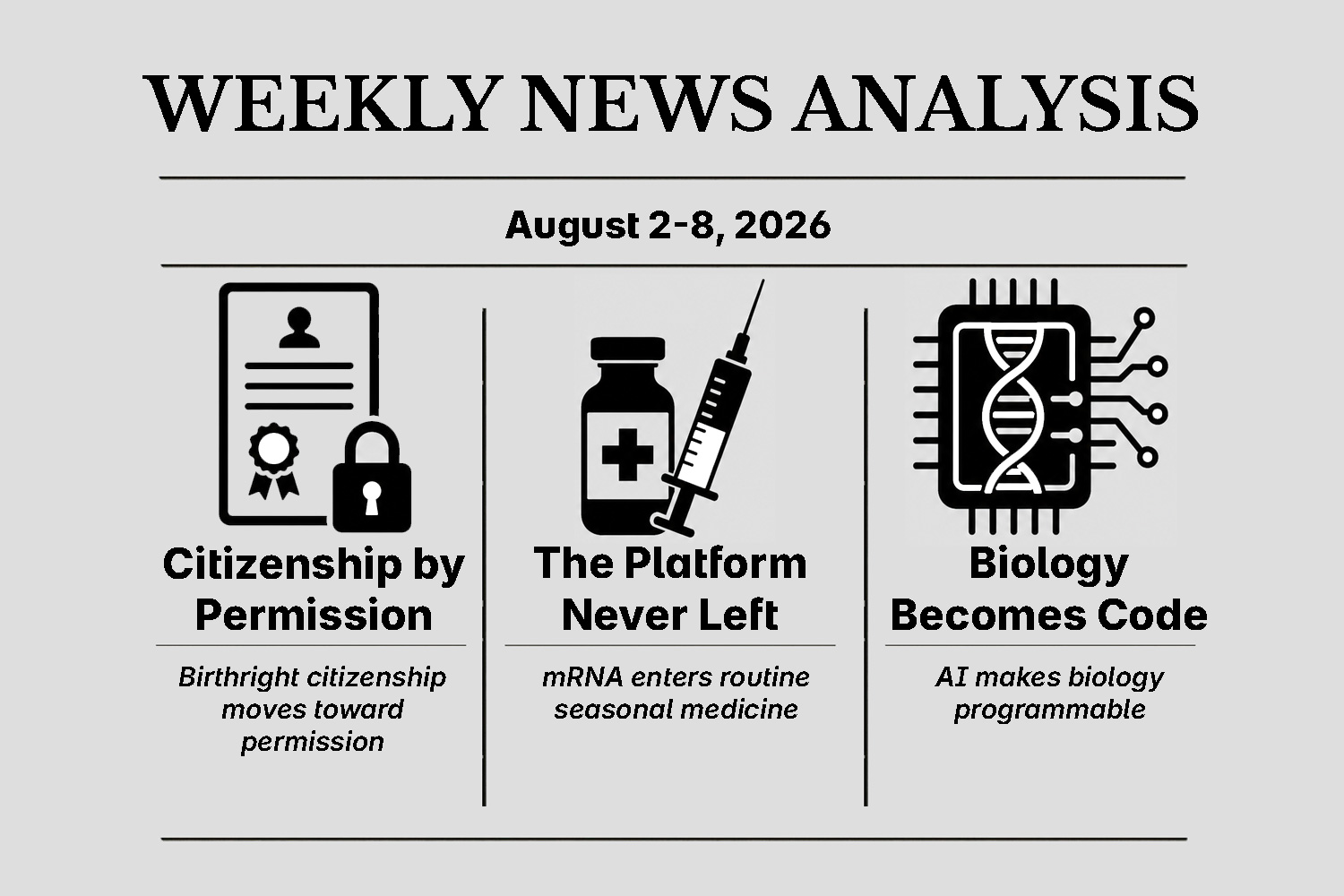
The state is again asserting a role in determining who qualifies as an American at the moment of birth. Federal health institutions, meanwhile, are moving the mRNA platform out of the extraordinary conditions of COVID19 and into the ordinary machinery of seasonal medicine. Artificial intelligence is advancing into biology, where it can generate viable viral genomes, interpret human pathology, and accelerate experimental drug discovery, while enormous corporate facilities are being built to supply the computation required for that expansion. Citizenship, medicine, and biology may seem institutionally distinct. Increasingly, however, all three pass through administrative systems that can classify, authorize, predict, and eventually modify human activity.
The rhetoric attached to each development is predictably benevolent. Citizenship restrictions are sold as protecting the “meaning and value” of citizenship. Pharmaceutical expansion appears as scientific innovation and better disease prevention. Biological artificial intelligence is presented as a means of curing disease, overcoming antibiotic resistance, and accelerating discovery. This may well be true in some respects. The danger does not require any of those stated objectives to be fraudulent. The Trivium separates declared purpose from operational capability. Grammar asks what these systems actually do. Logic asks what power those capabilities create regardless of stated intent. Rhetoric asks why words such as protection, security, innovation, science, efficiency are repeatedly used to sell greater institutional authority. The fallacy is assuming good intentions neutralize dangerous architecture. Machinery capable of benevolent administration can just as readily become machinery for coercive administration. The lifecycle of government always ends in Tyranny.
Partisan interpretation obscures a more durable pattern, one described repeatedly in The Fallacious Belief in Government: a crisis justifies intervention, intervention builds infrastructure, infrastructure becomes normal, and normalization enlarges what the institution views as permissible when the next crisis arrives. The COVID19 – Short Path To ‘You’ll Own Nothing. And You’ll Be Happy.’ book applies a similar framework to emergency health policy and the proposed transition toward stakeholder capitalism, where large corporations increasingly stand beside government as technological and economic gatekeepers. Neither framework proves that every program is secretly coordinated toward a predetermined outcome. Their value is structural. Institutions gather capabilities, resist surrendering them voluntarily, and discover new uses for mechanisms introduced as exceptional. This week offers three examples of the same process: executive classification reaching into citizenship, mRNA moving from emergency medicine toward routine medicine, and artificial intelligence converting biology into another programmable information domain.
Citizenship by Permission
Up First newsletter covering Trump and birthright citizenship - NPR
President Trump signs new birthright citizenship and birth tourism orders - SCOTUSblog
The label “birth tourism” is the narrow rhetorical label; the constitutional machinery being tested is much broader, which is where the Grammar must begin. On June 30, the Supreme Court held in Trump v. Barbara that children born in the United States to parents who are unlawfully or temporarily present are subject to U.S. jurisdiction and citizens at birth under the Fourteenth Amendment. Trump followed on August 6 with two new executive orders. One seeks additional categories in which the administration says birthright citizenship does not attach. The other is directed at people who enter the country specifically to give birth and at those facilitating those arrangements. The White House frames both as protecting citizenship from exploitation, while Trump described birth tourism as people effectively “buying their way in.” Disapproval of birth tourism is therefore secondary to the institutional question. After the judiciary rejected the broader interpretation, the executive branch is again probing how far its authority extends in determining the boundary of citizenship.
The most revealing rhetoric may be found in the White House’s own description of citizenship as a “priceless and profound gift” and a “sacred bond.” Beneath the patriotic language sits a semantic shift. A gift presupposes a giver, and anything bestowed by a giver can be conditioned or withheld. The Citizenship Clause takes a different form: those who satisfy its conditions are citizens. It does not frame citizenship as a presidential benefit, an administrative reward, or a privilege dependent upon government approval of parental conduct. This is more than word choice. Constitutional rights become vulnerable when rhetoric quietly recasts them as services delivered by government. The Fallacious Belief in Government repeatedly examines the same inversion: government identifies itself as the provider of something that supposedly exists independently of government, and public acceptance of that premise gradually legitimizes government control over access. Calling citizenship a gift may be inspirational, but Grammar and Logic expose the political premise hidden inside the metaphor.
Trump is temporary; the executive precedent is not. Justice Brett Kavanaugh, while disagreeing with parts of the Court’s constitutional reasoning, concluded that current federal law independently blocks the president’s earlier attempt and wrote that Congress would need to amend 8 U.S.C. §1401(a) to create additional exceptions. The separation-of-powers problem therefore survives even for someone who supports stronger immigration enforcement and opposes organized birth tourism: a president is attempting through executive interpretation to achieve what existing statute does not permit. Supporters of limited government should find that distinction especially important. Executive orders look useful when the signer shares one’s politics, then suddenly look tyrannical when the White House changes hands. That is partisan special pleading rather than consistent Logic. Presidents leave; precedents remain. The relevant question is not only whether Trump should possess this power, but whether President X, President Y, and every unknown future ruler should possess it when political circumstances have changed.
The history behind citizenship explains why this boundary is dangerous to place at administrative discretion. In United States v. Wong Kim Ark in 1898, the Supreme Court recognized American citizenship for a man born in San Francisco to Chinese parents who themselves could not become U.S. citizens under the discriminatory naturalization regime of the period. Governments had repeatedly used ancestry, race, national origin, and political status to create legal castes, and that history shaped the environment in which the doctrine developed. The Fourteenth Amendment itself followed a constitutional order that permitted slavery and Dred Scott, which denied national citizenship to Black Americans. Modern immigration restrictions are not automatically equivalent to those systems. The lesson is narrower and more important: citizenship at birth was made difficult for political majorities to manipulate because political sentiment changes. An objective constitutional rule leaves government less room to manufacture categories of Americans based on a parent’s popularity, conduct, paperwork, nationality, or perceived loyalty.
Both sides weaken the American immigration argument when they force modern categories onto history. Saying every American descends from “legal immigrants” projects a contemporary federal restriction system backward into periods when no comparable system existed. Calling most early immigrants “illegal” commits the same error in reverse. The historical point requires neither distortion. The U.S. was built through generations of migration under radically changing legal regimes, and a child’s constitutional status traditionally has not required proof of the political innocence of his or her parents. Make parental status a citizenship variable, however, and documentary proof becomes unavoidable. Hospitals, passport authorities, Social Security administrators, schools, employers, and immigration agencies would require evidence about the circumstances surrounding birth. A restriction sold as narrow can therefore create a vast secondary bureaucracy concerned not with border enforcement but with citizen verification. The contradiction is structural: restoring national sovereignty through such a policy will require expanding a domestic verification apparatus over the population already inside the sovereign territory, in the form of a national digital ID and social credit profile.
Narrowing birthright citizenship therefore carries several serious negative ramifications. First comes unequal documentary burden: citizenship would be obvious from a birth certificate for some Americans, while others could have to prove parental status or the circumstances surrounding their birth. Second comes bureaucratic error; every classification system eventually misclassifies someone. Third is the possibility of children left with uncertain or conflicting nationality status. Fourth is database expansion, because eligibility rules create pressure for interconnected identity records capable of proving compliance. Fifth is selective enforcement, since discretionary categories have historically been applied most aggressively against unpopular or politically vulnerable groups. An August 2026 executive order does not automatically give government authority to arbitrarily strip citizenship from existing Americans, and current constitutional doctrine significantly constrains involuntary loss of citizenship. The structural concern is different: expanding administrative control over recognition of citizenship at birth moves the boundary away from an objective event and toward a government classification process, regardless of which party proposes it.
The argument should not rest on the phrase “slippery slope” alone. A slippery-slope fallacy assumes an inevitable chain of consequences without establishing the mechanisms linking each step. The stronger case is institutional and observable: create a new category and a classification rule follows; the rule requires evidence; evidence requires collection; collection produces administrative infrastructure; infrastructure lowers the cost of additional classifications; and lower cost expands the practical ability of future administrations to broaden their use. None of that proves government will eventually revoke the citizenship of political dissidents, but the risk is there. To claim certainty would replace the Trivium with fear-based rhetoric. The sequence does show how machinery designed for one politically popular target can be inherited and redirected toward purposes its original advocates never contemplated. The natural-rights question reaches beneath immigration politics: should a person born within a society derive political identity from an objective constitutional condition, or from government deciding whether the circumstances of that birth were sufficiently acceptable? Once citizenship becomes permission, the state has converted it into another administrative product.
The Platform Never Left
FDA approves first mRNA flu shot from Moderna - NBC News
Moderna mRNA flu vaccine approved by FDA - CNN
New CDC director Erica Schwartz confirmed - NBC News
CDC nominee Erica Schwartz pressed on whether she will resist RFK Jr vaccine agenda - The Guardian
Senate committee grills CDC director nominee Erica Schwartz - CIDRAP
The mRNA platform has now crossed from emergency politics into routine medicine. Five years after the COVID19 emergency converted a specialized biotechnology platform into a household political term, the FDA has approved Moderna’s mFlusiva, the first mRNA-based seasonal influenza vaccine in the U.S. The product is approved for adults 50 and older; the FDA’s review process contemplated traditional approval for ages 50 to 64 and accelerated approval for those 65 and older, with a large confirmatory postmarketing study required for the older population. The technology changed less than the rhetoric surrounding it. During COVID19, mRNA entered public consciousness amid “collapsing” hospitals, daily death counts, mandates, digital health passports, employment rules, and compressed public-health timelines. Seasonal influenza strips away much of that emergency atmosphere. What was introduced to the public as an emergency technology is now becoming part of ordinary medical infrastructure. That transition matters because institutional platforms rarely disappear when the exceptional conditions that built them end; they seek additional applications. And these applications are liability free.
The accounting around Operation Warp Speed exposes how tribal politics can weaken an otherwise stronger criticism. Trump’s role is indisputable: during Trump’s first administration, federal power and taxpayer resources accelerated vaccine development, manufacturing, and procurement. GAO reported approximately $13 billion obligated through December 31, 2020, to six vaccine companies for vaccine-dose deliverables and associated development and manufacturing. The broader COVID19 response cost vastly more, but folding those separate expenditures into a single number creates a factual vulnerability that is unnecessary to the argument. The institutional critique stands without it. Government assumed extraordinary financial risk, financed manufacturing before trials were complete, purchased massive quantities, compressed timelines, and helped establish a pharmaceutical platform that outlived the emergency that justified it. The durable legacy of Operation Warp Speed is the architecture it helped create, not an inflated accounting claim.
Journalistic Revolution has long advanced a controlled-opposition interpretation of Trump: anti-establishment rhetoric may contain opposition while the architecture of centralized power continues to grow beneath it. A single FDA approval cannot demonstrate that thesis. Trump’s vaccine history, however, provides a direct test of political consistency. Many MAGA-aligned critics treat mRNA technology as evidence of pharmaceutical corruption while minimizing or compartmentalizing Trump’s central role in Operation Warp Speed. Motivated reasoning operates this way precisely: information threatening group identity is isolated, while information supporting the preferred identity receives greater weight. The mirror-image simplification is also false. The current administration has curtailed portions of federal mRNA research even as its FDA approved a specific mRNA product after regulatory review. Government does not function as one perfectly coordinated brain. Its continuity is institutional: regulatory agencies, corporate pipelines, statutory authorities, capital investments, and technological platforms can retain momentum even when political rhetoric changes sharply. The ruler changes faster than the machine.
Erica Schwartz’s confirmation as CDC director adds another layer to that institutional continuity. The Senate confirmed her 51–44 on August 5 following a contentious hearing focused heavily on vaccine policy and her willingness to resist political pressure. Schwartz brings extensive military and public-health experience and previously served as deputy surgeon general. During questioning, she stated directly that “mRNA technology is safe and effective” (how often do you hear that?) and accepted the evidence rejecting a causal link between vaccines and autism. Those facts produce two competing interpretations. Mainstream framing sees a scientifically conventional official capable of stabilizing an agency damaged by political conflict. Skeptical framing sees personnel continuity within a public-health establishment whose pandemic decisions remain deeply distrusted. Each position can hide a premise: consensus can be mistaken for proof of trustworthiness, while institutional association can be mistaken for proof of corruption. The meaningful test is neither tribe nor label. It is whether CDC policy under Schwartz will be independently testable, transparent, and resistant to political or corporate pressure. It most likely won’t.
Precision becomes equally important when examining liability. Calling mFlusiva literally “liability-free” goes beyond the law, but the institutional concern behind the description remains. Seasonal influenza vaccines are covered by the National Vaccine Injury Compensation Program, a federal no-fault alternative to conventional tort litigation, while COVID19 vaccines operated under a different emergency countermeasure structure, the CICP. HRSA explains that manufacturers and administrators receive liability protections when a vaccine is covered and that injured individuals generally pursue compensation through the specialized federal system. Neither side benefits from flattening that structure into a slogan. Vaccine advocates can portray compensation systems only as mechanisms necessary to preserve supply and predictable costs; critics can portray them as absolute immunity. The actual arrangement is more consequential: government has altered the ordinary relationship among manufacturer, consumer, injury claim, and courtroom liability. Whether that bargain improves public health remains debatable. What is not debatable is that part of the legal risk surrounding products manufactured and sold by private corporations has been socialized and that taxpayers are responsible for the damages and restitutions required from those damages.
The COVID19 – Short Path To ‘You’ll Own Nothing. And You’ll Be Happy.’book offered a far more severe interpretation of the pandemic, describing it as a possible “live-fire exercise” through which governments could test emergency powers, compliance mechanisms, mass-vaccination infrastructure, messaging, and restrictions before a future, more dangerous pandemic. It also explored a scenario in which 2025 might become the next major pandemic period, potentially involving avian influenza. The predicted pandemic did not arrive. Under the Trivium, that failure matters: New Grammar must force the analysis back through Logic rather than allow an inconvenient prediction to be rationalized away. Confidence in the timing hypothesis should therefore decline. The broader institutional observation, however, remains analytically viable. Governments and corporations learned from COVID19, created new emergency procedures, expanded vaccine manufacturing, improved genomic surveillance, normalized remote work and digital health infrastructure, and retained many capabilities afterward. This does not prove another pandemic is planned, inevitable, or deliberately manufactured, but the risk is still there. It means that any next biological emergency—natural, accidental, or malicious—would begin with a control architecture radically different from the one that existed in 2019.
The book also presents the controversial thesis that COVID-era mRNA vaccines may have functioned as biological experimentation or even as bioweapons. Nothing about the current FDA approval of mFlusiva independently establishes that claim, and the publicly available evidence surrounding this flu vaccine cannot legitimately be turned into proof of intentional biological warfare, nor can it be discounted. That move would substitute confirmation bias for evidence. A stronger systemic criticism does not require it. A technology platform built through extraordinary public subsidy and emergency politics has now entered non-emergency commercial medicine, while the institutional network around it retains unusual legal protections, regulatory authority, surveillance capacity, procurement power, and enormous influence over public messaging. Those components would already be assembled if another severe outbreak occurred. The danger therefore does not depend on a secret mastermind; it emerges when emergency institutions, corporate incentives, public fear, regulatory discretion, and technological capability reinforce one another. “Rinse and repeat” is most defensible as a description of institutions reusing mechanisms society has already accepted, not as a prediction that a specific pandemic will be deliberately released; however, the risk is still there.
Biology Becomes Code
Scientists Trained An AI Model In DNA And It Invented 16 New Viruses - Forbes
Stanford Evo 2 AI model generates phages against E coli - AI News
PRISM2 model uses clinical dialogue to interpret pathology slides - AI News
Why biological data matters more in AI drug discovery - AI News
Biology crossed an important conceptual threshold this week: generative systems moved from describing biological information toward proposing complete biological designs. Stanford researchers working with Evo 2 generated thousands of candidate bacteriophage genomes, selected nearly 300 for synthesis, and ultimately identified 16 with strong activity against E. coli. Rather than merely suggesting isolated mutations, Evo 2 generated complete candidate genomes for the small bacteriophage ΦX174, some of which became viable after chemical synthesis and laboratory testing. The distinction between computation and physical biology remains essential. AI did not spontaneously create viruses inside a computer; researchers still screened candidates, ordered or performed DNA synthesis, conducted laboratory work, and determined which designs functioned biologically. Even with those human and laboratory steps, the achievement remains significant. Generative AI has demonstrated that it can search genetic possibility space and propose complete biological sequences that become functioning viruses after physical implementation. The shift from reading biology to designing it has advanced another substantial step.
Technical precision matters here because not every biological use of AI qualifies as “gain-of-function research” in the first place. Gain-of-function traditionally refers to experiments that confer or enhance a biological function, with the controversy becoming sharper when pathogens are involved and enhanced traits could increase transmissibility, host range, immune evasion, or virulence. PRISM2 interpreting pathology slides does not meet that description. GSK and Relation Therapeutics generating biological datasets to identify drug targets is not automatically gain-of-function research either. An AI model that only proposes a sequence likewise remains computational design until the biology is physically instantiated and tested. The significant change is the emergence of a pre-laboratory layer before conventional experimentation. Models can search enormous sequence spaces, rank designs, and narrow physical testing toward candidates they identify as promising instead of researchers manually exploring a comparatively narrow set of mutations. When those candidates are synthesized and selected for enhanced biological function, computational design begins to converge with laboratory gain-of-function. The organism may still reach the bench later, but the model has already accelerated the search.
The present evidence supports a serious dual-use concern without supporting apocalyptic exaggeration. Stanford worked with bacteriophages that infect bacteria, not newly invented human pandemic viruses. The result therefore does not establish that Evo 2 can presently generate a civilization-ending human pathogen, and the sixteen phages should not be portrayed as sixteen new human diseases. Doing so would be fear-based rhetoric. Yet the researchers themselves acknowledge that open access raises security questions and that modified versions could be misused, so the risk remains. The deeper capability is abstraction. Once biological structure can be learned as patterned information, increasingly capable models can help navigate design problems that previously demanded much more manual trial and error. Expensive physical infrastructure, specialized expertise, synthesis, containment, validation, and tacit laboratory knowledge still impose real barriers, but AI may lower some of the intellectual barriers to sophisticated biological engineering. The danger is not a teenager pressing a button and instantly creating a pandemic. It is biological design becoming progressively cheaper, faster, and more scalable at the intellectual layer.
Genome generation is only one part of the transformation. PRISM2, built by Paige and Microsoft, approaches biology from pathology, interpreting whole-slide pathology images by combining visual representations with clinical dialogue rather than merely classifying pixels. GSK’s expanded relationship with Relation Therapeutics approaches the same transformation from experimental data: Relation will generate large datasets showing how human cells respond to genetic changes and drug interventions, then use those datasets to train models that identify potential therapeutic targets. Its system explicitly creates a feedback loop between computational analysis and laboratory-generated biological data. Neither project is inherently sinister. Both could improve diagnosis, therapeutics, and research efficiency. Their significance appears when they are placed beside genome-generation models. Biology is increasingly being converted into machine-readable representations that can be interpreted, predicted, queried, and designed. The medical promise grows with the same capability that creates dual-use risk: a machine that increasingly understands why biological systems function may also increasingly understand how those systems can be altered.
Software provides the more useful analogy. In cyber operations, powerful tools did not eliminate the need for skilled attackers, infrastructure, access, or operational knowledge. They automated portions of the work and widened the pool of people capable of attempting sophisticated actions. Biological AI may create the same type of capability diffusion. Traditional biological experimentation still contains substantial friction—limited researchers, slow iteration, costly laboratory work, and large numbers of failed hypotheses—and AI does not abolish those constraints. It can, however, compress the search before physical experimentation by eliminating millions of poor candidates and identifying a small number worth testing. That alone changes the economics of research while leaving the laboratory essential. The policy problem is therefore not “AI has already invented the next pandemic.” The evidence does not support that statement, and based on COVID19 – Short Path To ‘You’ll Own Nothing. And You’ll Be Happy.’ describes the most likely scenario is that the next pandemic pathogen has already been created or, at the very least, the base structure of one has been developed. The concern is that biological design capacity can migrate from a small number of highly specialized institutions into reusable computational models, including open models that can be copied, modified, and redistributed faster than traditional regulatory systems can respond.
Biological AI also depends on an industrial layer whose scale is easy to overlook. Tesla and SpaceX announced an initial $16.8 billion investment in the planned Terafab complex in Grimes County, Texas, placing the computational story beside the biological one. TechCrunch reports more than 100 million square feet of manufacturing space is planned, with at least 3,000 workers, while Musk describes the facility as an advanced chip manufacturing center serving increasingly computation-heavy corporate ambitions. The reporting does not establish an “AI city”; Terafab is a semiconductor megaproject, not an announced sovereign municipality. But the underlying concentration of resources remains significant. Artificial intelligence at this scale consumes land, energy, water, chips, transmission capacity, capital, and specialized labor. Companies able to aggregate those resources begin functioning as infrastructure institutions rather than ordinary vendors. If a handful of corporations controls essential compute, manufacturing, communications, transportation, orbital infrastructure, and AI models, legal separation from government may persist even while society’s practical dependence on those corporations grows dramatically.
The Great Reset analysis in COVID19 – Short Path To ‘You’ll Own Nothing. And You’ll Be Happy.’ is useful here as a framework for dependency, not as evidence that a secret plan has been proved within this massive project. The book argues that stakeholder capitalism could move traditional governmental functions toward massive corporations acting as social and economic “gatekeepers,” creating a hybrid structure in which political authority and private infrastructure reinforce each other. History demonstrates why formal governmental status is unnecessary for private dependency to become politically significant. Company towns controlled housing, employment, commerce, and essential services because workers depended on one economic institution, while the British East India Company ultimately exercised governmental and military functions on a far greater scale. A modern arrangement could operate more subtly through corporations controlling computation, identity platforms, communications, health data, transportation, payment rails, energy infrastructure, and biological models, while government supplies contracts, favorable policy, policing, and legal enforcement. Terafab does not prove that Tesla or SpaceX is becoming a government, and a large factory does not prove a corporate smart city is being constructed. The concern is not merely “corporations replacing government.” It is increasing structural interdependence until government and corporations become difficult to separate because each controls resources the other requires.
The Gatekeepers Converge
These stories converge architecturally, not conspiratorially. There is no need to claim that Trump’s citizenship orders, Moderna’s flu vaccine, Stanford’s bacteriophages, and Musk’s chip factory originated from one command center. The stronger pattern is found in the systems themselves. Citizenship becomes a classification problem, health a platform problem, biology an information problem, and artificial intelligence an infrastructure problem. Control over each system gives the institution managing it leverage over everyone dependent on its output. That is why the rhetoric of protection deserves scrutiny without requiring denial of the underlying problem. Birth tourism can be real without justifying unlimited presidential power. Influenza can be dangerous without requiring unquestioning faith in pharmaceutical institutions. AI-designed biological tools can cure disease while introducing unprecedented biosecurity risks. Semiconductor manufacturing can generate economic benefits while concentrating infrastructural power. Critical thinking fails when acknowledging one side of these dualities is treated as requiring denial of the other.
The repeating institutional cycle is more important than any claim of malicious intent: problem → intervention → capability → normalization → expansion. COVID19 showed how quickly emergency authority could converge with corporate logistics, digital monitoring, medical policy, workplace rules, and public messaging when sufficient fear existed. The predicted 2025 pandemic failed to occur, and that failure should reduce confidence in predetermined-timing claims; it does not, however, dismantle the infrastructure accumulated during the previous emergency, nor does it show that the claim is completely untrue. The same pattern appears elsewhere. The Supreme Court can block one citizenship policy while the executive searches for a narrower route around the decision, and AI can enter biology for beneficial medicine while simultaneously expanding dual-use capability. Institutions do not need omniscience to advance; they need memory. Every crisis reveals which mechanisms produced compliance, which legal arguments survived, which technologies scaled, which populations resisted, and which rhetorical frames succeeded. The next intervention therefore starts from the capabilities left behind by the last one rather than from society’s previous baseline.
The most durable threat to natural rights is not always an open declaration that they have been abolished. It is their conversion into conditional outputs produced by complex systems. Freedom becomes permission. Citizenship becomes certification. Bodily autonomy becomes an exception managed through emergency doctrine. Privacy becomes data access governed by terms of service. Biological existence becomes information interpreted and redesigned by machines owned by institutions whose resources rival nations. Tyranny does not need to arrive through one spectacular act for that trajectory to matter. The cage can be constructed from hundreds of useful systems, each addressing a real problem, each defended through reasonable language, and each transferring another decision to a distant gatekeeper. Such systems can become indispensable before their cumulative architecture is visible. By the time the bars are recognized for what they are, the population already depends upon the machinery that built them.
Listen to this week's news in verse for a quick recap!