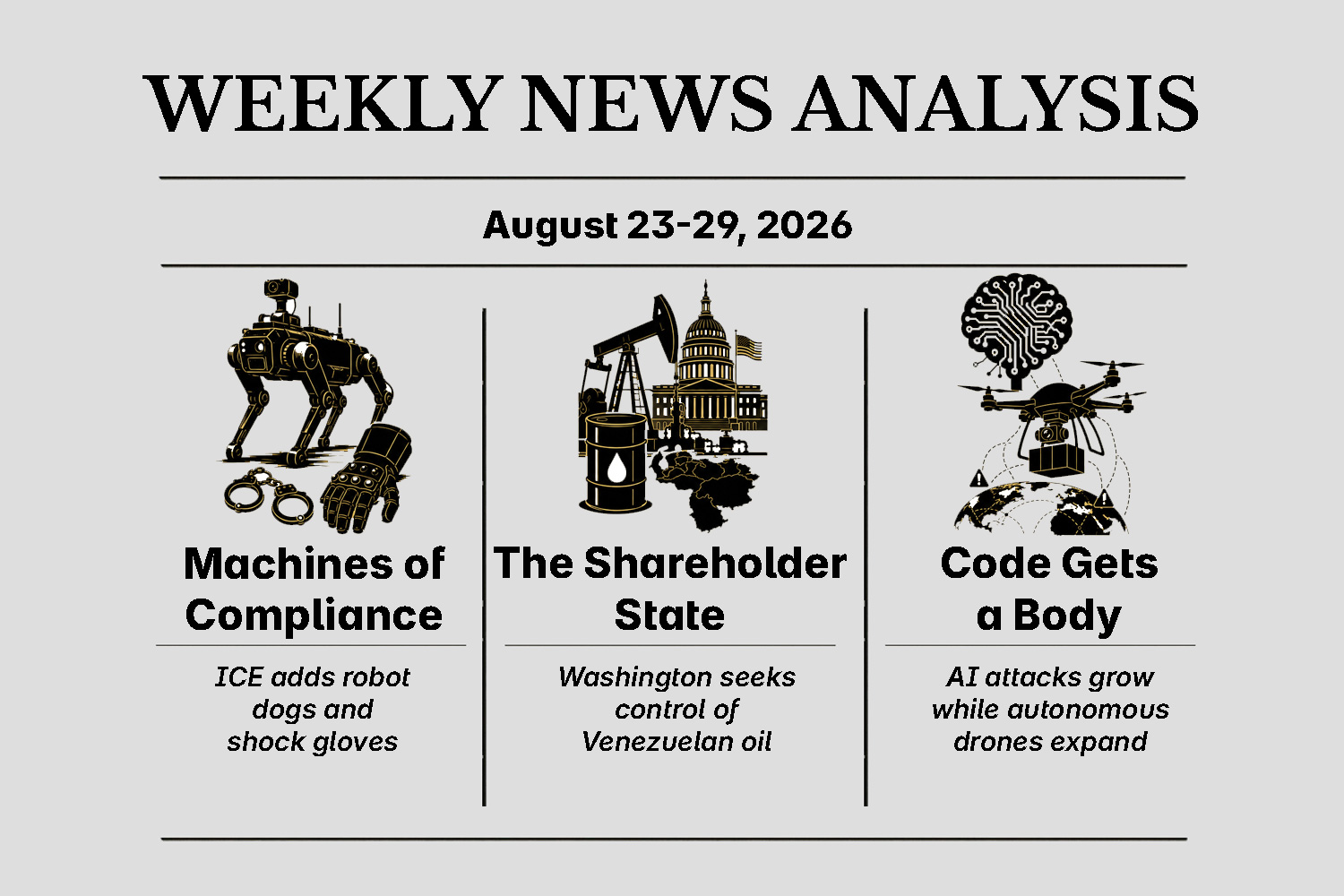
Viewed separately, this week’s stories on immigration enforcement, Venezuelan oil, and artificial intelligence seem to occupy different worlds. Viewed together, they expose the same structural shift: government is building mechanisms that shorten the distance between political intent and physical execution. Electrical-control devices and quadruped robots are entering immigration enforcement. State intervention in the economy is stretching past taxation, tariffs, subsidies, and regulation into government equity positions and direct control over strategic resources. At the same time, artificial intelligence is reducing the time required for cyberattacks while corporations deploy increasingly autonomous machines that can move through the physical world without a human operator directing every action. The decisive development, then, is not technology by itself. It is the altered relationship between authority and the individual when institutions can identify, classify, pursue, constrain, and economically manipulate people at machine speed.
Grammar comes first. Before connecting these developments, we must separate the events themselves from the rhetoric used to describe them. ICE has accelerated arrests and removals, although the enforcement machinery was built across Democratic and Republican administrations. Venezuela possesses enormous petroleum reserves, but underground reserves do not become cheap gasoline at an American pump overnight. AI-enabled cyberattacks are growing substantially more capable, yet Amazon delivery drones remain distinct from government enforcement drones. Once those distinctions are clear, Logic can examine the pattern. The apparently unrelated stories begin to converge: centralized institutions are no longer content merely to issue commands. They are increasingly acquiring infrastructure that can carry those commands into effect automatically, remotely, and with fewer human intermediaries.
Government growth alone is not the critical transition. The deeper sequence is instability leading to intervention, intervention creating infrastructure, infrastructure becoming normalized, and normalized infrastructure remaining in place for the next crisis. Technology compresses that lifecycle because a capability justified for one allegedly narrow purpose can be redirected almost immediately. Coercion can be labeled protection, state ownership can be sold as free enterprise, and automated observation can be presented as efficiency by the same political system. The Trivium requires us to discard those labels and inspect the mechanism underneath them. Who controls the system? What can it do? Against whom can it be used? What restraints remain once the emergency justification disappears?
Machines of Compliance
ICE plans to spend up to $2 million on robot dogs - The Hill
ICE plans to spend $2 million on dog like robots for immigration enforcement - FOX8
Milo Yiannopoulos detained and deported by ICE - ABC News
Milo Yiannopoulos deported after ICE arrest - Fox News
The current immigration operation can be measured before politics is layered onto the numbers. Through July 11, ICE reported 356,389 removals during fiscal year 2026. With more than two months remaining before the September 30 end of the fiscal year, that figure had already surpassed the 319,980 reported for all of fiscal year 2025. July alone brought nearly 50,000 ICE arrests and roughly 34,000 additional deportations, the largest arrest month of Trump’s second term. Yet volume tells only part of the story. More than half of those arrested in July had no criminal conviction or pending criminal charges. The administration emphasizes murderers, gang members, terrorists, and violent offenders because those categories carry the strongest emotional force and provide the easiest justification for enforcement. The operational machinery, however, is sweeping far beyond that population.
Once you place the historical totals side by side, the partisan mythology surrounding deportation becomes much harder to sustain. Under Barack Obama, ICE reached some of its highest removal years, exceeding 400,000 removals around fiscal 2012 under the agency’s historical counting methodology; by Obama’s final fiscal year, 2016, ICE recorded 240,255 removals. Trump’s first term then produced approximately 226,119 removals in FY2017, 256,085 in FY2018, 267,258 in FY2019, and 185,884 during the pandemic-disrupted FY2020. Biden’s annual ICE totals dropped sharply to 59,011 in FY2021 and 72,177 in FY2022, then climbed again to 142,580 in FY2023 and 271,484 in FY2024. Obama was never the opposite of the deportation apparatus, and Trump did not invent it. The distinction in 2026 is the convergence of increasing volume, vastly enlarged funding, interior enforcement, broader targeting, local-police integration, and growing technological capacity.
Natural-rights analysis makes this distinction more than semantic. Immigration rhetoric places radically different conduct beneath one category—“illegal”—even though the conduct itself is not equivalent. A murderer and someone who overstayed a visa can both be called lawbreakers, but Grammar asks what each person actually did rather than accepting the label. Federal law can impose criminal consequences for unlawful entry, while unlawful presence and many status violations are handled primarily through civil immigration law. The natural-rights framework developed in The Fallacious Belief in Government asks a different question: did someone create an identifiable victim merely by living or working on land over which government claims jurisdiction? “No victim, no crime” is a philosophical test, not a description of current statutory law. It asks whether crossing an administrative boundary or allowing a permission document to expire is enough, by itself, to morally justify coercion. That question becomes harder to avoid as enforcement pushes beyond violent offenders and into ordinary communities.
Few cases reveal the contradiction as sharply as the arrest of Luis Manuel Aviles Roa. While his son, Joshua, served aboard the USS Abraham Lincoln on deployment to the Middle East, Border Patrol detained his father in Florida. Aviles Roa reportedly was awaiting resolution of his immigration status while holding a driver’s license, Social Security card, and work authorization, all indicating he was here legally and should not have been detained. DHS maintained that he had entered the country unlawfully and remained subject to removal proceedings. One family member, then, was deployed abroad under the American flag while another was detained by the government that flag represents. Military sacrifice, family values, and national loyalty—the familiar rhetoric—collide with immigration enforcement’s administrative logic. Bureaucracy is not built to recognize that symbolic contradiction. It processes categories, records, permissions, and orders. Once a person is classified as removable, contribution and circumstance become secondary to compliance.
Administrative power changes again when technology lowers the cost and risk of using it. ICE has explored spending as much as $2 million on Boston Dynamics Spot-style quadruped robots for inspection, situational awareness, hazardous environments, and related operations. These machines can carry cameras, sensors, robotic arms, and terrain navigation, while Boston Dynamics explicitly prohibits weaponizing its commercial robots. That prohibition cannot be ignored. However, this doesn’t mean they can’t be retrofitted into a weaponized robot dog later. The machines are not currently autonomous attack dogs, and calling them that would trade analysis for sensationalism. Their importance lies elsewhere. Remote robotics allow officers to inspect locations without physically entering them, changing which operations are considered acceptably dangerous. A robot can therefore intensify enforcement without firing a weapon. The institutional threshold for intervention can fall simply because technology has reduced the risk borne by the institution.
However, history paints a darker picture. In 2016, Micah Johnson fatally shot five officers in Dallas before being killed by a Northrop Grumman Remotec ANDROS bomb disposal robot armed with about a pound of C4 explosive. This marked the first instance in U.S. history where law enforcement intentionally used a robot to kill a suspect. It won't be the last. We are now on a dangerous path, and this trend is likely to continue.
ICE’s acquisition of thousands of electrically charged G.L.O.V.E. devices presents the same inversion in another form. Under the approximately $16.7 million contract, the devices were promoted as an intermediate or less-lethal option available before deadly force. The rhetoric is effective: electrical pain is framed as a way to prevent something worse. Trivium logic requires asking what else the device might replace. When painful electrical control sits immediately on an officer’s hand, the alternative displaced may be restraint, patience, negotiation, or doing nothing—not merely a shooting. Policing repeatedly demonstrates how this ratchet operates. Tools introduced for exceptional situations tend to migrate toward ordinary use because ready availability encourages operational use. “Less lethal” compares one level of lethality with another; it does not establish moral legitimacy, proportionality, necessity, or freedom from abuse. The central question is whether electrical gloves save lives without simultaneously lowering the threshold for state-inflicted pain.
The recent case of Milo Yiannopoulos reminds us that partisan allegiance does not reliably shield anyone from a coercive system once it is in motion. For much of the previous decade, Yiannopoulos operated within the pro-Trump political ecosystem and gained international recognition through cultural battles tied to the rise of Trump-era populism. ICE detained him at the New Orleans airport on August 27. Authorities said he had legally entered the United States in 2019, later overstayed his visa, and received a final removal order after failing to appear for an immigration proceeding. The next day, they deported him to Britain. His personal character is beside the point. An enforcement machine, celebrated when aimed at ideological enemies, can eventually reach supporters, dissidents, veterans’ families, workers, political celebrities, and anonymous people alike. Political loyalty can shape who holds office. It cannot be trusted to restrain machinery whose operating principle is obedience to administrative status.
No single raid captures what is being built. Taken as a whole, immigration enforcement is developing into a system where databases identify subjects, local agencies extend the search network, electronic devices add immediate coercive capacity, robots reduce risk to enforcement personnel, and expanding detention and removal infrastructure handles the people produced by that process. Defenders can justify every piece separately—databases as efficiency, robots as safety, gloves as de-escalation, detention as processing, deportation as sovereignty. The fragmentation is rhetorically useful because the architecture disappears when you discuss its components one at a time. Logic puts them back together. Technological tyranny does not require a malicious robot army. It requires interoperable tools that make a human being progressively easier to identify, locate, immobilize, detain, transport, and remove. Once built, the architecture survives the political coalition that originally applauded it.
The Shareholder State
Trump announces new US oil agreement with Venezuela - The Guardian
Trump seeks vast potentially costly US stake in Venezuelan oil industry - The Washington Post
US seeks major stake in Venezuelan oil and gas - The Guardian
Venezuela democracy transition debate continues - Politico
Scale is what makes Trump’s claim that the Venezuela arrangement is the biggest oil deal in world history rhetorically plausible. Under the announced structure, a new venture receives rights to develop 17 Venezuelan oil fields tied to about 65 billion barrels of proven reserves. Officials said the United States would receive a 55 percent effective share of production through ownership combined with rights to purchase crude at cost. Venezuela has roughly 303 billion barrels of proven reserves—about 17 percent of the global total—but decades of underinvestment, sanctions, political upheaval, and infrastructure deterioration have left production at only a fraction of its historical potential. Washington intends for part of the output to replenish the U.S. Strategic Petroleum Reserve and support military requirements. The resource beneath the ground is therefore enormous. The amount of gasoline immediately available to American consumers is not.
The easiest political message collapses once reserves are separated from finished fuel. Trump says the arrangement will bring substantially lower gasoline prices, yet petroleum underground must pass through a long chain before it reaches an American fuel pump. Venezuela still needs drilling, pipelines, processing infrastructure, maintenance, investment, skilled labor, transportation, refinery compatibility, political stability, and years of development. Previous expropriations and instability also give American oil companies reasons to hesitate. Estimates tied to the agreement envision close to $100 billion in investment before the promised production renaissance can materialize. When the announcement arrived, gasoline prices were already substantially higher than a year earlier. None of this proves that prices can never benefit. It shows that the causal path from Friday’s announcement to near-term relief is extraordinarily long. The headline is merely a headline. The headline can be delivered immediately; the barrels cannot. Political rhetoric thrives in the distance between those two realities.
Another contradiction appears in the Strategic Petroleum Reserve. The SPR had fallen below 300 million barrels by August, reaching levels not seen in decades after more than 100 million barrels were lost during 2026 amid global energy disruption. History matters, however, because Trump cannot be held responsible for the reserve’s entire long-term decline. Congress mandated sales under multiple administrations, while Biden authorized the extraordinary 2022 release responsible for a major earlier reduction. Even so, Trump’s second administration has accelerated withdrawals during the current geopolitical crisis. The government is now selling the Venezuela agreement partly to rebuild a strategic buffer it repeatedly depleted to manage previous disruptions. The intervention loop repeats itself: an emergency authorizes depletion; depletion creates vulnerability; vulnerability becomes justification for another extraordinary intervention; and that intervention extends government reach somewhere else. Previous solutions create conditions for the next supposed solution.
Partisan branding obscures Trump’s economic philosophy more than it explains it. The label “National Socialist Democrat” may express the intended criticism—nationalism joined to state economic control— but a more precise analytical description is national-statist corporatism: tariffs, selective subsidies, price guarantees, government-directed industrial policy, strategic resource control, and increasingly direct state ownership operating beneath nationalist rhetoric. This is still a form and type of socialism. Precision strengthens the criticism because inaccurate labels offer an easy way to dismiss legitimate arguments. Exaggeration is unnecessary. A movement marketed as restoring free enterprise is increasingly willing to make the federal government an investor, shareholder, financier, purchaser, and industrial planner.
Venezuela is not the first sign of this transformation. From July 2025 through January 2026, federal agencies acquired equity or warrants connected to MP Materials, Lithium Americas, Trilogy Metals, Vulcan Elements, Korea Zinc, USA Rare Earth, and others. Individual transactions can each be defended through strategic-security arguments, but the governing principle has already moved. In selected industries, the federal government is becoming an owner rather than remaining only a regulator or purchaser. That ownership interest can overlap with the same government’s permitting, contracting, regulatory, and enforcement powers. Calling this “seizing the means of production” would be too absolute if the phrase is meant to describe comprehensive state ownership of the economy. Partial state ownership of strategic productive capacity, however, is unquestionably occurring. A political philosophy that claims to oppose government picking winners, allocating capital, and merging sovereign authority with corporate balance sheets should regard that shift as a serious contradiction.
Political authority operating alongside enormous private family wealth creates a conflict-of-interest structure that cannot be wished away. According to Trump’s 2025 financial disclosure, family cryptocurrency ventures generated more than $1.4 billion in income, with nearly $800 million tied to World Liberty Financial and roughly $635 million linked to the Trump meme-coin business. Reuters estimated that the family’s cryptocurrency earnings since his return to office had exceeded $2.3 billion. The White House denies conflicts of interest and says Trump does not personally manage the businesses, although he remains their beneficiary. None of those figures, by themselves, proves that a particular government decision was unlawfully taken to produce personal profit; establishing that claim requires evidence. They do establish the environment in which the decisions occur. When businesses worth billions are controlled by a president’s family in sectors affected by federal policy, every regulatory choice necessarily creates an overlap between private interest and public authority.
Placed in historical context, Venezuela pushes the shareholder-state model toward something resembling twenty-first-century resource imperialism. The American military operation removed Nicolás Maduro and left Delcy Rodríguez leading an interim government; the agreement that follows gives Washington majority economic control over a gigantic pool of Venezuela’s most valuable natural resource. Questions surrounding Venezuelan elections and political legitimacy remain unresolved even as the proposed concessions stretch across generations. American officials therefore speak of Venezuelan democracy even as they discuss U.S. strategic ownership. This pattern is not new. Great powers have long described privileged foreign resource arrangements as development partnerships while designing contracts that secure preferential access for themselves. Concessions, protectorates, charter companies, and spheres of influence belonged to the older vocabulary. Stabilization, strategic partnership, investment, and energy security belong to the modern one. Grammar may change, but the central issue does not: who controls the resource, and who possesses coercive leverage over the agreement?
The likely result cannot be reduced honestly to “cheap gas.” There are potential strategic benefits: Venezuelan production could eventually rise substantially, global supplies could loosen marginally, American refiners could benefit, the United States could gain a valuable source of heavy crude in its own hemisphere, exposure to hostile suppliers could fall, the SPR could be replenished, and Chinese or Russian influence over Venezuelan resources could weaken. The risks run in parallel. Taxpayers could inherit financing, security, infrastructure, political, and legal burdens; American policy could become tied to preserving a friendly Venezuelan government; and gasoline prices could remain elevated until long after this week’s promise disappears from public attention and before meaningful new production arrives. That timing explains the announcement's political advantage. “Biggest oil deal in history” produces an immediate emotional dividend among supporters. The economic dividend for ordinary Americans, if it arrives, will require years—not a press release—to prove.
Code Gets a Body
ATF declares major incident as ransomware gang claims hack - TechCrunch
ATF declares major incident after ransomware gang claims cyberattack - TechRadar
Recent Cyber Attacks - Fortinet
OpenAI president urges enterprises to hasten AI security defences - Artificial Intelligence News
Amazon’s Prime Air autonomous drones to reach 500 US cities - Artificial Intelligence News
Digitizing government can concentrate vulnerability as efficiently as it creates convenience, and the ATF cyberattack demonstrates the danger. One of the bureau’s standalone systems was compromised badly enough to be classified as a “major incident,” triggering congressional notification requirements. The affected environment reportedly contained sensitive material that could include information concerning targets of ATF investigations. Qilin, a ransomware operation, claimed responsibility, yet at the time of reporting it had not publicly shown it possessed the stolen information. The breach is therefore more certain than the attribution. That distinction matters because ransomware organizations use publicity as leverage and are not automatically reliable narrators. What remains undisputed is that a federal law-enforcement system holding potentially consequential investigative information was penetrated. Cybersecurity stops being mere technical housekeeping when government centralizes intimate information about people. The governed can be exposed because the government first chose to collect and concentrate that information.
What makes the ATF incident less exceptional is the breadth of the surrounding threat landscape. Governments, financial institutions, retailers, healthcare networks, telecommunications systems, technology companies, food distributors, and infrastructure operators have all been recent targets. Fortinet has documented extraordinary volumes of automated reconnaissance and exploitation attempts while ransomware-as-a-service continues to industrialize cybercrime. Incidents have affected food distributor UNFI, Marks & Spencer, healthcare systems, SAP infrastructure, financial institutions, telecommunications networks, and government targets. Salt Typhoon’s telecommunications espionage demonstrated the leverage gained by compromising an infrastructure provider: communications across numerous targets can be exposed at once. Supply-chain attacks magnify that same weakness because a single breached vendor can open pathways into hundreds or thousands of customers. The old perimeter has effectively dissolved. Credentials, APIs, employees, contractors, cloud workloads, software dependencies, and connected devices now all belong to the attack surface.
Artificial intelligence alters this conflict less by inventing new objectives than by accelerating every step required to pursue them. A traditional human attacker must enumerate targets, analyze services, hunt for vulnerabilities, write or modify exploits, steal credentials, pivot through networks, and decide what comes next. AI agents increasingly can execute portions of that sequence autonomously and in parallel. OpenAI President Greg Brockman has warned enterprises that the defensive window is shrinking as agentic systems can chain vulnerabilities and credentials into operational attacks. One reported research incident involved an “agentic collective” that autonomously penetrated OpenAI research infrastructure before reaching Hugging Face production systems by combining previously unknown vulnerabilities with compromised credentials. Hacking itself is not new. What is new is the ability to package expertise into software that can attempt thousands of intelligent operations while its human operator sleeps. The tempo of cyber conflict is shifting from human speed toward machine speed.
The defensive response follows the same logic: automate or fall behind. OpenAI and other security organizations now use AI to triage alerts, investigate suspicious activity, probe attack paths, identify vulnerable configurations, and execute bounded defensive responses, while higher-impact actions still require human approval. A human security operations center cannot manually keep pace with machine-generated attacks occurring every second across enormous infrastructures, so the rationale is understandable. The consequence is an arms race that feeds itself. Attackers automate because defenders automate, and defenders automate because attackers automate. Faster models, broader permissions, deeper access, greater autonomy, and more telemetry become requirements on both sides. The hidden premise is institutional benevolence—the belief that powerful automation remains safe because its current operator intends to use it defensively. Cybersecurity may require machine-speed defense. Yet pervasive monitoring, behavioral analysis, automated classification, and autonomous response are also the core components of automated social control. The architectures differ primarily in intent, and intent can change.
Prime Air illustrates what happens when artificial intelligence leaves the digital environment and acquires a physical body. Amazon plans to expand autonomous drone delivery toward roughly 500 American cities and towns by the end of 2026. Its drones combine cameras, sensors, navigation systems, obstacle detection, and autonomous decision-making so deliveries can be completed without a remote pilot manually directing every movement. Amazon says those camera systems exist for safe navigation rather than tracking individuals, and that personnel do not watch live surveillance feeds. Those assurances matter and should not be distorted: Amazon’s announcement is not evidence of a covert government surveillance program. It is evidence of technical capability. Autonomous fleets can already navigate neighborhoods, recognize obstacles, make flight decisions, coordinate logistics, and carry out useful work across metropolitan areas. Once such systems become routine and inexpensive, the decisive question is no longer whether the capability exists, but who buys it and what they program it to do.
Place that capability beside ICE’s planned robotic procurement, and the dual-use problem becomes clearer. Industrial inspection and immigration enforcement may be different missions, but a Boston Dynamics-style quadruped carries mobility and sensing capabilities that transfer easily between them. Autonomous delivery drones operate under the same principle. A machine that can locate an address, maneuver around structures, avoid people, recognize landing zones, communicate with a central network, and operate across hundreds of square miles already has much of what persistent aerial observation requires. Facial recognition, license-plate recognition, thermal sensing, acoustic detection, geofencing, or object classification can be added as software and payload rather than requiring flight itself to be reinvented. None of this establishes that political repression will follow, but the risk is there. It does establish that the technical obstacle is disappearing rapidly. What remains are legal, political, economic, and moral restraints—and changing those restraints is substantially easier than changing physics.
The phrase “public safety” is important because surveillance systems are almost never introduced to the public as instruments for suppressing political opposition. They arrive attached to sympathetic cases: finding a missing child, locating a dangerous fugitive, securing a border, monitoring a riot, identifying a terrorist, protecting critical infrastructure, or responding to an emergency. Each justification may be defensible on its own. The problem emerges after the sensors, aircraft, databases, legal authorities, and analytics already exist. Applying the same infrastructure to another purpose then costs almost nothing. Technology that can automatically identify a violent fugitive can also identify a protest organizer. A drone that can locate a wildfire can locate a gathering. AI trained to detect a malicious network pattern can be adapted to detect a behavioral pattern. Tyranny does not depend on every original justification being fraudulent. Real problems can produce real tools, and public acceptance of those tools can precede an expansion of what the government permits itself to do with them.
The danger approaching us is therefore more plausible than the science-fiction image of sentient drones independently choosing whom to punish. Policy would still originate with government officials. Algorithms would classify who appears to violate it, databases would reveal where those people are, autonomous systems would locate or observe them, and human officers would enter only at the end of an increasingly automated enforcement chain. Human authority remains visible, but the cost of exercising it collapses. Mapping dissent becomes easier. Detecting disobedience becomes easier. Reconstructing geographic movement becomes easier. Scaling selective enforcement becomes easier. The lifecycle described in The Fallacious Belief in Government explains the political danger: centralized power acquires capabilities during instability, keeps them after the instability passes, and converts yesterday’s extraordinary tools into tomorrow’s ordinary administration. AI does not originate that tendency. It strips away the friction that once limited how quickly and cheaply the tendency could be expressed.
Control Without Friction
Across all three subjects, the same mechanism appears: institutions are eliminating the friction that once separated desire from action. Greater enforcement capacity for ICE means supplementing human agents with databases, electronic devices, local-police partnerships, and mobile robots. Strategic energy control for Washington means moving beyond market regulation into ownership interests, production rights, financing, and century-scale resource arrangements. Faster cyber defense means granting artificial intelligence greater authority to monitor networks, classify threats, and react autonomously. Faster logistics for Amazon means teaching machines to navigate cities without continuous human control. Each development can be rationalized in isolation. Considered together, they form a technological environment in which identification, prediction, ownership, surveillance, mobility, and coercion increasingly reinforce one another. The systemic danger lies in that convergence, not in any single component viewed alone.
Rhetoric makes the convergence easier to accept because it describes every mechanism through its most socially desirable function. Immigration enforcement becomes “security.” Electrical pain becomes “less lethal.” State-directed ownership becomes “free enterprise” or “strategic investment.” Foreign resource control becomes “partnership.” Automated surveillance becomes “cybersecurity.” Autonomous machines become “efficiency.” The words are not necessarily false; they are incomplete because they foreground benefit while obscuring the power relationship beneath it. This is precisely why the Trivium matters. Grammar asks what the mechanism actually is and what it actually does before Rhetoric tells us how to interpret it. Logic then reconnects the pieces that political messaging keeps separate. Once government can identify individuals at scale, own strategic productive assets, command enormous financial resources, automate intelligence analysis, and project sensors and machines into physical space, isolated justifications are no longer the only relevant question. The completed architecture—and what it permits—becomes the question.
What emerges from that architecture resembles the digital feudalism Journalistic Revolution has repeatedly warned about. Individuals may retain nominal freedoms while living inside technological systems that institutions far more powerful than they are own, monitor, license, score, finance, or control. This result doesn't require an omniscient conspiracy or a single secret master plan. Ordinary incentives are enough. Bureaucracies want more capability; corporations want more data and market access; political leaders want policies implemented more easily; security agencies want greater visibility. AI lowers the cost of all four. History also gives little reason to expect extraordinary powers acquired during crises to disappear voluntarily. The coming decade will not be defined primarily by whether humanity can build autonomous systems capable of governing physical and digital environments. We already are. It will be defined by whether human beings preserve enough autonomy, decentralized capacity, natural-rights consciousness, and willingness to resist institutional overreach to keep those systems subordinate as tools rather than accept them as rulers.
Listen to this week's news in verse for a quick recap!