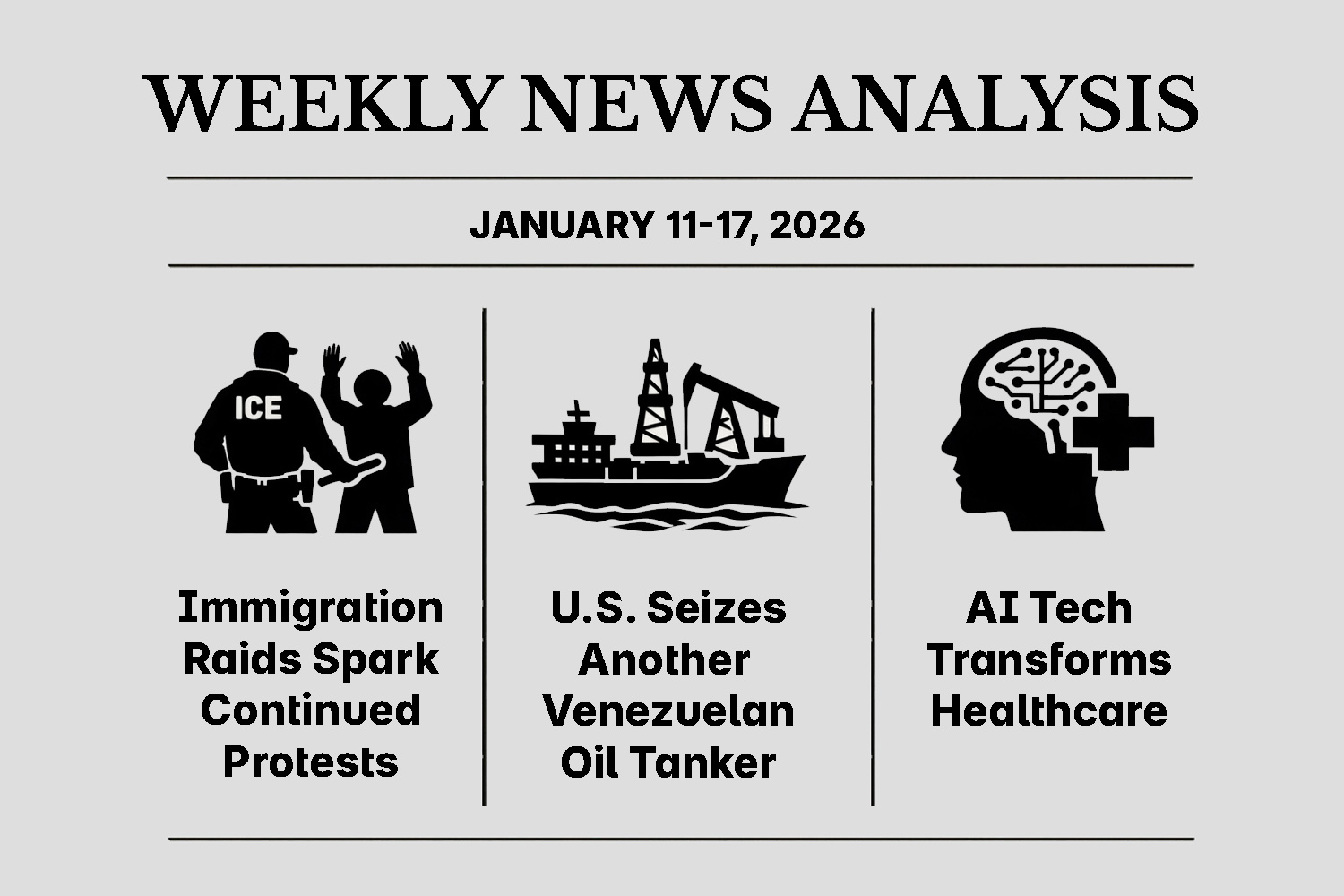
This week’s common thread isn't just about immigration protests, oil seizures, and healthcare AI as separate stories. Instead, it reveals a consistent governing approach that disguises itself in different forms: legitimacy is initially established via administrative authority and later justified through narrative framing. The public is presented with a binary choice—order versus chaos, security versus subversion, progress versus regress—while, behind the scenes, a quiet growth of discretionary power occurs. The Trivium Method of Critical Thinking framework clarifies this pattern: grammar is managed through labels, logic is skewed through selective standards, and rhetoric is employed to generate engineered consent for what might otherwise be perceived as extraordinary.
Across these three topics, institutions present their actions as reluctant necessities—emphasizing that enforcement, resource allocation, and infrastructure development are unavoidable. Opponents, however, are depicted as irrational, dangerous, or misinformed. This reflects the policy ratchet discussed in The Fallacious Belief in Government: crisis rhetoric serves as a moral justification that erodes procedural limits, which rarely return once weakened. Consequently, society becomes conditioned to accept intrusions as normal under the guise of urgency and to dismiss dissent as illegitimate if it threatens the narrative of managerial control.
The underlying connection is that each narrative acts as a permission framework. ICE enforcement reaches street- and doorstep interactions; foreign policy involves resource extraction and territorial influence; AI impacts medical decisions and energy systems. All are presented as responsible management, but they share a core focus on custody—over people, resources, and decision authority. Meanwhile, the public debates the spectacle, unaware that the support structure of control is being solidified through concrete and code.
Papers Please Republic
ICE protests erupt amid arrests - BBC
ICE Minneapolis arrests spark protests - Politico
ICE resistance funding controversy - Conservative Brief
Former Iranian prisoners reveal torture horrors as regime kills protesters on sight – Fox News
Iran unrest and crackdown intensify - BBC
Regime journalist blames CIA and Mossad for protest bloodshed - India Today
ICE Barbie warns Americans must be prepared to prove citizenship - The Daily Beast
The initial rhetorical device is linguistic: “ICE protests” are portrayed either as civic resistance against state overreach or as a hindrance to lawful enforcement. The left-leaning perspective highlights due process, community concern, and the chilling effects of enforcement tactics. Conversely, the right-leaning view emphasizes sovereignty, order, and the moral assertion that “law is law,” suggesting that any disruption is inherently illegitimate. Both perspectives downplay the deeper institutional change: shifting from a society in which citizenship is recorded in documents for administrative purposes to one in which it becomes a mobile checkpoint. When “show your papers” moves from border checkpoints into everyday life, the debate shifts from immigration to whether the state regards free movement as a right or a privilege that can be revoked.
Both sides can express genuine concerns, and these should be clearly communicated without propaganda. The Left warns that aggressive enforcement can cause collateral damage—such as destabilized families, pressured employers, communities avoiding compliance, and an overall atmosphere of suspicion. Conversely, the Right warns that a lack of enforcement encourages illegal entry and questions the legitimacy of sovereignty. Each side also holds an unspoken assumption that undermines its stance: the Left trusts institutions if they are managed by “their team," while the Right views institutional power as harmless when focused on a politically unpopular target. The core issue isn’t policy preference but selective distrust—skepticism only when power is held by the opposing group.
This selective distrust is evident when contrasting moral attitudes toward protests at home and abroad. Many on the Right criticize domestic resistance to ICE as chaotic, unpatriotic, or criminal, but celebrate foreign uprisings against regimes seen as enemies. The underlying principle shifts from emphasizing "law and order” to supporting "order when it benefits us." If protesting is inherently illegitimate because it disrupts government functions, then foreign unrest should also be condemned. Conversely, if protests are justified when opposing tyranny, the focus shifts to whether enforcement methods are becoming tyrannical—especially as rhetoric increasingly defends broad immunity and more freedom in action. The aim is not to equate every situation but to reveal the hidden assumption: “protest is acceptable when it supports my faction’s geopolitical narrative.”
The hypocrisy of the Left is often opposite: many activists and commentators who openly condemn authoritarianism abroad tend to be surprisingly respectful of domestic administrative authority when it is presented as humanitarian aid, public safety, or anti-extremism efforts. This pattern involves emotional outsourcing: believing that "our leaders mean well," leading to the view that coercive measures are neutral tools rather than permanent powers. This mirrors the cycle described in The Fallacious Belief in Government, where legitimacy shifts to enforcement because the public judges power by declared intentions rather than structural incentives and past results. When intent becomes the main measure, the state learns to craft narratives around it, and the media adopt those narratives. Consequently, the public is encouraged to trust the same institutions it once feared—simply because their image has been rebranded.
The coverage of Iran demonstrates the second common rhetorical tactic: framing foreign unrest through competing, often politicized narratives. One side highlights regime brutality, including claims of killings and harsh repression, while the other blames external provocation, suggesting outside intelligence agencies and “terrorists” are fueling instability. Fox reports feature former detainees describing detention brutality and alleging that security forces execute wounded protesters with 'final shots,' portraying the crackdown as unprecedented and escalating. India Today presents a regime-friendly counter-narrative, blaming foreign-backed actors like the CIA and Mossad for the violence. The main point is that both narratives can be used as tools: one to justify external intervention, the other to legitimize domestic repression and emergency actions.
This creates fertile ground for the possibility—though it can never be proved solely through rhetoric but is historically plausible—that intelligence agencies might exploit unrest for strategic purposes. “Plausible deniability” is not merely a conspiracy term; it is a recognized tactic in statecraft and covert operations. However, the most critical insight is that the public is presented with a simplified narrative: protests are either purely spontaneous or entirely staged. In reality, situations are often more complex, with legitimate grievances coexisting alongside opportunistic manipulation, infiltration, and amplification. The analytical challenge is to determine which outcomes—such as increased security powers, stricter information controls, and a population willing to sacrifice rights for normalcy—are predictably driven by chaos. This cycle—crisis, intervention, consolidation, and new crisis—defines the structural rhythm of modern governance.
Domestically, a similar pattern emerges in which “enforcement” is rhetorically reframed as a form of social sorting. When political leaders and agencies endorse greater immunity for enforcement actions and public discourse begins to normalize the request for proof of citizenship, the state isn't just enforcing immigration laws; it is demonstrating a broader compliance framework. The Daily Beast's depiction of warnings about readiness to show proof of citizenship highlights how quickly cultural norms can shift from assuming liberty to assuming suspicion. Even if not all partisan rhetoric is endorsed, the overall trend is clear: door-to-door checks coupled with document requirements form the structure of internal border enforcement. The phrase “papers, please” from history is not solely a Nazi-era reference but a recurring bureaucratic appeal whenever states treat identity as a checkpoint rather than a status taken for granted unless proven otherwise.
The core role of political theater is to distract and deepen moral divisions. The public remains occupied debating whether protesters are heroes or villains, whether ICE represents protection or oppression, and whether Iran's actions are revolutionary or sabotaging. Meanwhile, administrative capacity grows regardless of which narrative dominates. The Fallacious Belief in Government sees this as a structural trait: spectacle leads citizens to view the state as a legitimacy judge rather than a power eager to expand. When politics turns into theater, each side performs its role—either as outraged dissenters or enforcers—yet the result remains the same: increased discretionary power, fewer practical limits, and greater reliance on institutional approval for daily life.
Resource Empire Drift
US military seizes another fugitive oil tanker linked Venezuela - Fox News
Plane used in boat strike painted to look like civilian aircraft - AP News
Greenland dispute escalates - BBC
Trump knows Greenland’s value for national security - Fox News
Billionaires bet big on Greenland after Trump took interest - Forbes
Troops from Europe deploy Greenland rapid mission amid takeover push - Fox News
The second topic presents the empire narrative as a form of management. The taking of oil assets and aggressive interdictions are justified as law enforcement, sanctions enforcement, or national security measures. This rhetoric suggests that the US is simply enforcing rules against “bad actors,” but in reality, it controls the flow of commodities—deciding who can move resources, profit from them, or face punishment. Fox reports another seizure related to Venezuela and connects it to a broader pattern of enforcement. The key question is not whether Venezuela’s leadership is corrupt or if sanctions are legally valid, but what kind of world order is being established when a leading power treats resource movements as a permissions system governed by its military and legal tools.
The drug-war narrative acts as a familiar justification for expanding coercive measures. AP’s coverage of operations targeting “drug boats,” including details like aircraft displays and tactical approaches, shows how quickly “law enforcement” shifts into “war,” and how war can serve broader strategic aims. Even if trafficking is seen as a serious problem, enforcement efforts often go beyond their original goal: maritime control and intelligence gathering become the main results, while the drug issue continues to evolve and endure. This illustrates the classic problem where the means—surveillance, interdiction, seizures—end up overriding the intended ends. Once these systems are in place, institutions tend to defend them, regardless of whether they achieve their objectives.
Interestingly, since the U.S. took control of Venezuela, the U.S. has stopped blowing up boats, thereby revealing a narrative façade that highlights a key rhetorical pattern: the public is made to see changing tactics as evidence of moral purpose rather than as simple strategic adjustments. If the main goal were humanitarian—aimed at reducing drug-related harm—transparency about results would be crucial. Instead, the audience mostly sees fleeting spectacles: dramatic interjections, seizures, and symbolic wins. Meanwhile, the underlying strategic logic stays the same: the Caribbean and nearby waters are strategic chokepoints, and Venezuela’s resources are a geopolitical prize in a world where energy and minerals drive global power. The spectacle is the “drug war,” while the infrastructure is regional dominance.
Greenland is presented as the Arctic extension of the same resource-and-position pattern. The language shifts to themes of “national security” and “strategic necessity,” and an ownership perspective is introduced, emphasizing possession over partnership or basing rights. Fox opinion articles use real estate metaphors and security arguments, subtly depicting territorial ambitions as practical negotiations. Coverage of European troop movements highlights that other nations see these moves as destabilizing enough to provoke noticeable reactions. In modern discourse, empire-building language is often masked: annexation is rarely called that—instead, it is described as “security alignment,” “defense,” “stability,” or “strategic integration.”
In this scenario, tariffs serve more as tools of influence than as simple trade policy instruments. Using economic sanctions to push territorial goals is inherently coercive, even if the rhetoric remains focused on transactional exchanges. This also highlights a persistent contradiction: the international order is upheld through principles of the rule of law and sovereignty until a major power considers sovereignty a hindrance. Then, sovereignty appears negotiable, situational, or obstructive. Rulers who cite international norms to criticize opponents often treat those same norms as flexible tools to achieve their goals. This hypocrisy isn't just a partisan issue; it is a fundamental aspect of how state power operates.
Transnational capital and policy networks pursue predictable goals—access to resources, stable investment climates, and governance structures that facilitate large-scale projects. Greenland’s mineral wealth, strategic location, and the Arctic’s increasing accessibility attract such interests. This is why we are now seeing the globalists and those directly connected to the World Economic Forum, even without a single ruler orchestrating actions, convergence naturally occurs because incentives align. The public often gets distracted by personality politics—who said what, which ruler appears “strong”—while capital quietly positions itself. Therefore, analysts should differentiate between claims of coordinated conspiracy and the more ordinary reality of aligned incentives among governments, defense agencies, and major investors.
The assertion that the U.S. is the “evil side” in an impending global conflict is emotionally charged, but it highlights a truth: moral stories change depending on perspective, and empires tend to see themselves as stabilizing forces. The risk is that unwavering moral certainty encourages escalation. When rulers normalize territorial ambitions and resource grabs, opponents respond in kind, allies grow cautious, and the security dilemma deepens. This pattern precedes war: each move is justified as defensive, each counteraction seen as provocation, and the public is influenced by narratives of unavoidable conflict. The phrase “we must” becomes a relentless call, making extraordinary measures seem ordinary.
The progression from legitimacy to tyranny occurs as steadily through external conflict as through domestic crises. War or the threat of war serves as the most effective means for the state to suppress dissent and accelerate centralization. Greenland exemplifies this dynamic beyond its own borders: it demonstrates how democratic publics can be rapidly conditioned to accept coercion when driven by narratives of “security” and how alliances can be swiftly reshaped when material interests and strategic geography outweigh proclaimed principles. When an empire justifies itself as a matter of “defense,” it is already well on its way to normalization.
Algorithmic Clinicians
Trump administration wants tech companies to buy 15B of power plants they may not use - Tech Crunch
Medical AI diagnostics race involving OpenAI Google Anthropic - Artificial Intelligence News
OpenAI invests in Sam Altman’s brain computer interface startup Merge Labs - Tech Crunch
6.6B data center investment in Independence Kansas - Gov Tech
IBM university partnership uses AI to fuel research - Gov Tech
The third topic explores how the infrastructure narrative often masquerades as a technology story. AI doesn't merely “take control” through a sudden takeover; instead, it gradually becomes the default interface between institutions and reality. Recent reports highlight three essential layers for this interface: computing and energy needs, domain integration, such as healthcare, and research pipelines that establish AI as a scientific authority. TechCrunch's discussion on encouraging tech giants to invest in large-scale power plants openly acknowledges a key constraint: the AI development path is limited more by electricity and capacity planning than by ideas themselves. When governments urge private companies to acquire power sources they might not use, it reflects a strategic stance—prioritizing reserve capacity and infrastructure dominance—more similar to military logistics than consumer technology.
Healthcare is the perfect field for AI normalization due to its moral significance and need for respect. According to TechCrunch’s Equity podcast, there is a rapid trend: corporations like OpenAI, Anthropic, and others are aggressively developing health-related products, despite acknowledging risks such as hallucinations, incorrect medical information, and security issues involving sensitive data. The messaging will likely emphasize benefits such as greater access, efficiency, and improved outcomes, but underlying this is a transfer of authority: clinicians and patients will increasingly rely on machine-recommended decisions because these systems are faster, cheaper, and scalable. Once this reliance becomes normal, the focus shifts from “Is it accurate?” to “Are you permitted to refuse?” Control then appears not as coercion, but as the default expectation of dependency.
The framing of medical diagnostics as a “race” also creates a sense of unavoidable competition. When several key players release new tools, the public is led to believe that these advancements are inevitable, regardless of regulatory concerns. The term “race” suggests that slowing progress is irresponsible because competitors will forge ahead regardless. This falls into a coercive comparison fallacy, equating speed with virtue and oversight with weakness. Publications like Artificial Intelligence News highlight the competitive scene and product launches, reinforcing the idea that adoption is inevitable rather than optional. Consequently, considerations such as safety, privacy, and epistemic humility are seen as barriers rather than as essential. This atmosphere nudges the public to accept risk as a natural part of progress, even when such risks could be life-or-death.
Investment in brain-computer interfaces is expanding even further, moving directly into hardware. TechCrunch reports that OpenAI has backed a brain-computer interface startup linked to Sam Altman, shifting the focus from software that predicts and recommends to hardware that could read or connect with cognition. While initial uses are described as therapeutic and assistive, the underlying message is clear: transforming cognition into data makes governance more personal. Though the rhetoric will emphasize patient empowerment, systemic risks include new layers of dependency—such as proprietary interfaces, subscription-based access to capabilities, and the normalization of monitoring as part of care. Historically, surveillance begins as an optional tool for vulnerable groups but often becomes expected for everyone.
Public-sector and regional investment stories highlight the territorial spread of AI infrastructure as part of economic development. A $6.6B data center investment is not just a local jobs story; it is a physical anchor for computation, network control, and long-term power demand. The framing of such investments as “independence” projects is itself rhetorically loaded: “independence” suggests resilience and autonomy, but it can mask new dependencies on centralized compute providers and energy monopolies. The political economy is straightforward: once a locality’s revenue and employment are tied to hyperscale infrastructure, policy becomes captive to uptime demands, grid concessions, tax incentives, and permissive regulatory climates. That is how governance is shaped by infrastructure without ever announcing itself as governance.
GovTech’s report on IBM’s partnership with the University at Albany emphasizes how AI expertise is becoming embedded in academic research through specialized hardware like Spyre Accelerator chips, substantial funding, and practical projects in climate, medicine, and engineering. This fosters epistemic legitimacy not just through propaganda but by creating a knowledge ecosystem in which AI secures grants, accelerates publications, and becomes the dominant inquiry method. When a particular approach is the main gate to progress, other methods tend to be marginalized—not necessarily because they are wrong, but because they lack funding, are slower, or are viewed as anti-science.
When these elements—such as energy procurement pressure, healthcare product integration, neural interface investments, data center expansion, and university research pipelines—come together, a distinct pattern emerges: AI is evolving into a core governance layer. It controls access to services, shapes institutional decisions, and creates new points at which permissions can be granted or denied. The framing—such as innovation, efficiency, and modernization—serves as the “crisis” wrapper seen earlier. Tyranny isn't just about overt brutality; it's about systematically replacing rights with permissions. AI accelerates this shift by making permission seem like convenience.
When these elements—such as energy procurement pressure, healthcare product integration, neural interface investments, data center expansion, and university research pipelines—come together, a distinct pattern emerges: AI is evolving into a core governance layer. It controls access to services, shapes institutional decisions, and creates new points at which permissions can be granted or denied. The framing—such as innovation, efficiency, and modernization—serves as the “crisis” wrapper seen earlier. Tyranny isn't just about overt brutality; it's about systematically replacing rights with permissions. AI accelerates this shift by making permission seem like convenience.
The key question this week is not whether AI will become powerful but whether society will maintain the right to remain analog, to reject machine intervention, and to keep human judgment as the ultimate authority in personal areas. If society defaults to "no," AI won't just “take control"; it will become the unseen foundation of social life—an algorithmic system that enforces norms, assesses risks, and discreetly decides who gets what, when, and under what conditions. This represents control without overt action: a subtle, inevitable structure.
The Permission Machine
The three topics reveal a common structural reality: modern governance acts as an internal border, an external empire, and a digital intermediary—all representing different aspects of the same authority. Debates over ICE enforcement focus on whether free movement and due process are inherent rights or require ongoing proof. Resource seizures and territorial issues highlight whether sovereignty is upheld as a core principle or used as a bargaining tool. AI infrastructure and healthcare integration raise questions about whether human life is managed by fundamental rights and consent, or by platforms and institutions controlling optimized access. In each scenario, the public remains embroiled in factional disputes while the state and corporate systems build lasting capabilities.
The Trivium clarifies how manipulation works. Grammar: dissent is categorized as “threat” or “resistance,” while coercion is framed as “security” or “innovation.” Logic: consistency is forsaken in favor of tribal exceptions, making hypocrisy commonplace. Rhetoric: urgency shortens deliberation and makes refusal seem irresponsible. Modern tyranny often develops gradually—not through abrupt dictatorship, but through incremental permissions such as papers, checkpoints, tariffs, seizures, and algorithms—each justified as necessary and made permanent. When reading the week’s stories together, the message is clear and stark: the theater changes, but the control mechanisms continuously evolve.
Listen to this week's news in verse for a quick recap!