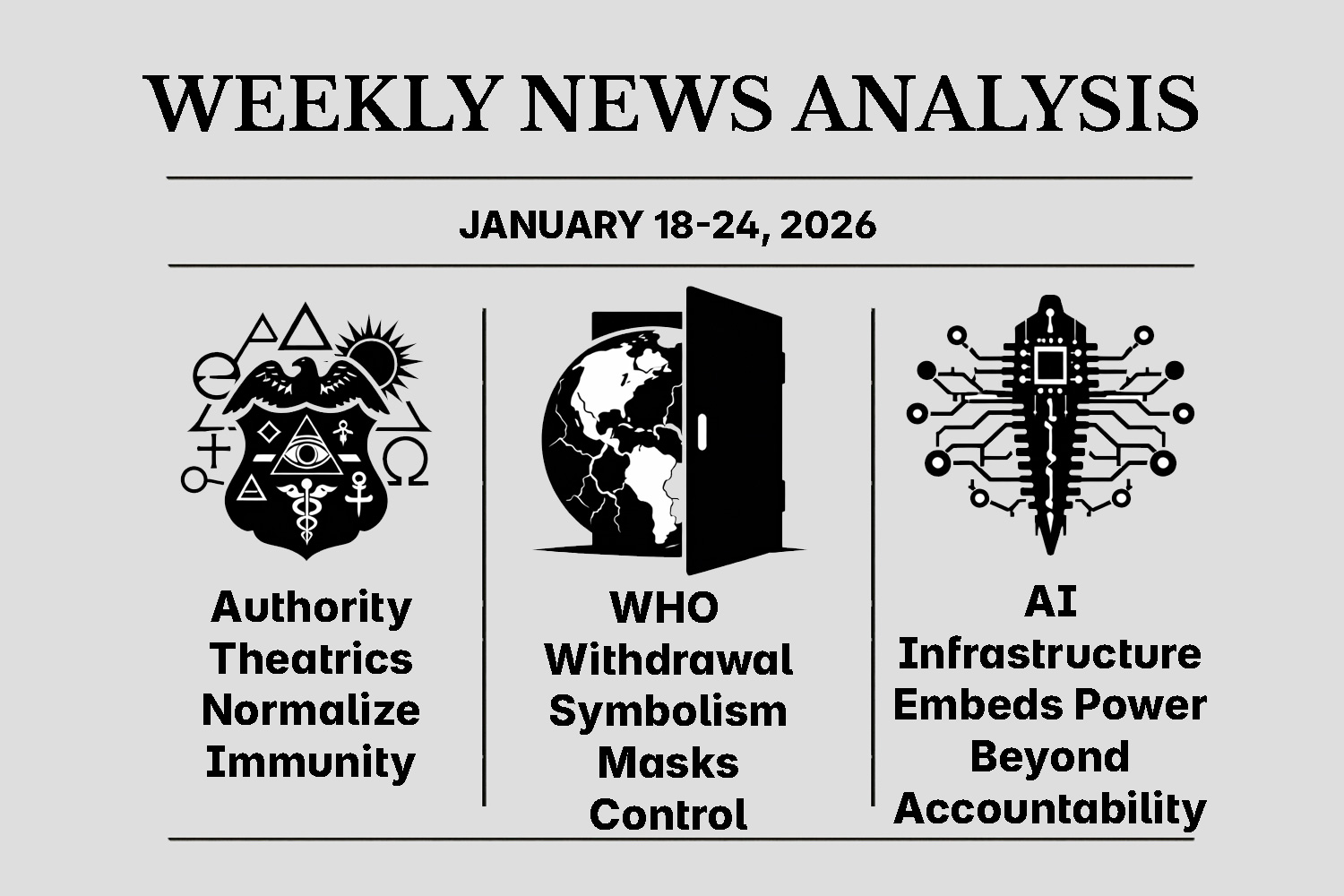
This week’s events reveal a core principle: legitimacy is first established through displays of authority and then maintained through narrative control. Whether it's an immigration enforcement interaction, a public health dispute with global organizations, or increased AI infrastructure spending, the goal isn't solely policy—it's perception management. The public is presented with emotionally charged binaries—law versus lawlessness, sovereignty versus globalism, innovation versus stagnation—to prevent deeper questions from gaining prominence. Who consolidates lasting power? Who sacrifices procedural protections? Which institutions quietly expand their discretionary authority while the public debates superficial symbols and slogans?
Across all three topics, the Trivium method sheds light on the underlying mechanism. Grammar is shaped through labels such as “threat,” “gunman,” “withdrawal,” “efficiency,” and “national priorities.” Logic becomes biased by selective criteria, like what qualifies as resistance, public safety, and independence. Rhetoric is used to evoke instinctive tribal loyalty, making the citizen’s main identity partisan rather than principled. The result is predictable: crisis theatrics garner support for stricter enforcement, increased data integration, and more centralized control—while the population remains caught in a continual debate over the moral framing of the story.
This lifecycle dynamic, also outlined in The Fallacious Belief in Government: Warp Speed Toward Tyranny, describes how an interventionist state can operate without requiring full consensus. Instead, it relies on compliance, exhaustion, and a divided opposition. This creates a cyclical pattern in which conflict intensifies, authority is justified, institutions strengthen, and each new “emergency” is embedded in the public consciousness. When people mistake the spectacle for the actual structure, they argue over superficial details, while the machinery of control learns the lesson: polarization is not merely a side effect; it is the very mechanism of control.
Badge Alchemy
Investigators cite videos in Minneapolis officer shooting - CNN
Alex Pretti identified in fatal shooting - Fox News
Bondi warning letter to Gov Walz - Conservative Brief
Minneapolis shooting and immigration enforcement fallout – BBC
Video challenges DHS narrative - The Free Thought Project
Another week and another citizen’s death at the hands of ICE. The core issue here isn't just what happened on the streets of Minneapolis, but also what institutions want the public to believe happened—because storytelling shapes operational capacity. When different perspectives, partial footage, and official summaries clash, power tends to favor the storyteller with authority—be it the badge, the podium, or the media. That’s why the debate quickly turns into semantics: threat versus observer and self-defense versus execution. This argument is made to be unresolved for most, as most lack full information, investigative patience, and trust in the same authorities. In this confusion, the institution’s main goal isn’t truth but engineered permission to move forward.
The wedge-driving technique is simple: each faction is provided with a moral shortcut that reinforces its identity. For security supporters, the shortcut is “he had a gun, so the state’s use of force is justified." This stance also shows that these individuals are anti-Second Amendment. For opponents of enforcement, it is “ICE agents are illegitimate, making every use of force a crime.” Both shortcuts avoid confronting the more complex issue: the policy framework that normalizes aggressive federal street operations while preventing transparent accountability, e.g., qualified immunity. When the public adopts either shortcut, the underlying structure remains unchanged. The debate stays interpersonal—citizens blame each other—while the state enhances tactics, increases authority, and sets new precedents.
The second-order manipulation pertains to the Right’s selective stance on the Second Amendment. Ideally, many view firearms as a sacred defense against tyranny; however, in reality, this principle is often secondary to institutional loyalty. When a citizen’s gun ownership leads to a moral judgment—such as “they shouldn’t have been there,” “they should have complied,” or “they brought it on themselves”—the core message is less about self-defense and more about deference. This suggests that citizens' rights are granted only when the state approves, with the state ultimately defining what “responsible” behavior entails. Consequently, rights become hollow by being redefined as provocations, punished accordingly, and justified as necessary for “public safety.”
The most significant aspect of this situation is the broader political spectacle of immigration enforcement, serving as a dramatized distraction. The visible clashes—agents, crowds, pepper spray, gunfire, outrage—generate a charged moral scene that overshadows systemic understanding. People are drawn into tribal narratives: one for loyalty to “law and order,” the other for outrage against “state violence,” with both sides taught to see the other as the real enemy. This is the intended divide. A population preoccupied with moral judgment is less likely to focus on the growth of the administrative state, the expanding surveillance infrastructure under “enforcement,” or the legal precedents being established through normalized exceptional measures.
The key point is the comparison: deportations and removals have occurred significantly across multiple administrations, even those praised as “more humane.” However, the chaotic imagery—the televised showdowns, street demonstrations, and performative escalations—is mainly linked to the Trump era branding. This difference is strategic. It helps one side see the crisis as uniquely tied to a single ruler, while the other sees it as justified by that ruler’s toughness. Both views are politically advantageous and help stabilize the system. If enforcement actions can be carried out by both parties, but only one side’s style sparks ongoing street drama, the public gets stuck in personality-driven politics rather than focusing on policy details.
This is why the conflict appears poised to escalate rather than reach a resolution. Escalation isn't just a possibility; it's embedded in the system's structure. Every flashpoint produces narratives that can be funded—more enforcement resources, increased media coverage, political donations, and justification for an emergency stance. The system doesn't need peace to succeed; it benefits from continuous scenes that keep the public’s anxiety high. Therefore, the danger of the conflict spreading to additional cities isn't an unintended risk but a likely outcome that certain actors may welcome. It fuels demands for crackdowns, data-sharing, and federal-local clashes, ultimately normalizing stronger central control.
Label it accurately: it’s not a true revolution but a flashy spectacle with a predetermined storyline shown across screens. The “plot” simplifies complex institutional issues into a morality tale about personal virtue—who merits sympathy, who deserves blame, and who “started it.” This transformation serves as political cleansing, turning the erosion of structural power into personal drama and then convincing the public they are involved through outrage. This process allows tyranny to grow subtly—without any major constitutional declaration—through countless small precedents, each justified by new emotional crises and supported by citizens conditioned to see compliance as wise.
Exit Door Illusion
U.S. formally exits WHO - Fox News
United States completes WHO withdrawal - HHS
U.S. officially withdraws from WHO - The Hill
California sticks with WHO as U.S. exits - The Hill
U.S. endorses $1.16B commitment - GAVI
The withdrawal from the WHO is portrayed as a moral reset: cutting ties with the global bureaucracy, restoring national sovereignty, and punishing the organization seen as overreaching during COVID-19. This narrative appeals to many on the Right because it presents a clear villain and a straightforward solution. However, the key issue isn't whether the WHO warrants criticism but whether withdrawing actually shifts the power structures that supported the COVID-19 response. If the same domestic agencies, funding pathways, pharmaceutical alliances, liability protections, emergency protocols, and propaganda strategies stay in place, then the 'exit' is more about branding than real structural change. Removing the logo doesn't necessarily decrease technocratic influence.
The issue of hypocrisy is unavoidable: the Right’s celebratory stance often ignores its own decisive actions during the same period it criticizes others. Operation Warp Speed isn't just a minor detail; it's a key example of how the state and pharmaceutical industries mobilized—through large funding, rapid development timelines, and widespread messaging that created public support. If our analysis of the situation is based on principles, accountability should focus on how the response was structured, not just on who delivered the message later. When accountability is unfairly assigned—like blaming Biden alone while exonerating Trump—the political narrative replaces ethical considerations. This leads to a predictable outcome: the public perceives “truth” as whatever maintains tribal loyalty, and institutions repeat these strategies under different administrations.
The deeper, ongoing influence is a blend of philanthropic and technocratic control that serves as a governance layer. During the COVID-19 pandemic, the public was conditioned to view certain private entities and foundations as unofficial authorities on reality—through funding channels, policy advice, media collaborations, and global narratives that blurred the distinction between private interests and public authority. The book COVID19 – Short Path to ‘You'll Own Nothing. And You'll Be Happy.’: Welcome to the new Age of Tyranny shows how fear can be deliberately manipulated via coordinated messaging, selective expert promotion, and policy language that narrows public debate into conformity. In this system, the WHO is just one part of a broader influence network capable of rerouting around obstacles. If a node becomes politically problematic, the whole network adjusts.
This explains why the GAVI funding is significant in the symbolic economy. If the public is told that “we escaped global health control,” but key vaccine alliance funding and partnerships continue or can be reestablished via alternative channels, it creates a sense of victory among the public, even as the operational system remains intact. The public-health governance model is adaptable: funding, procurement, standards, surveillance, and emergency-response protocols can be managed through different institutional frameworks. The framework that is politically advantageous today might be dropped tomorrow without altering the core ability to coordinate large-scale actions.
The “California sticks with WHO” narrative demonstrates the system’s preference for federated structures with a centralized result. Allow states and institutions to act independently; this creates the illusion of diversity while the managerial class maintains shared standards, data definitions, vendor networks, and compliance requirements across regions. Governance is achieved through interoperability rather than explicit orders. Debates over membership divert attention, while actual consolidation happens in metrics, digital health documentation standards, procurement agreements, and coordinated messaging. The debate—national withdrawal versus state alignment—keeps the public preoccupied, even as the underlying technocratic framework continues to develop.
The future risk isn't that the exact pandemic repeats itself, but that the pattern of moving from crisis to control repeats with better tools. The absence of the called-for Bird Flu pandemic in 2025 doesn't break the pattern; it may just be due to timing, preparedness, or strategic choice. If a bird flu or another high-fear threat arises, the main question remains: how quickly can authorities and institutions shift from deliberation to enforced compliance using emergency language, moral outsourcing “trust the experts,” and social coercion? The system doesn't need biological certainty to push political goals; it only needs plausible fear, aligned institutions, and a population ready to accept extraordinary measures as good.
In The Fallacious Belief in Government, the Tyranny phase of the lifecycle of government is characterized by the acceptance of “necessary” violations of natural rights—presented as temporary, targeted, and compassionate, yet often expanded over time. The WHO exit can act as a strategic distraction: it boosts partisan pride, upholds the myth that “our side is fixing it,” and lessens the demand for comprehensive institutional reform. Meanwhile, the next crisis can be pre-designed—introducing new surveillance standards, public-private health systems, data harmonization methods, and emergency powers. Everyone plays their role until the stage is fully prepared, since the stage is prioritized over the script.
Silicon Command Spine
U.S. semiconductor market timeline - Tech Crunch
Memory chip prices and 2026 outlook - Reuters
JPMorgan treats AI as core infrastructure - Artificial Intelligence News
AI cost efficiency and data sovereignty - Artificial Intelligence News
Gates Foundation and OpenAI in African healthcare - Artificial Intelligence News
Leidos and OpenAI for federal operations - NASDAQ
The timelines of semiconductors, rising memory prices, and the message of "AI as core infrastructure" are interconnected business narratives that reflect the physical supply chain of governance. Chips are not just consumer electronics—they form the essential substrate for surveillance, automation, predictive modeling, and administrative scaling, with scarcity control. When memory prices climb and supply chains become strained, the benefits primarily go to entities with capital, procurement advantages, and regulatory influence, such as large banks, defense contractors, cloud providers, and state-aligned integrators. In this context, “infrastructure" often signifies asymmetry—those who can afford extensive computation hold power over outcomes.
The rhetorical device involves presenting AI investment as neutral modernization—focused on efficiency, innovation, and competitiveness. JPMorgan’s framing of AI as infrastructure normalizes the idea that algorithmic systems are as fundamental as electricity—something you don’t vote on but simply accept. Infrastructure derives power because it is often taken for granted. Once integrated, it ceases to be openly debated and becomes an assumption. The public seldom discusses the moral aspects of “infrastructure” because the term suggests necessity. This is why institutions favor it: it turns controversial social decisions into unavoidable technical upgrades.
The concept of “data sovereignty” reveals something important because it openly admits what the public isn’t usually told: that data’s location, jurisdiction, and control determine who can demand access, oversee surveillance, and profit from it. This sovereignty language can be used genuinely to protect against reliance on foreign powers or as a marketing tool to justify consolidating power domestically. A country might “sovereignly” centralize data by forming partnerships between the government and private corporations that are even less transparent than each sector individually. While the public hears rhetoric of independence, the real outcome is an internal empire of interconnected identifiers, shared analytics, and automated systems for compliance.
The narrative of the Leidos–OpenAI federal partnership should be interpreted from an administrative perspective rather than a tech-news perspective. Saying “Transform federal operations” admits that the government is aiming for greater scale, speed, and automation of decisions. The key issue is: what limits are left when decision-making cycles accelerate beyond public understanding? Automation does not remove human judgment; it shifts it to areas such as model design, data choices, threshold setting, and institutional incentives. When an AI system signals “risk,” “fraud,” “threat,” or “noncompliance,” humans tend to defer to it because the system appears objective. This process gradually undermines procedural rights—not by outright banning them, but by making them impractical to enforce in the face of automated speed.
The importance of the semiconductor perspective lies in exposing the geopolitical and economic pressures behind the AI industry. If consumer electronics companies experience setbacks due to rising memory costs, these difficulties do not affect all players equally. More “strategic” sectors—such as defense, intelligence, finance, and federal modernization—continue to gain priority access. As a result, scarcity functions as a selection process. While the machine advances, the public bears the burden through higher prices and compromised alternatives. This burden is not just over rising prices for electronics and electricity, but also for water resources. Over time, this leads to a two-tier society: elite institutions with high computing power rule, while ordinary citizens adapt to lower capabilities and resources, slowly moving to owning nothing and being happy. This essentially resembles digital feudalism, even if the term isn't explicitly used.
The Gates Foundation and OpenAI’s exploration of AI in international healthcare repeats a familiar pattern: using philanthropy as a soft power tool to set standards. When new clinical workflows, triage protocols, and public health monitoring are framed as humanitarian efforts, they can subtly establish data standards, dependencies, and reliance on platforms. The moral appeal—supporting underserved communities—can mask underlying criticisms. Over time, this can lead to the development of governance models that are adopted domestically, including automated risk assessments, centralized record systems, and compliance prompts. Thus, 'global health' and 'AI infrastructure' increasingly intersect—not necessarily through WHO membership, but through interconnected ecosystems.
This is the point where the frameworks of the two books by Jeffrey Hann intersect: crisis and efficiency serve as the twin engines driving consent. COVID-19 showed how fear can restrict rights, while AI suggests that convenience can erode them. Tyranny grows by framing power as protection; similarly, the AI age advances by framing power as optimization. The public is told resisting is reckless: why oppose tools that “save time,” “save money,” or "save lives”? However, saving money can also mean denying services, suppressing dissent, limiting movement, or quietly reclassifying citizens into risk groups. Once the digital command infrastructure is in place, politics becomes a consequence of computation.
Quiet Convergence
Throughout the week, the common thread is that institutions no longer need to persuade the entire public; they only need to influence perceptions enough to keep opposition divided. Street conflicts over immigration enforcement stir anger and encourage identity sorting. The WHO's withdrawal leads to triumphal distraction and selective forgetfulness about previous cooperation. Building AI infrastructure quietly strengthens the administrative foundation, which will endure beyond any election cycle. The public faces three separate crises, while the system undergoes one ongoing upgrade—gaining more discretionary power, increasing narrative influence, and expanding computational capacity to manage society at scale.
The path is straightforward: crises lead to emergency policies, which set precedents and establish lasting capabilities. Whether the crisis is viewed as border disorder, a global health crisis, or economic rivalry, the policy momentum follows the same pattern. The key question isn't which narrative “wins” right now, but which practices become routine next month: federal and local tensions becoming normal, public-health governance using interchangeable units, and algorithmic management becoming unquestioned infrastructure. This process gradually embeds technocracy into culture—legally, rhetorically, and subtly—and then suddenly when the next crisis hits.
In discussions of natural rights, there's a danger that citizens focus on debating permission, while system engineers push forward inevitability. The state doesn't have to declare tyranny outright; it simply expands what is considered a "reasonable” exception until rights are seen more as slogans than protections. When the public is conditioned to view every conflict as a partisan performance, resisting the underlying system becomes harder. That's why new distractions keep appearing: not to educate the public, but to control it.
Listen to this week's news in verse for a quick recap!