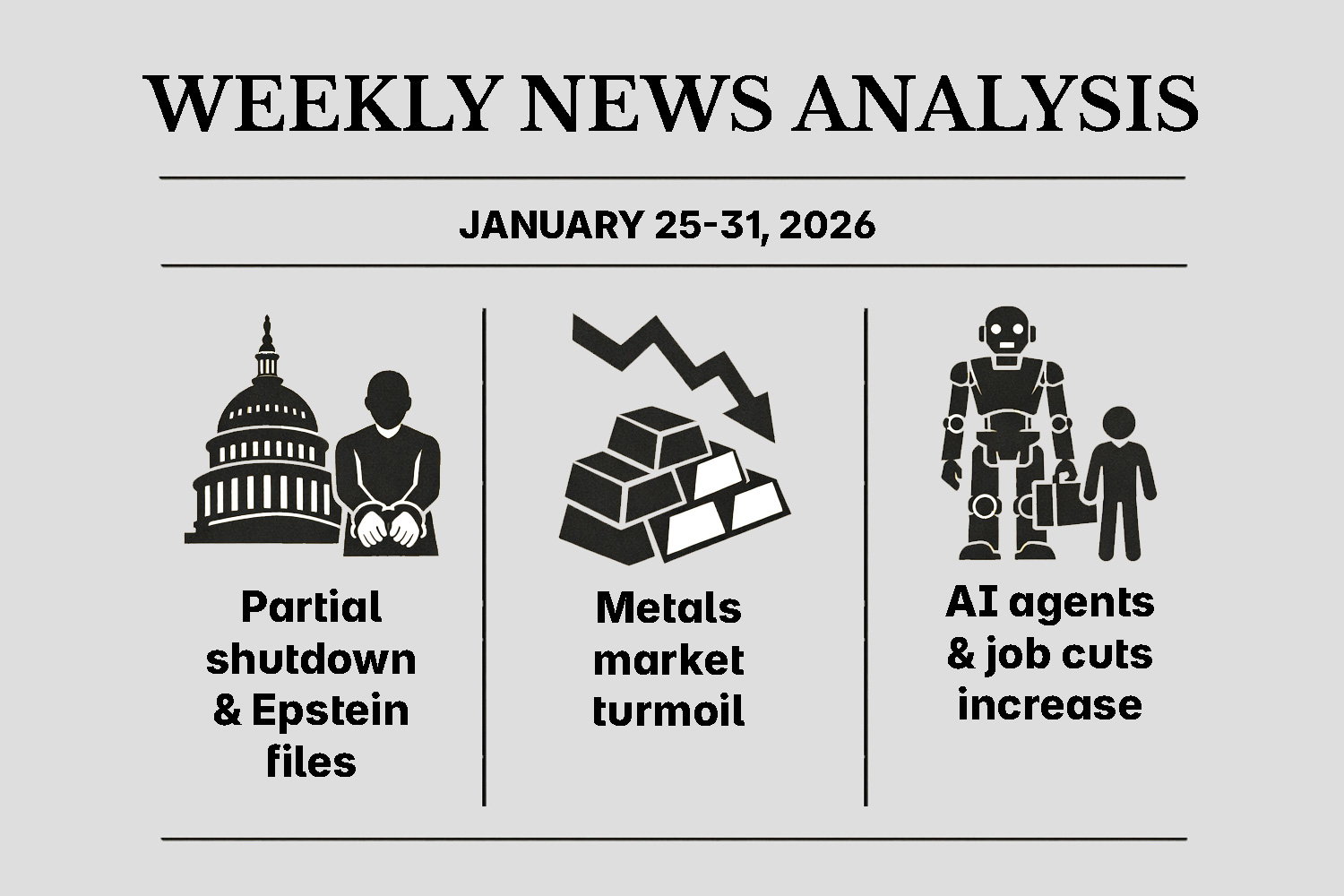
This week, the situation resembles systems engineering more than politics: a deliberate clash of budget issues, scandal revelations, and economic fluctuations, arranged so the public perceives each as a separate story rather than a unified power movement. The public narrative claims these events are unconnected: Congress stumbles into a partial shutdown, the Justice Department releases more Epstein documents, and markets react to instability in precious metals as AI investments grow and layoffs increase. However, the true operational dynamic shows that institutions depend on compartmentalization. When people have to respond to three crises simultaneously, their attention becomes a limited resource—and such scarcity makes it easier to capture, redirect, and profit from.
The Trivium method sheds light on how these mechanisms work. In Grammar, words like “shutdown,” “funding lapse,” “transparency,” “release,” “efficiency,” “restructuring,” “investment,” and “innovation” act as euphemisms, subtly shaping consent by suggesting inevitability and professionalism. In Logic, the public faces false dilemmas: either accept funding conditions or own the shutdown; trust a curated Epstein release or be accused of bailing out predators; or endorse AI “growth” or be labeled anti-progress. In Rhetoric, the week exploits moral appeals—focusing on immigration enforcement, child abuse, financial fears, and job loss—to keep citizens emotionally engaged while institutions strengthen their control.
This familiar lifecycle continues: crisis is not just endured; it is managed and transformed into legitimacy, funding, surveillance, and compliance. The COVID-19 period demonstrated how rapidly emergency language shifts into governance language. This week further illustrates that pattern: the public is presented with a timed spectacle (a shutdown plus a scandal) while the underlying control infrastructure (AI tools, corporate restructuring, and data consolidation) progresses in the background.
Scandal And Shutdown Sync
Government shuts down again after Democrats revolt over DHS funding - Fox News
US government partially shuts down - Fox News
Epstein files Trump DOJ release live updates - NBC News
Steve Tisch Epstein files NY Giants – New York Times
Trump is named in the latest batch of the Epstein Files - Miami Herald
Musk busted pleading to visit pedo island – The Daily Beast
Trump DOJ releases new cache of Jeffrey Epstein files - Reuters
The narratives of the shutdown and Epstein release are portrayed as separate, with one focusing on governing and the other on accountability. This distinction is misleading. When a partial shutdown threat depends on DHS funding and congressional brinkmanship, it naturally creates a loud story: deadlines, votes, blame, and political showmanship. At the same time, a large amount of Epstein-related data is made public, along with talking points about redactions, victim protections, and data completeness. Reuters calls this release a massive cache—millions of pages, videos, and images—and points out it mentions high-profile individuals, though it is criticized as incomplete and heavily redacted. The public is expected to track both stories, but in reality, that often means following neither clearly. The system doesn’t want you well-informed; it prefers to keep you fragmented.
Timing is crucial because attention functions as the currency of governance. When a shutdown is at stake, partisan instincts sharpen: citizens tend to defend their team and repeat familiar narratives about who “caused” the problem. In this climate, the Epstein release shifts from a moral issue to a political tool—something used to attack opponents or boost credibility (“look, we released files”) without fully clarifying the facts. Democrats see the release as incomplete and heavily redacted, and discuss the internal review process and political pressures involved. Republicans are divided between always and forever Trump supporters and those who struggle to support those named in the Epstein files. The key trick is turning transparency into a brand rather than a genuine act. A staged disclosure can act as a reputational shield: releasing enough information to make headlines but not enough to resolve questions or ensure justice.
The new data and names indicate possible signs of manipulation. Key figures include well-known individuals associated with Epstein’s network, such as Bill Gates, Elon Musk, Steve Tisch (co-owner of the New York Giants), Howard Lutnick (Commerce Secretary), Kevin Warsh (Trump’s 2026 nominee for Federal Reserve Chair), and Brett Ratner (Director of the 2026 Melania Trump documentary), all of whom interacted with Epstein and attended his parties. AP’s report highlights that the documents contain communications and references involving notable people and criticizes how survivors’ interests might be compromised, even under the guise of transparency. The public often perceives being “named in files” as either complete exoneration or undeniable guilt, which is a false dichotomy. A more nuanced understanding recognizes that the files reveal social proximity—close access points where influence and protection schemes operate. Nonetheless, given how much the government and those in power have shielded these individuals, condemning them all might be justified, considering the numerous violations against children they are accused of and or convicted of.
Musk’s role in this cycle serves as a prime example of rhetorical opportunism. Reuters states that the newly released documents reveal Musk declined an island invitation but inquired about parties with Epstein. The Daily Beast takes a more confrontational stance, highlighting emails that seem to discuss arranging a visit by Musk. Whether or not the visit happened, the key issue is the association and intent: trying to connect with a known convicted pedophile is not “edgy networking" but a sign of elite immunity culture. When Musk earlier supported claims that Trump appeared in the files, during their staged fighting in 2025, he became part of the release narrative, illustrating the elite pattern: scandals are selectively weaponized until they become inconvenient.
This is where Journalistic Revolution’s long-standing idea about scripted conflict becomes relevant. The public is repeatedly shown elite disputes as if they are genuine—Trump vs. Musk, parties against each other, agencies in conflict—yet the results always lead to the same structural outcome: increased government discretion, greater protection for the wealthy networks, and a rotating lineup of outsiders who always come out ahead. Reuters’ description of the release highlights how political rulers can promise transparency and then manage disclosures through redaction and selective presentation.
The Kevin Warsh element heightens concerns about institutional decay by linking monetary influence to a social circle that is fond of children. Warsh appears in the recently released Epstein materials in connection with invitations and social lists, drawing criticism of Trump’s pick for Fed chair. Even without accusing him of criminal acts, the optics are significant: central banking already faces a legitimacy crisis among citizens who view monetary policy as protected by elites. When social ties to Epstein’s world are considered, the public may adopt two cynical views—either everyone is compromised, or nothing matters. Both perspectives benefit power by discouraging targeted reforms and efforts to reduce elite impunity.
Under the surface, the pairing of shutdown threats and scandals isn't accidental; it follows a predictable crisis cycle. Threats of shutdown act as regular stress tests, making disruption seem normal, while scandal disclosures function as pressure valves, releasing public anger without changing the core protections for elites. The public perceives these events as signs of instability, but the system views them as opportunities. As citizens become conditioned to take sides in a rigged contest, they become less inclined to challenge the very arena.
Metal Spike Paper Crash
Gold and silver keep hitting record high but the market may be broken - CNBC
Gold and silver prices plunge from record highs - Investopedia
Gold slips on firmer dollar set best month since 1980 - Reuters
Gold silver $5.9T flash crash forced liquidation event - AInvest
Dollar collapse warning and gold silver surge - Forbes
This week saw historic price fluctuations in the gold and silver markets. The surge and sudden fall of gold and silver are not just market fluctuations; they challenge the very concept of measurement. CNBC’s suggestion that the market “may be broken” hints at a hidden truth: the paper-based fiat price discovery system often acts more like a liquidity spectacle than a true reflection of supply and demand. When prices rise sharply, it is seen as a sign of inflation fears and mistrust of the currency. When they fall quickly, it’s usually dismissed as profit-taking or as a technical factor. While Investopedia highlights the implications for investors—volatility, positioning, and fund strategies—the real issue is that volatility is a feature, not a flaw, of late-stage fiat currencies. It serves as a governance mechanism that punishes the unprepared and benefits those with leverage, speed, and privileged access.
Reuters' perspective is notably prominent: gold’s strongest monthly gain since 1980 is more than just a typical statistic—it’s a warning sign. Comparing current events to that period subtly suggests that we are entering an era where currency trust needs careful management rather than being taken for granted. With national debt nearing $40 trillion and the system responding with a mix of fiscal improvisation and reassurance, the metals' surge acts as a stark indicator: confidence is waning. Even as Reuters notes gold's decline due to a stronger dollar, the overall message remains that this month’s movement is historically significant. A collapse is coming.
A large-scale forced liquidation event, or a “flash crash,” has widespread impacts on leveraged positions. Although opinions may differ on its exact scale, the process is well understood: leverage tends to grow during upward trends, and margin calls accelerate the downturn, leading to the chaos observers see. Yet, forced liquidation isn’t just disorder—it’s a system-mandated discipline aimed at those with insufficient collateral. This reflects modern finance's approach to hierarchy, enforced not only by laws but also through liquidation calculations. As a result, the public looks for "safe havens," but is often reminded that even these can be sharply revalued—especially when most exposure is paper-based rather than physical.
This is where collapse-prep economics becomes more tangible than politics. As the dollar nears a confidence crisis, survival shifts from an ideological to an inventory concern. Precious metals act as a way to store labor—an exit from digital, permissioned systems. The week’s activity also indicates a split in the metals trade: paper instruments, influenced by liquidity events, versus physical metals, which function more like insurance than mere ticker symbols. The system prefers you to operate on paper because it is controllable—can be halted, taxed, tracked, rehypothecated, and margin called. In contrast, physical metals are harder to control, which is why they are often dismissed as “doomerism’—despite being more pragmatic in crisis.
Real estate debt highlights the disconnect between nominal agreements and actual conditions. In environments with high inflation, fixed-rate mortgages may seem to decrease in real value—yet this illusion can vanish if cash flows falter, taxes increase sharply, insurance costs soar, or employment drops. The real concern isn’t whether inflation will wipe out mortgages but whether someone can maintain payments as the broader cost environment becomes unpredictable. When confidence wanes and metal prices surge, land and shelter serve as reliable hedges: tangible assets fulfilling essential needs. However, their durability depends on proper maintenance—necessities such as tools, spare parts, fuel, water, and plans for handling disruptions. Monetary collapse rarely occurs suddenly; instead, it involves a gradual erosion of stability followed by a “sudden” collapse.
Food and water are fundamental to political economy, not just 'prepper tropes.' A partial collapse occurs when shelves are still stocked, but prices are high, and availability is inconsistent; a complete collapse occurs when distribution systems fail entirely. In both cases, the government tends to impose rationing—either openly or subtly—and increases enforcement measures. That’s why a focus on weapons and ammo goes beyond fears of conflict; it’s about deterrence in a landscape where institutions can fail selectively. While the system can’t or won’t secure your supply chain or safety, it can still enforce compliance. As the dollar weakens, the power of coercion grows, because when credibility drops, coercion is what’s left.
Finally, the metals narrative for the week ties back to the lifecycle-of-government framework: late-stage systems shift costs onto citizens while shielding core institutions. During stable times, the public is informed that money is neutral and markets are rational. During periods of volatility, people are told that volatility is normal, and they continue to trust the same managers who profit from it. The metals’ spike-and-crash exemplifies this: the dollar’s movement is more than just an economic issue—it reflects a social contract imposed on citizens. When a social contract becomes uncertain, survival depends less on maximizing returns and more on preserving autonomy. This distinction is key: it determines whether entities weather partial collapse or are overwhelmed by full collapse.
Agents Replace The Workforce
Deloitte agentic AI guidelines published - Artifical Intelligence News
China hyperscalers agentic AI commerce battleground - Artificial Intelligence News
Universal basic income used to cover AI job losses - The Guardian
Amazon reportedly in talks to invest $50B in OpenAI - Tech Crunch
Amazon cuts 16,000 jobs globally broader restructuring - Reuters
This week’s AI narrative unfolds through two perspectives: an optimistic macro view and a detailed micro perspective. The macro view—represented by government and industry forecasts—frames AI as an inevitable force, likening it to the Industrial Revolution while predicting gains in GDP and productivity. In contrast, the micro perspective—coming from consultancies and corporate communication—centers on guidelines, governance, and responsible deployment, especially for agentic systems capable of acting independently rather than merely generating text. These perspectives aren’t in conflict; they complement each other. One fosters public acceptance by asserting that progress is inevitable, while the other builds compliance by establishing rules for living within that progress. Together, they create an environment where opposition seems irrational and oversight appears already managed.
Now consider the reality of labor. Reuters reports that Amazon has confirmed 16,000 corporate job cuts, framing this as part of a bureaucracy-reduction and efficiency effort, and explicitly linking the broader trend of restructuring to AI’s influence on workforce dynamics. This illustrates the actual outcome of the rhetoric: “AI growth” is not evenly spread; it consolidates power at the top while reducing middle-class labor. This is achieved through language that remains polished—terms like restructuring, layers, ownership, and adjustments. The phrasing is designed to obscure moral responsibility. People aren’t laid off; organizations optimize. Communities don’t break apart; the market adapts.
The Guardian’s framing of universal basic income (UBI) introduces a political safety valve: if jobs are lost, the system suggests income smoothing, retraining efforts, and social policy supports—presented as compassionate updates. However, the core issue is what UBI grants the ruling class: time, compliance, and less opposition during the changeover. When livelihoods are threatened, people tend to become more manageable, especially when their survival relies on digital payment systems. While UBI can be marketed as a form of freedom, in practice, it will act like a leash when combined with surveillance, strict eligibility criteria, and behavioral controls. The point isn’t that UBI is inherently malicious; rather, on a technocratic path, support often comes with additional conditions and increased data collection.
The investment and consolidation perspective reveals the long-term architecture. TechCrunch reports that Amazon is negotiating a $50 billion investment in OpenAI. Regardless of the specifics of the deal, the message is clear: massive capital is flowing into centralized AI infrastructure in a way that exceeds public awareness. When such vast sums support AI platforms, it’s more than garage innovation; it’s empire-scale infrastructure. Entities that reduce labor on a large scale can also buy the tools that replace those jobs. This is not a contradiction but the core business model. Once these tools are integrated into commerce, logistics, security, and communication, the questions of who governs and who owns the stack become fundamentally linked.
Agentic AI guidance functions as the new regime's soft law. Deloitte-style governance models treat autonomous systems as something to be managed through policy layers such as risk scoring, human-in-the-loop checkpoints, and audit logs. This appears reassuring until you see that these systems can also apply to people: risk scoring shifts to eligibility assessment; audit logs become surveillance data; and “safety” transforms into permissioning. In the post-COVID technocratic shift, crisis-driven adoption leads to dependence, which in turn facilitates mandates. Agentic systems don’t just automate tasks—they redefine what actions are acceptable, as platforms determine which actions agents are permitted to take.
From a global perspective, focusing on China's hyperscalers and commercial competition highlights that the AI shift is also a battle over sovereignty, though politicians seldom acknowledge this. Countries emphasize national competitiveness, but the real competition centers on the core infrastructure of digital life: payments, identity, commerce, content sharing, and workplace tools. Control over these essential systems allows nations to set rules that appear as “platform policies” but effectively serve as a form of governance. Once again, the public is encouraged to engage in superficial tribalism—US versus China, left versus right—while a more profound integration quietly progresses: both sides increasing data collection, automation, and centralized oversight under different banners.
In the week’s other discussions, AI serves as a backup to institutional authority during fiscal and political turmoil. When legitimacy is challenged through shutdown theatrics and scandal cycles, systems don’t withdraw; they move online. AI agents are seen as a means to cut costs, speed up enforcement, target propaganda more efficiently, and predict dissent. Executives openly associate AI tools with workforce reductions and company transformation. This is the key point: AI isn't just about increasing productivity; it’s about reallocating power—shifting authority from individual workers to larger institutions.
The final form resembles algorithmic governance—akin to digital feudalism with polished branding. Citizens act as tenants of platforms, earning revenue through systems they don’t own, assessed by unseen metrics, and disciplined by policies that can shift suddenly. The term “growth” masks the underlying dependency. When the public is distracted by scandal timing or blame-shifting during shutdowns, core infrastructure projects progress with little opposition. This is why this issue should not be dismissed as mere tech news. It represents the administrative backbone of the upcoming control era, evolving in real time while the public engages in spectacle and debate. The foundational structure of this new Age of Tyranny.
Empire Of Managed Chaos
This week’s pattern is coherence hidden within chaos. A shutdown conflict dominates attention with procedural drama, while a scandal release focuses attention on moral outrage and celebrity connections. A surge and crash in metal prices drives concern about financial and AI investments, while layoffs highlight fears about the future and personal insecurity. The system thrives on this simultaneity because it hampers sustained inquiry. Each story acts like a shot fired at the same target: autonomous judgment. When judgment is weakened, compliance becomes easier, often through narrative fatigue rather than direct force.
The core insight is that contemporary power increasingly depends on managing instability as a governing strategy. While stability is rooted in legitimacy, instability can stand in for legitimacy when labeled as an emergency. The COVID-19 pandemic highlighted this: fear shortens the perception of time, and, in turn, compresses it. Today’s situation demonstrates this same mechanism in different forms. Transparency often manifests as carefully controlled information releases. Funding acts as a lever of control. Markets function as discipline tools through liquidation processes. Innovation automates both livelihoods and governance, making them more efficient.
In such an environment, what endures is not partisan loyalty but readiness and principles. Readiness includes tangible resources—food, water, shelter, practical skills, stable value stores, and defensive measures. Principles are philosophical—rejecting the outsourcing of moral judgment to institutions that often have conflicting interests. When the government's cycle reaches its Tyranny phase, its first tactic is not necessarily overt violence but narrative control and fostering dependency. The counterstrategy involves decentralizing needs and independent thinking. Therefore, it’s not just three separate stories; it’s one core message: the system is tightening its hold, and it prefers that you stay distracted while it consolidates power.
Listen to this week's news in verse for a quick recap!