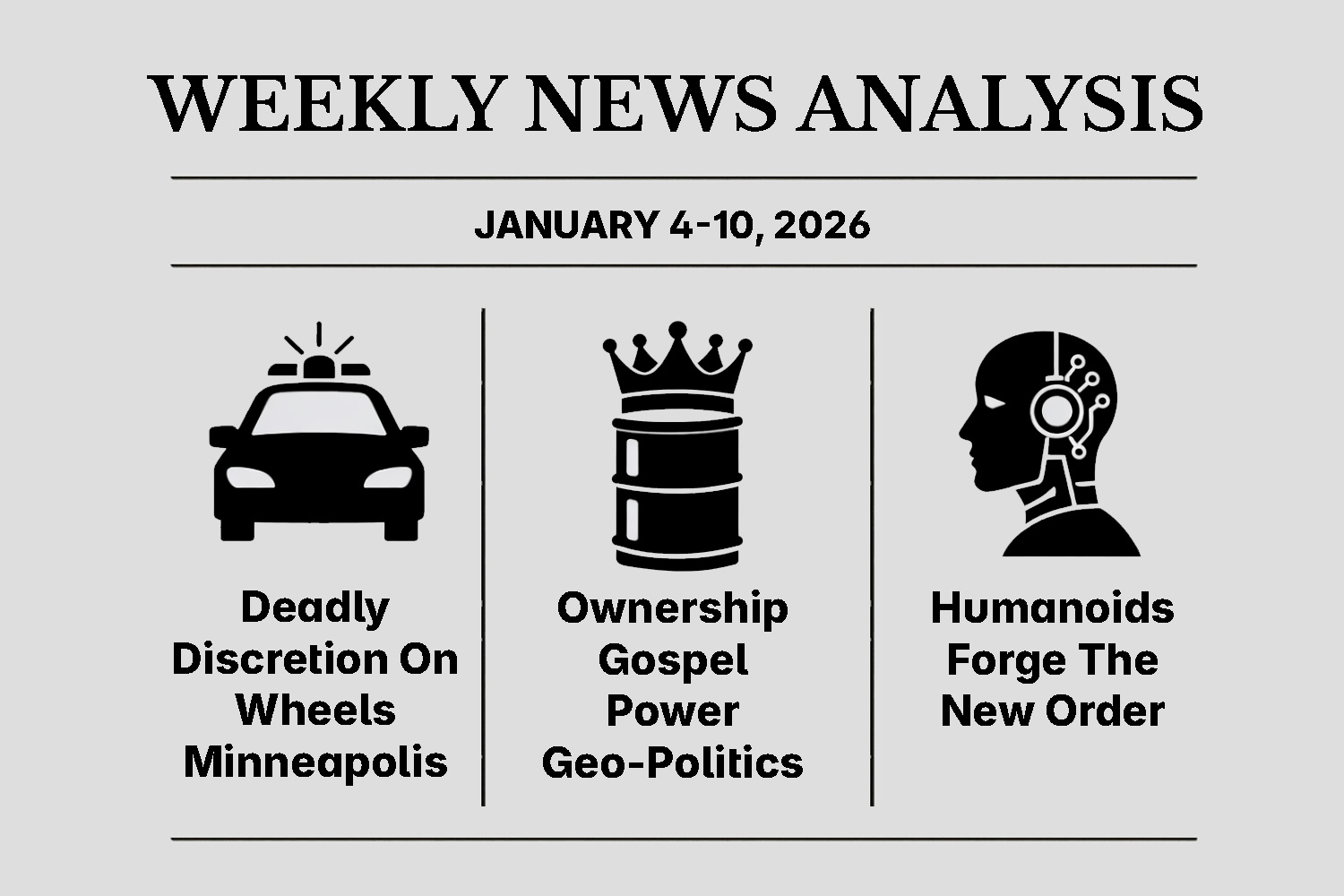
This week’s pattern isn't about immigration, oil, and robots as separate headlines. Instead, it reveals a recurring governance template: a public crisis prompts moral urgency, which in turn normalizes extraordinary measures. Over time, these measures become part of the built infrastructure. Although the rhetoric often focuses on safety, prosperity, or innovation, the real driver is discretion—determining who can stop whom, seize assets, or automate decisions.
In all three topics, a manipulative tactic is consistent: the state and its media allies present a single emotionally charged frame to the public, then rely on trust in institutional judgment. In Topic 1, the frame is “law enforcement under threat.” In Topic 2, emphasis is placed on “national strength and ownership.” In Topic 3, it centers on "progress and competitiveness.” The underlying assumption is that the public must accept increased administrative power—over bodies, borders, capital, and computation—because rejecting it could lead to "chaos” and “death.”
Applying the Trivium (grammar → logic → rhetoric) frames the week as a debate over definitions: what “threat” signifies, what “ownership” includes, and what “smart” suggests. Once these definitions are established, convincing others of subsequent conclusions becomes simpler. As the system becomes more technocratic, it increasingly relies on uncontestable “expert” judgment—used to justify crises, consolidate power, diffuse accountability, and shape a public conditioned to equate authority with legitimacy.
Deadly Discretion On Wheels
Video of Minneapolis shooting filed by ICE agent - BBC
Minneapolis ICE shooting live updates - Fox News
Trump response to Minneapolis ICE shooting - New York Times
Justice Manual Use of Force policy – Department of Justice
The first point we should discuss is the legal framework governing immigration enforcement actions. 8 U.S.C. §1357 is not a broad police authority; it specifies targeted warrantless powers related to immigration, such as interrogating or arresting aliens without warrants under certain conditions, limited border searches, and some arrest powers for federal offenses committed in view or for felonies under federal law. The statute consistently centers on the term “alien,” not “any person,” and links several powers to reasonable belief, immediacy, and risk of escape. When public rhetoric blurs this structure—stating, for example, that “ICE can do what cops do”—it subtly encourages acceptance of a broader, discretionary police authority beyond the law’s original scope. This is a significant distinction, not just a semantic issue, between a confined administrative role and a general domestic enforcement power.
Another important point is that DOJ policy, even when not directly creating enforceable rights, publicly outlines institutional standards—specifically, it bans shooting at moving vehicles. According to the DOJ Justice Manual 1-16.200, deadly force is only justified when necessary, such as when there is a reasonable belief of imminent death or serious injury. It also emphasizes two critical restrictions: firearms cannot be used solely to disable a moving vehicle, and firing at a vehicle is only allowed if (1) the occupant poses a deadly threat through means other than the vehicle, or (2) the vehicle’s operation itself threatens death or serious harm and there are no other reasonable options, like moving out of the way. In simple terms: “Avoid placing yourself in front of a car; if you can move aside, do so.” This is significant because it challenges the common argument—“the car was a weapon”—by framing it instead as a question of officer safety and the possibility of avoiding danger.
This brings us to Barnes v. Felix (2025), in which the Supreme Court unanimously rejected the “moment of threat” doctrine, which limits review to the specific moment an officer claims to fear. The Court ruled that excessive-force evaluations under the Fourth Amendment must consider all relevant circumstances, including events leading up to the critical moment, and cautioned against “chronological blinders.” The case details are instructive: an officer shot a driver during a traffic stop as the driver started to move; the Fifth Circuit emphasized the “two seconds” of perceived danger, but the Supreme Court clarified that the investigation cannot be artificially limited in that way. This is directly relevant because if an officer places himself in harm’s way when other options are available, courts cannot ignore the preceding behavior just because the final moment appears threatening. The concept of “threat” can no longer be used to dismiss causation logic.
The Minneapolis shooting, as covered publicly, serves as a real-time test of whether institutions will adhere to their stated standards or fall back on the old “moment” narrative. Reports and video describe a confrontation similar to a traffic stop, with a driver trying to leave, shots fired, and public outrage leading to protests. Major media accounts identify the driver as a U.S. citizen and narrate a sequence where she attempted to depart and was then shot. Cell phone video from the ICE agent shows her smiling and saying “That’s fine, dude. I’m not mad at you” at the agent shortly before force was used, and that “fucking bitch” was uttered after the shooting by the agent —a detail that should influence legal analysis by addressing escalation speed, mental state, and perceived necessity. Currently, these detailed claims should be scrutinized closely: they rely on official videos, statements, and inferences by partisan actors seeking to shape the narrative.
The key point —regardless of partisan perspective—is the question of legal authority to initially detain a U.S. citizen. ICE officers often cite immigration-related powers, but when the individual is a citizen not suspected of an immigration violation, the legal basis must be grounded in other lawful reasons, such as a federal offense observed directly or another recognized justification. If the cause was not an immigration violation and the citizen was not committing an arrestable federal offense, the enforcement amounts to an unlawful seizure under the Fourth Amendment—particularly if physical force is used to remove someone from a vehicle. This means she had the legal right to drive away from their unlawful attempt to stop her. The claim that “she should have complied” is a political mantra, not a legal rule. The Constitution grants authority to the government and its agents by law, not vague feelings.
The “in-front-of-the-vehicle” claim is crucial because it relates to preventability and necessity—key points highlighted by DOJ policy and the Barnes v. Felix (2025) case. If an officer had enough space to move away but chose to stay in the vehicle’s path, or leaned to the left to remain in front of the driver for a clear shot, the threat might have been largely caused by the officer. Additionally, if shots were fired after the vehicle had already passed the officer, the justification of “imminent danger to the officer" becomes weaker, shifting the focus from defensive needs to potentially punitive or retaliatory actions. This type of evidence—showing the sequence of events before and after—is exactly what Barnes v. Felix (2025) emphasizes cannot be excluded. This is also why the timing of video releases is important: delays can lead to narrative manipulation, undermining the account's legitimacy.
Both political groups (Left and Right) often have hypocritical views by flipping their stated values depending on which agency or administration is involved. The Right that denounces “tyranny” may justify lethal force as border enforcement; the Left that opposes police violence might defend expanding agencies when framed as protecting vulnerable groups or maintaining “order.” This allows power to persist beyond electoral changes: moral language shifts, but the institutions stay the same.
Ownership Gospel Power Politics
Trump and Venezuela oil executives - New York Times
What oil executives told Trump about Venezuela - CNBC
Trump order protecting Venezuela oil revenue - Fox News
Trump and international law - The Guardian
Trump says US needs to ‘own’ Greenland - BBC
Trump calls for 10% cap on credit card interest - Reuters
This topic extends beyond Venezuela alone to a broader worldview: politics as a means of acquisition, sovereignty as negotiable, and law as a rhetorical tool. The Guardian reports that Trump views his constraints as personally grounded in "morality” and “my own mind”—and regards international law as optional or dependent on interpretation. He emphasizes "ownership” as psychologically essential for success. Simultaneously, the report connects this attitude to active interest in Greenland and to justification narratives about Venezuela that rely on threat claims, such as gangs and drugs, serving as moral cover for coercive policies. This exemplifies the typical "security-washing” of resource strategy: instead of saying “we want leverage," they claim “we must protect the homeland," framing foreign assets as instruments to bolster domestic political legitimacy.
Trump is a National Socialist, which is what the Nazis were, and we know how that ended. Historically, National Socialism is a specific ideology and should not be conflated with vague notions of “small government.” Nonetheless, the pattern of Trump remains analytically significant: a nationalist authoritarian regime prioritizing control over markets, borders, and strategic resources, while demanding public obedience under the guise of national revival. The key question isn't whether these labels align with a 1930s model; it’s whether the actual tactics—state-led economic restrictions, an assertive territorial stance, cycles of vilification, and personalized law—are moving toward a similar fundamental outcome: governance by discretionary authority instead of by stable, rights-based principles.
The Reuters article about a proposed one-year, 10% cap on credit card interest highlights how “populist mercy” can serve as a form of control. Trump’s statement, as reported, lacked details on implementation and implicitly conflicted with the realities of credit underwriting, risk pricing, and congressional authority. Reuters points out that analysts previously dismissed the pledge as needing congressional approval, noting bipartisan interest but no clear legislative plan. Industry warnings also indicate that caps can reduce credit access. The adverse effects are real: when price ceilings fall below risk-adjusted costs, lenders ration credit, shift costs to fees, tighten approvals, or exit segments, often affecting lower-income borrowers first. The public is sold 'relief,' but the system results in 'rationing,' which then justifies further intervention. This cycle—crisis, intervention, distortion, new crisis—drives the governance flywheel.
The Venezuela aspect, as seen in mainstream coverage, also hides a deeper idea: foreign ownership is equated with domestic stability. When executives talk about investing in Venezuela, they cite barriers such as sanctions, legal uncertainties, a history of expropriation, and political upheaval. The political solution often involves executive authority—such as issuing orders, controlling assets, and setting up "protective” mechanisms in U.S. accounts—allowing private capital to operate with government support. This isn't free-market capitalism; it's a socialist corporatist alliance where profit relies on state-backed risk management. Although termed “national interest," it effectively creates a state-controlled investment environment reinforced by geopolitics.
The Greenland thread is just as revealing because it normalizes the language of acquisition in a post-colonial context. Even without tanks, the idea of “ownership” redefines sovereignty as a transaction and treaties as leasing deals that could be replaced by purchase-like dominance. The public is conditioned to accept this shift by changing the moral language: it is not about conquest but about security, shipping lanes, rare earths, and strategic posture. Once people accept this logic internationally, it becomes easier to adopt it domestically: if the state can override distant sovereignty for “the greater good,” why can't it also override local autonomy, property rights, or bodily freedom under the same reasoning?
Documented reports over the years reveal that Epstein built connections across finance, politics, and celebrity circles; institutional failures allowed his abuses to continue. This history supports a broad critique of elite protection systems, suggesting that the government is “run” by criminals. The important point is this: when public trust erodes due to visible impunity, rulers may use cynicism to increase their power. People often think “all sides are corrupt,” and therefore accept strongman rule as a form of cleansing—only to find out that such rule is just corruption with fewer procedural constraints.
Public schools condition the public to suppress critical thought while rewarding blind obedience to authority. This promotes viewing legitimacy as a matter of institutional faith rather than as a set of defining limits on power. When citizens are taught that “law” is simply what authorized officials do, they may support coercion that harms their own interests if it is executed by the “right” officials against the “right” villains. This tendency can enable proposals for economic control, the pursuit of foreign resources, and legal exceptionalism to be framed as patriotic reforms instead of consolidations of centralized discretionary power.
Humanoids Forge The New Order
Robotics collaboration with Microsoft - Hexagon
Bosch AI investment - Artificial Intelligence News
French armed forces ministry awards Mistral AI framework agreement - Reuters
Domain-centric path for smarter systems - U.S. Navy
The public is encouraged to see humanoid robots and defense AI as neutral tools—focused on efficiency, labor support, and safety. However, the underlying issue is institutional: questions about who owns, trains, and audits these models, and bears responsibility when automated perception leads to automated coercion. Defense-oriented “domain-centric” architectures aim to integrate sensing, targeting, and decision support into a unified operational view. Once this approach is adopted, it tends to spread inward. The same pattern appears in domestic governance: risk assessments, predictive compliance, automated alerts, and eventually, automated enforcement mechanisms.
The Reuters report about the French armed forces ministry signing a framework agreement with Mistral AI highlights a key trend this week: sovereign nations are formalizing AI supply chains as part of their defense infrastructure. These agreements go beyond pilots; they serve as foundational procurement frameworks that enable ongoing capability growth. Today, it might be for “analysis,” but it could tomorrow support “operational decision advantage,” and eventually lead to embedded autonomous systems. As this practice becomes standard, the idea of “national competitiveness” is increasingly used to justify reduced transparency and greater secrecy. The public is told that secrecy is necessary to stay ahead of rivals, and dissent is often portrayed as a threat to national security.
The Navy’s use of “domain-centric path” functions as a rhetorical euphemism: it resembles architecture but actually signifies a worldview where the environment is perceived as understandable, computable, and thus controllable. The phrase “smarter systems” is persuasive but conceals a critical trade-off: creating smarter systems requires gathering more data, integrating multiple sources, and reducing complex human judgments into machine-readable choices. This process shifts power to those who define the ontologies—what constitutes a threat, anomaly, or target—effectively controlling the decision space. Often, rights are compromised not through dramatic robot uprisings but through subtle reclassification of individuals into categories that activate automated responses.
Hexagon’s partnership with Microsoft on humanoid robotics highlights a platform strategy that integrates cloud computing, AI tools, data pipelines, and industrial robotics. The main promise is increased productivity and capabilities, but the underlying reality is reliance on these systems. When essential robotics components depend on major cloud providers, sovereignty shifts from technology independence to contractual dependence. You may own the hardware, but updates, model improvements, and analytics can be controlled through subscription agreements. Control, therefore, becomes routine—not through legislation, but via terms-of-service updates, procurement standards, interoperability mandates, or compliance audits that push the use of dominant platforms.
The AP’s CES coverage and Bosch’s investment plans highlight how rapidly the private sector is shifting towards AI-driven manufacturing. This trend goes beyond simply replacing jobs with robots; it involves restructuring labor relations by integrating oversight directly into machinery—through sensors, performance analytics, and algorithmic scheduling. As production becomes regulated by data, workers also become subject to it. The system then frames these changes as benefits such as “safety” and “efficiency,” subtly reducing human bargaining power in favor of model-based measurement.
The Trivium perspective highlights a common mistake in tech discussion: assuming capability is predetermined. Just because something can be achieved doesn't mean it will be; just because it might happen doesn't mean you must accept it; and if acceptance is assumed, the focus shifts to “how fast” rather than “under what constraints." This creates a logical trap. The crucial questions are constitutional and civilizational: What limits prevent these systems from being used for domestic control? What auditing is essential? What due process exists when automation makes an accusation? And what human accountability remains when “the model” is the primary reason? Without addressing these issues up front, they won't be resolved later, as sunk costs, contracts, and security claims will hinder reform.
Fields like immigration enforcement, protest management, and policing are already heavily data-driven. As humanoid robotics and targeted analytics become more advanced and affordable, the incentive to use them for crowd control, checkpoints, and coercion will grow—especially during crises. This is why the cycle of tyranny matters: emergencies enable the use of certain tools; these tools establish a new normal; the new normal then calls for more emergencies. Ultimately, it’s not about a single dictatorship but about continually expanding coercive capabilities with changing political labels.
Crisis Scripts Control Systems
This week’s three stories share a common theme: redefining legitimacy as whatever maintains order under pressure. In Minneapolis, the debate centers on whether “threat” is based on an officer’s momentary fear or the entire sequence of decisions that lead to lethal force—precisely what Barnes v. Felix warns against with its call to avoid chronological tunnel vision. In Venezuela and Greenland, the language of “ownership” is used as a moral excuse, framing law as optional and sovereignty as negotiable—transforming geopolitics into a game of acquisition. In robotics and defense AI, the term “smart” often masks expanded surveillance, integrated targeting systems, and reliance on platforms.
The core hypocrisy is bipartisan and structural: each group denounces coercion but accepts it when aimed at their opponents. This sustains the system. The public is conditioned—through slogans, crisis rhetoric, and moral outsourcing—to see discretionary power as safeguarding rather than predatory. Effective correction requires principled constraints, such as clear laws, transparent rules, mandatory bodycam/video disclosures, enforceable force limits, and strict governance for AI systems affecting liberty.
This week serves as a warning: the future isn’t solely determined by election outcomes. It depends on whether the public reclaims their natural rights from institutions that persistently push for greater operational freedom and control over the masses. If people keep sacrificing their principles for the illusion of safety—tolerating warrantless actions, acquisitive rhetoric, and automated governance—the result is predictable: greater restrictions, more exceptions for the politically connected, and a society conditioned to mistake control and slavery as stability and safety.
Listen to this week's news in verse for a quick recap!