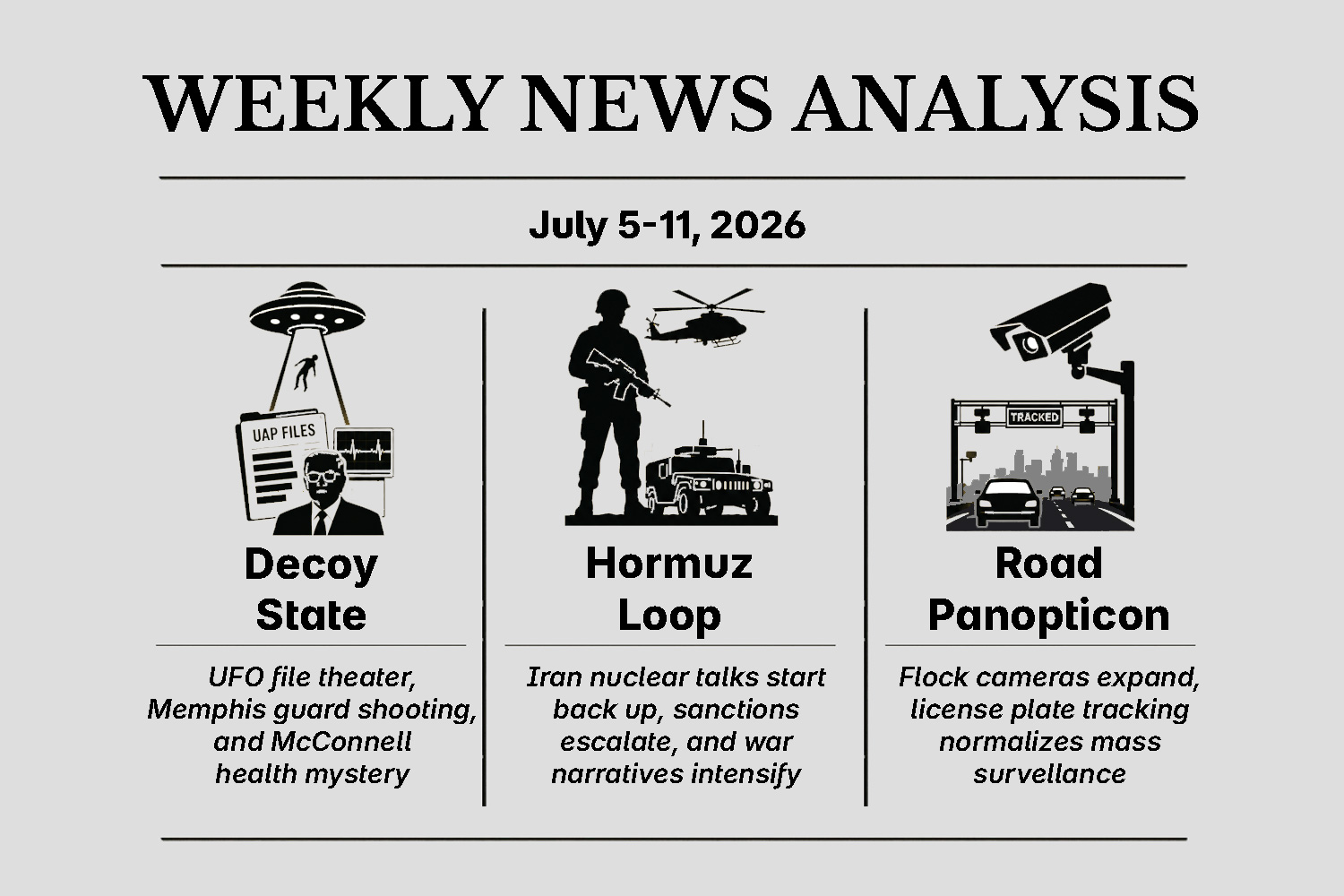
The week moved through three managed theaters of perception: the sky, the battlefield, and the road. On the surface, each story seemed isolated. UFO files supplied the mystery above. Iran revived the familiar foreign-enemy template. Flock cameras exposed the domestic machinery of routine surveillance. Beneath those separate images, the operating pattern remained the same. The public was asked to treat official opacity as information, military escalation as security, and mass tracking as safety. The vocabulary shifted from “rights” to “risk,” from “evidence” to “trust us,” and from “public servant” to “authorized sensor,” while the logic stayed fixed: crisis produces intervention, intervention normalizes control, and control survives long after the original crisis has faded.
The Trivium framework matters because the first discipline is not emotional reaction, but definition. Grammar asks what is actually known. Logic exposes the contradictions hidden inside the narrative. Rhetoric identifies the behavior the story is designed to produce. When the government releases mystery footage without firm conclusions, deploys soldiers into domestic streets, withholds meaningful public proof of a senator’s condition, escalates war while calling it diplomacy, and markets surveillance as neighborhood safety, the surface events are not the central issue. The repeated structure beneath them is. The language of protection becomes a velvet covering over coercion, a pattern central to the lifecycle-of-government analysis and the safety-as-control warning developed in Journalistic Revolution’s broader work.
Decoy State
New Trump UFO file dump includes military footage of mysterious star-shaped object - Fox News
National Guard members on patrol in Memphis fatally shoot man during pursuit, police say - AP News
National Guard soldiers shoot and kill man in Memphis overnight - Task & Purpose
Laura Loomer, Reporter Claim Hospitalized Mitch McConnell Is ‘Brain Dead’ - Breitbart
Details scarce as Mitch McConnell ‘continues recovery’ in hospital - The Guardian
The UFO release operated as classic shiny-object governance: disclosure stripped of resolution, spectacle detached from accountability, and mystery distributed through official channels at the speed of political usefulness. Fox reported that the administration released a fourth tranche of UAP records, including military infrared footage of a six-pointed star-like object over the Yellow Sea and additional material tied to a 2015 incident near the Pantex nuclear weapons facility. Yet the same reporting noted that officials cautioned that the descriptions should not be treated as official conclusions about identity or significance. That caveat is the hinge. The public receives enough imagery to provoke awe, fear, and speculation, but not enough verified context to discipline interpretation. The state becomes a magician and fact-checker at once, producing the object of fascination while reserving authority over what that object is allowed to mean.
The Gateway Pundit framed the UFO files through the language of suppressed truth, stressing that 40 new declassified files had been released and quoting a military aviator who described an object as unlike anything seen in 28 years of Air Force and Navy service. That framing speaks directly to a public already conditioned to suspect that every official denial conceals a deeper disclosure event, and after decades of classified programs, redactions, and national-security evasions, that suspicion is not without cause. The logical danger comes when the mind leaps from “the government is withholding information” to “therefore the preferred theory has been proven.” Project Bluebeam belongs to that suspicious imagination as a theory of manufactured alien-threat spectacle used to consolidate global governance. The deeper analytical point is not that every detail of that theory has been proven; rather, that the official UAP theater trains the public to accept cosmic-emergency language as a plausible future pretext for political centralization.
Controlled ambiguity works this way precisely. Mainstream reporting presents the release as an act of transparency, while alternative reporting reads it as confirmation that hidden realities are surfacing. Both frames can produce the same operational result when mass attention is redirected away from ordinary abuses of power. A mystery in the sky is rhetorically valuable because it floats above party politics and destabilizes the public imagination. It can make local militarization, financial extraction, surveillance expansion, and institutional decay appear small by comparison. The fallacy at work is an appeal to mystery: because the object remains unexplained, the audience is nudged to abandon ordinary evidentiary standards and accept expert-managed uncertainty. When the state controls the footage, the classification process, the timing of release, and the official vocabulary, disclosure can become another form of enclosure.
The Memphis shooting brought the focus back to Earth, where the abstraction of “security” became a body in a city street. AP reported that two Tennessee National Guard members assigned to a crime-fighting patrol fatally shot 20-year-old Tyrin Johnson during a downtown pursuit after authorities said he turned toward soldiers with a gun. The Tennessee Bureau of Investigation was investigating the circumstances, and the Guard stated that medical specialists attempted first aid before Johnson died at the scene. Task & Purpose likewise reported that Guard soldiers joined a pursuit involving Memphis police and that the shooting occurred within the broader Memphis Safe Task Force environment. The official grammar centers on pursuit, weapon, escalation, and investigation. The buried premise is that soldiers belong inside domestic policing by default.
Whether the shooting is ultimately judged justified does not settle the broader constitutional and historical contradiction. The founders’ fear of standing armies was not decorative rhetoric; it was a structural warning about what follows when military force becomes ordinary inside civilian life. Task & Purpose reported that hundreds of Tennessee National Guard troops had deployed to Memphis in support of a federal task force created by Trump, operating under the governor’s authority rather than federalization. AP similarly connected the Guard presence to Trump’s prior campaign of sending troops and federal agents into cities described as overrun with crime. That language matters because “overrun” belongs to the vocabulary of occupation. It recasts a city as hostile terrain and citizens as population-management objects. The state does not need to formally declare a warzone if it can import warzone logic into ordinary streets.
The McConnell hospitalization supplied a third shiny object: the opaque body of institutional power. Breitbart reported that Laura Loomer and Desiree Townsend claimed, citing unnamed sources, that Mitch McConnell had been declared brain dead, while McConnell’s spokesperson said the senator continued to improve and was working with staff on Kentucky and Senate matters. The Guardian reported that McConnell had been admitted to the hospital on June 14, that his office had released only limited statements, and that staff had declined to provide details about his condition or whether he would return when the Senate reconvened. The documented fact is not that McConnell is brain-dead. The documented fact is that public claims, anonymous sourcing, official reassurance, and scarce visible proof created a vacuum.
That vacuum matters because institutional power often depends on controlling the timing of biological truth. If an officeholder is meaningfully incapacitated, the public has a legitimate interest in knowing whether representation has become a legal fiction maintained by staff, party leadership, and procedural delay. If he is recovering, official communication should be clear enough to end needless speculation. The contradiction is that the same system that demands public trust refuses to provide sufficient evidence for the public to verify its basic functional capacity. In such an environment, conspiracy does not grow because citizens are irrational. It grows because institutions have made secrecy habitual. The rhetoric of privacy becomes a shield for the continuity of power, and the public is asked to accept government-by-statement, in which a spokesperson’s sentence replaces visible accountability.
Taken together, the UFO files, Memphis shooting, and McConnell opacity formed one lesson in distraction and late-stage governance. One story lifted the public gaze into cosmic uncertainty. One normalized soldiers in the city streets. One showed how political bodies can vanish behind institutional curtains while authority continues speaking in their name. The connective tissue is not that each event proves the same hidden plot; rather, each event conditions obedience to mediated reality. Believe the footage, but not too much. Accept the patrol, but do not ask why soldiers are policing cities. Trust the senator is fine, even when meaningful evidence is unavailable. The lifecycle of government moves toward tyranny not only through coups d'état, but also through repeated small acceptances of managed perception.
Hormuz Loop
US pauses Iran attack after ceasefire break as Israel reveals plot to kill Trump - Fox News
Investigates: Polglase Iran nuclear satellite imagery - CNN
Iran war escalation - The New York Times
Iran updates: Trump says agreed to talks with Tehran, but ceasefire ‘over’ - Al Jazeera
The Iran story returned with the oldest imperial rhythm in the American playbook: escalation sold as restraint, retaliation sold as peace, and oil volatility treated as an unfortunate side effect rather than the predictable result of militarized policy. Gateway Hispanic reported that Trump ordered U.S. military strikes after alleged Iranian attacks on commercial shipping in the Strait of Hormuz, framing the action as “peace through strength” after a fragile ceasefire collapsed. Fox reported that Trump said the U.S. had agreed to resume talks while declaring that the ceasefire was over. Al Jazeera’s live page carried the same contradiction in its headline: talks continue, ceasefire over. That is not diplomacy in the ordinary sense. It is a war loop with diplomatic subtitles.
The official rhetoric rests on a hidden premise: the U.S. may bomb, blockade, sanction, negotiate, and threaten in the same breath while still calling itself the stabilizing actor. Gateway Hispanic’s framing describes U.S. strikes as decisive action against a regime violating a ceasefire and threatening global energy security, while Fox emphasized Iranian attacks on commercial ships, shipping disruptions, oil-price pressure, and continued negotiations. This is the grammar of imperial indispensability. The waterway becomes a global artery, the enemy becomes the destabilizer, and U.S. forces become the surgeon’s hand. The logical fallacy is special pleading. When Iran threatens shipping, it is aggression. When the U.S. surrounds the region with naval power and launches strikes, it is a form of security. The distinction is not moral; it is managerial.
The assassination-plot narrative added personal danger to geopolitical escalation. Fox reported that an Iranian cleric publicly called for Trump’s assassination and that Israeli intelligence had reportedly shared information with U.S. officials suggesting Iran was considering a fresh plot. The public is then moved through a familiar emotional sequence: the enemy is not merely strategic but personal; the president is not merely commander but target; military action is not merely policy but self-defense by proxy. The problem is not that threats against public officials should be ignored. The problem is that assassination narratives can act as accelerants, especially when they arrive via intelligence claims that the public cannot independently verify. The emotional appeal narrows the room for skepticism by making doubt feel like sympathy for the enemy.
The nuclear frame follows the same repetitive machinery. CNN’s linked segment focused on satellite imagery and claims around Iran’s nuclear activity, while Fox reported that Netanyahu said Iran would not be permitted to obtain a nuclear weapon regardless of any agreement reached with Washington. This is the rinse-and-repeat machinery of Middle East war rhetoric: nuclear danger, proxy danger, shipping danger, assassination danger, then sanctions, strikes, negotiations, and renewed danger. The public has watched this cycle before in Iraq, Syria, Libya, and the broader post-9/11 atmosphere. The fallacy is the appeal to future catastrophe. Because a hypothetical future weapon is intolerable, present violence becomes pre-cleared. The standard of proof shifts from demonstrated attack to inferred capacity, and that inferred capacity is sufficient to justify permanent pressure.
Oil exposes the material logic beneath the moral language. Fox reported that attacks in the Strait of Hormuz sent oil prices sharply higher, that only 22 vessels transited the strait on Thursday amid renewed strikes, and that this was far below the June daily average after the partial ceasefire. The report also noted that global oil supply had been recovering before the renewed hostilities and that further recovery depended on swift de-escalation. In other words, war is not simply a foreign-policy event. It is a domestic extraction mechanism. Every escalation becomes a price signal. Every threat becomes a market opportunity. Every presidential sentence becomes an advantage for those positioned ahead of public knowledge. Soldiers absorb the physical risk, citizens absorb the price shock, and insiders trade the volatility.
This is where the story connects directly to the economy and to engineered distraction. A public watching bombs, shipping lanes, funerals, clerics, nuclear imagery, and assassination claims is less likely to track who profits from the chaos. War rhetoric creates moral urgency; energy markets convert that urgency into wealth transfer. The official story says the state is defending commerce. The operational reality is that conflict itself becomes commerce. Defense contractors, oil traders, intelligence vendors, reconstruction interests, logistics firms, and political consultants all feed from the same cycle. This is not a side effect of war. It is the mature form of war. The battlefield becomes a market-making engine, and the public is told that sacrifice is patriotic while the connected class treats instability as a portfolio event.
Trump’s brand complicates the matter because he sells anti-endless-war rhetoric while participating in the same loop that sustains endless war. Gateway Hispanic described his stated posture as “no endless wars, but no weakness either,” a phrase crafted to reconcile contradiction without resolving it. The slogan allows every escalation to be presented as the single strike necessary to prevent a larger war, even when the cumulative effect is prolonged conflict. That is the Broken Window Fallacy in military form: destroy infrastructure, then call the resulting activity strategy; provoke retaliation, then call the response proof of necessity; disrupt energy flows, then call military control the cure for instability. The crisis becomes its own justification, producing the next intervention that preserves the system that created the crisis.
The deeper trajectory is not merely war with Iran. It is a public habituation to managed escalation. The citizen is trained to live inside permanent emergency, where ceasefires are temporary, talks continue under bombardment, intelligence claims arrive through allied channels, and the economy shakes in synchrony with military announcements. The result is a population psychologically softened for rule by crisis. The war does not need to end if its political function is distraction, its financial function is volatility, and its institutional function is expanded power. Iran becomes the external enemy, oil becomes the pressure point, and the public becomes the audience told to cheer strength while paying for the consequences.
Road Panopticon
Dump the Flock: Flock Cameras as the Catalyst for a Modern Boston Tea Party - Joe Hoft
DeFlock proposed law felony city - Yahoo News
Flock Cameras Screw Up, Swarm Innocent Man With Armed Police - Futurism
Flock is not merely a camera company. It is a distributed surveillance platform built around automated license plate recognition, searchable vehicle evidence, data-sharing relationships, and increasingly AI-driven investigative tools. Flock’s own product language describes license plate readers, video cameras, mobile security trailers, audio detection, drones, FlockOS, Flock Nova, Flock911, FreeForm, a national LPR network, and public-sector offerings that include law enforcement, corrections, education, parks, transportation, and federal categories. That menu matters because it proves the system is not a lone device attached to a pole. It is a modular infrastructure stack. Once installed, it can expand from plates to video, from video to audio, from audio to drones, from local searches to multi-jurisdictional pattern analysis.
Flock’s official article on AI-powered investigations is more revealing than any critic could be. The company says its nationwide LPR network already assists major cases and that new tools are designed to “supercharge” investigations. FreeForm allows officers to search vehicle imagery through plain-language descriptions such as a blue SUV with a racing stripe or a white pickup with a ladder. Other tools include Plate Swap Insights, Multi-State Insights, and Hotlist Hotspot Insights, designed to identify suspicious plate behavior, cross-state vehicle movement, and concentrated alert patterns. This is not passive observation. It is machine-assisted suspicion generation. The system does not merely record what happened; it helps authorities decide which patterns should matter.
That architecture is precisely why integration with broader data-fusion systems is so dangerous. Flock generates structured, time-stamped, geolocated vehicle data; platforms like Palantir-style government analytics systems exist to fuse structured data streams into searchable profiles, link charts, alerts, and predictive workflows. Local police see a stolen-car tool. State agencies see cross-jurisdictional intelligence. Federal agencies see movement patterns, associations, and operational leads. The same data point can be sold to the public as neighborhood safety and used upstream as behavioral mapping. Once a license plate becomes a persistent identifier, the car becomes a proxy ankle monitor, funded by taxpayers who were told the cage was a service.
The misuse is no longer theoretical. CBS News Atlanta reported that five Georgia police officers were fired and arrested after authorities said they used access to Albany’s Flock system for non-law-enforcement purposes. The department said an internal audit found serious policy violations, while the Georgia Bureau of Investigation said the officers accessed license plate data on multiple occasions outside authorized purposes. This is the predictable failure point in every surveillance regime: the system is defended as safe because policies exist, then the policies fail because people with access use the tool for their own purposes. The violation is not an anomaly outside the system. It is a preview of the system’s real-world incentive structure.
Futurism’s account sharpened the danger from privacy abstraction into physical consequence. It reported that automotive journalist Joel Feder was surrounded by armed police while test driving a Range Rover with his wife in Minnesota after Flock’s AI-integrated cameras allegedly tagged the vehicle as stolen by mistake. Four squad cars boxed him in, and officers reportedly said they had been tracking him for days. The civic meaning is chilling. A software error became an armed state confrontation. A misclassification became a police stop. A normal drive became an encounter where the innocent person had to survive the machine’s accusation. That is the operational contradiction behind “public safety”: the innocent are placed at risk so the system can claim efficiency.
Gateway Pundit framed Flock as Big Brother arriving one license plate at a time, asking where crime-fighting ends and government surveillance begins. Joe Hoft’s published piece went further, describing Flock as an 80,000-camera nationwide system and comparing the surveillance backlash to a modern Boston Tea Party. The historical analogy works because the original conflict was not merely about tea. It was about political authority, monopoly privilege, taxation, search, and control. A surveillance contract funded with public money places taxpayers in the position of financing the mechanism that records their own movement. That is not ordinary policing. It is compelled participation in one’s own monitoring. The road, once a symbol of free movement, becomes an interface for automated suspicion.
The founders would likely have recognized the structure, even if the technology had seemed impossible. Replace Redcoats with networked cameras, general warrants with bulk searchable databases, informants with AI alerts, and customs searches with automated movement logs, and the principle becomes familiar. A people who fought over writs of assistance and arbitrary searches would not have treated warrantless mass movement tracking as a harmless convenience. The modern state’s rhetorical advantage is that it no longer needs a soldier at every road when it can install a camera, route the data through a private vendor, and call the arrangement innovation. Tyranny modernizes by lowering the visibility of force. The bayonet becomes a sensor. The checkpoint becomes a database. The knock at the door becomes an automated lead.
The question of destroying cameras must be handled with precision because the state benefits when moral outrage is converted into easily prosecutable acts. A person who destroys surveillance equipment may view himself as a patriot in the older sense of a factious disturber of government, while the state may label him a vandal, felon, extremist, or domestic threat. Jury nullification enters this debate as a residual power of the people: jurors can refuse to convict when they believe a law or its application violates justice. But nullification is not a permission slip issued in advance, nor is it legal immunity for property destruction. Its importance is political and philosophical. It reminds the state that conscience still sits inside the jury box, and that legitimacy can fail even when prosecution is technically available.
The deeper issue is that cameras are being installed faster than public understanding can mature. Each new device creates facts on the ground. Each contract creates a dependency. Each database query normalizes the next query. Each claimed success story makes the opposition sound pro-crime. Safety rhetoric repeats ad nauseam until the presumption of innocence is quietly replaced by the presumption of trackability. The camera does not need to accuse everyone to control everyone. It only needs to make movement permanently searchable. That is the cage tightening: not one dramatic prison door, but a thousand small poles, dashboards, alerts, integrations, retention policies, and interagency sharing agreements. Big Brother no longer needs a face on a screen. It has eyes on the road.
The Cage Learns
The week’s three stories converge in one direction: institutional power is governing through spectacle, emergency, and automation. UFO disclosures train the public to receive mystery through official channels. Iran's escalation trains the public to accept war and negotiation as simultaneous realities. Flock cameras train the public to accept continuous tracking as the price of safety. In each case, the central rhetorical move is moral outsourcing. Citizens are told they do not need to understand the evidence, the strategy, the source code, the intelligence, the contract, or the medical truth. They need only trust the institution claiming to manage danger on their behalf. That is the beginning of civic childhood, where adults are reduced to dependents inside a system that speaks in the language of protection while expanding its capacity to command.
The warning is not that every event is fake, every official is lying, or every technology has no legitimate use. The warning is that systems built for emergencies rarely retire themselves after the emergency passes. The lifecycle of government advances by accumulation. A disclosure office here, a domestic patrol there, a naval escalation abroad, a license plate network at home, an AI search tool inside a police dashboard, a spokesperson statement standing in for visible proof. The pattern is the point. Natural rights do not usually vanish in one decree. They are surrendered in fragments, each exchange packaged as safety, transparency, strength, or efficiency. The cage tightens because the public keeps mistaking each new bar for a separate story.
Listen to this week's news in verse for a quick recap!