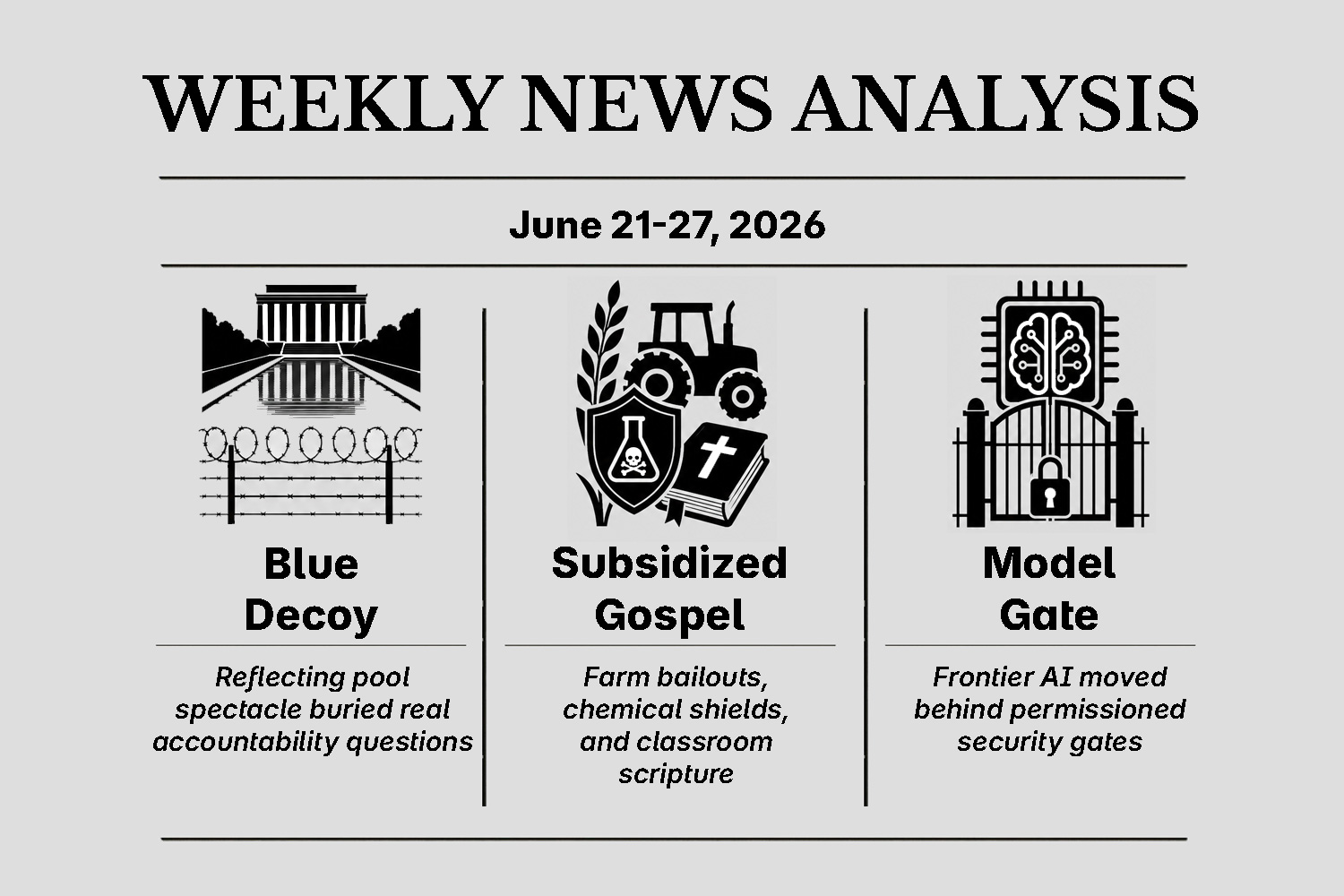
The week unfolded as a lesson in managed attention. A blue reflecting pool became a national morality play; Epstein files returned as controlled-disclosure theater; farmers were offered billions after policy-driven cost shocks; chemical liability was routed through federal preemption; religious reading lists entered public schools; and frontier AI was solidified into a permissioned national-security asset. On the surface, the events looked unrelated. Underneath, the mechanism was consistent: crisis, spectacle, institutional immunity, and a narrowing corridor of acceptable thought.
The Trivium reveals the operation clearly. The Grammar of the week was a pile of facts: damaged liners, court orders, federal subsidies, Supreme Court preemption, Bible curriculum mandates, Five Eyes warnings, restricted model rollouts, and agentic AI efficiency breakthroughs. The Logic exposed the contradiction: the same state apparatus that claims to protect the public repeatedly shields itself, its contractors, its preferred corporations, and its chosen narratives from direct accountability. Then the Rhetoric arrived dressed as safety, patriotism, faith, public health, food security, cybersecurity, and national survival.
This was not a week of isolated stories. It was a systems demonstration. The state does not govern through force alone; it governs through attention. It floods the public square with symbolic fights while the machinery of dependency, immunity, indoctrination, and algorithmic gatekeeping tightens behind the curtain. The reflecting pool gave the public a puddle to stare into. The real reflection was the institutional face looking back.
The Blue Decoy
Reflecting Pool liner was cut with a sharp knife or razor, National Park Service says - ABC7
Reflecting Pool coverage - BBC
Reflecting Pool liner cut with sharp knife or blade, National Park Service says - FOX 5 DC
Reflecting Pool Cut With Sharp Knife or Razor, According to Court Filing - The Gateway Pundit
Trump May Have Damaged Reflecting Pool by Motorcade Decision - Newsweek
DOJ Epstein Files Lawsuit - The Hill
The Reflecting Pool story functioned less like civic infrastructure reporting than a loyalty ritual staged around a wounded monument. The dominant headline, repeated across outlets, was simple: the liner was cut with a sharp knife or razor. That phrase moved with the cadence of official reproduction. National Park Service language became media language; media language became public language; public language became political language. In a normal evidentiary process, the public would ask what was cut, when it was cut, how long the cut was, who did it, what video shows the act, what material failed, what installation conditions existed, and whether other plausible causes were ruled out. In a managed narrative process, the public receives a phrase and is invited to react emotionally before the underlying grammar has been assembled.
The contradiction appeared immediately. The rhetoric emphasized vandals, razors, sick people, and sabotage, while the available public imagery largely depicted people reaching into the water and pulling at already loose or flaking material. That does not prove vandalism did not occur, but it does expose the gap between the theatrical claim and the public evidence. A 250-to-350-foot gash is not a casual act of curiosity by someone touching water for a short clip. It implies time, access, tools, risk, and a security failure around one of the most-watched public spaces in the country. The hidden premise was that the public should treat official assertion as proof enough because the state had spoken. That is not an investigation. That is catechism.
The deeper issue is not whether damage occurred. The deeper issue is how quickly every other explanatory pathway was rhetorically demoted. Improper surface preparation, curing time, rushed deadlines, water chemistry, heat, algae, chemical treatment, prior physical stress, contractor competence, and a presidential motorcade driven through the pool basin all deserved serious scrutiny. Those questions are inconvenient because they move attention from anonymous vandals to managerial responsibility. Once the public accepts sabotage as the central frame, accountability shifts away from procurement, engineering, deadlines, political vanity, and material science. The story becomes moral rather than operational. The villain is no longer the system that produced the failure; the villain is a faceless vandal useful enough to absorb the blame.
This is the psychological structure described in The Fallacious Belief in Government, and in the broader analysis of state propaganda: a repeated phrase becomes more important than a complete fact pattern and truth. The technique is simple. Select a vivid object, collapse complexity into a moral binary, repeat the approved explanation, and let partisan audiences fight over symbols while the structural questions disappear. The reflecting pool was an ideal stage because it carried national mythology. It sits between monuments, mirrors imperial architecture, and can be visually coded as patriotic restoration or anti-American destruction. Once the water turned green and the coating began to fail, the rhetoric needed an enemy. A technical failure would imply incompetence. A vandal implies desecration.
The right-wing alternative framing added another layer without escaping the trap. Some coverage noted that Obama and Biden-era pool repairs cost more and did not receive the same level of hostile media attention. That observation may expose selective outrage, but it misses the performative difference. Those prior repairs were not turned into a presidential branding exercise with public boasts, deadline pressure, symbolic color choices, and later accusations of sabotage. Trump made the pool a spectacle before the alleged vandalism story ever emerged. Once a ruler turns maintenance into theater, the theater must continue when the maintenance fails. The right’s instinct was to defend the performer rather than ask why public works had become political stagecraft in the first place. To enhance the spectacle, the National Guard has been deployed at the reflecting pool, where a chain-link fence has been erected to keep people away, and announcements have been made stating that loitering is prohibited.
The order to unredact the Epstein files served as the second shiny object. The public was again invited to wait for the state to expose the state, as though the same machinery that buried, redacted, mishandled, protected, delayed, classified, and strategically released records would finally prosecute its own network cleanly. This is the nothing-burger cycle: sealed files, promised release, partial disclosure, redactions, outrage, lawsuits, court orders, delayed deadlines, and another round of hope. The public is held in a false climax. The emotional promise is that accountability is always one filing away. The operational reality is that controlled disclosure preserves institutional legitimacy by making the cover-up appear procedural rather than intentional.
The reflecting pool and Epstein files, therefore, served the same function: attention management. One used patriotic vandalism imagery; the other used elite sex-trafficking horror and the unresolved hunger for justice. Both topics are emotionally powerful. Both can dominate feeds. Both allow partisan audiences to rehearse familiar scripts while using their limited attention resources to focus on subject outcomes that will not change the machine. Both also obscure larger movements unfolding in parallel: war costs being socialized through bailouts, corporate chemical liability being narrowed through federal preemption, religion being routed through public school curriculum, and frontier AI being turned into a permissioned infrastructure of national-security governance. The blue pool was not the week’s crisis. It was the week’s mirror. It showed how easily symbolic damage can crowd out structural damage.
The Subsidized Gospel
Trump seeking $11 billion to help farmers with fuel and fertilizer costs - FOX 4
Supreme Court Blocks Monsanto Cancer Lawsuits - Daily Caller
Monsanto Co. v. Durnell - Supreme Court
EPA is falsifying risk assessments for dangerous chemicals, say whistleblowers - The Guardian
Texas leaders approve Bible stories as required reading in schools - FOX 9
Texas board approves required Bible reading in public schools - AP News
The $11 billion farmer bailout request exposed Trump’s socialist machinery beneath the nationalist costume. The rhetoric presents itself as rescue: farmers are struggling with fuel and fertilizer costs, the Middle East conflict has disrupted shipping and prices, and Congress must therefore approve another infusion of taxpayer funds. The hidden premise is that the public must pay twice: first through inflationary and war-driven disruptions, then through subsidies meant to cushion the damage those disruptions created. This is the Broken Window Fallacy translated into federal agriculture policy. The state breaks the window through geopolitical escalation, sanctions pressure, shipping instability, monetary distortion, and fuel-cost exposure, then demands praise for sending the glazier with a taxpayer-funded invoice.
The deeper contradiction is that the modern right increasingly denounces socialism as a cultural enemy while embracing socialist mechanisms whenever favored constituencies are affected. A bailout is a bailout whether it wears red-state farm language or blue-state industrial language. Direct payments socialize risk, dull market signals, reward dependency, and keep producers tied to the political apparatus that caused or amplified the problem. Farmers become both victims and clients. Their survival is increasingly mediated through congressional appropriations, agency formulas, emergency declarations, crop categories, and political favor. This is not food independence. It is feudal agriculture administered through subsidy ledgers.
The Monsanto decision extended the same pattern into chemical liability. The Supreme Court’s majority treated federal pesticide labeling authority as a shield against state failure-to-warn claims when the EPA has approved a label without a cancer warning. In narrow legal terms, the decision turns on federal preemption under FIFRA. In systemic terms, it raises agency approval above jury accountability. The court effectively tells injured consumers that once the federal gatekeeper has blessed the label, the state-law path to warning-based remedy is blocked. That may create regulatory uniformity, but uniformity is not truth. A single approved label can be uniformly wrong, uniformly captured, or uniformly insulated from ordinary people seeking redress.
That matters because the EPA is not an oracle. It is a government agency operating inside political, corporate, bureaucratic, and scientific pressure systems. Past whistleblower allegations that agency risk assessments for dangerous chemicals were distorted or softened do not automatically prove that every EPA conclusion is false, but they undermine the premise that agency determinations should be treated as sacred. The appeal to authority fallacy sits at the center of the Monsanto ruling’s public meaning. The public is told that because the EPA has repeatedly concluded that glyphosate is not likely to cause cancer, the dispute over the warning is effectively settled for purposes of state tort claims. But regulatory repetition is not the same as independent verification, and bureaucratic consistency can just as easily signal institutional lock-in as scientific certainty.
The MAHA contradiction became unavoidable. A political movement that claims to make Americans healthy cannot also cheer a legal structure that narrows public recourse against chemical giants. Health rhetoric without liability is branding. Food purity language without corporate accountability is campaign décor. If the state protects pesticide manufacturers from warning litigation because a federal agency approved the label, then the health movement has already been routed into the very administrative cage it claims to oppose. The manufacturer points to the agency, the agency points to its process, the court points to federal law, and the injured person is left staring at a closed loop. That is not health sovereignty. That is managed helplessness.
Texas added the spiritual layer by making Bible stories required reading in public schools. Supporters framed the move as a historical correction, arguing that Judeo-Christian traditions influenced the nation’s founding. Critics framed it as church-state fusion, favoritism toward Christianity, and curricular exclusion of other traditions. The sharper question is not whether biblical literacy can have literary or historical value; it plainly can. The question is who selects the stories, which translation is used, what interpretive frame is imposed, what other traditions are excluded, and whether students are being taught to analyze texts or submit to a state-approved moral narrative. The same officials who would erupt if the Qur’an were required reading often see no contradiction when their preferred scripture is added to the compulsory curriculum.
This returns to the education framework described in The Fallacious Belief in Government on literacy slavery: teach enough reading to produce function, not enough independent analysis to produce genuine thought, with a focus on blind obedience toward authority. A public school can use the Bible to deepen historical and literary understanding, or to manufacture obedience through selective moral conditioning. The difference lies not in the text alone; it is in the pedagogy and the power behind it. When a state board mandates religious readings, the classroom becomes a collision point for government authority, parental anxiety, cultural identity, and moral instruction. The future trajectory is clear: curriculum will continue to be one more battlefield where factions seek control over the moral operating system of children while continuing to call the result “education.”
Together, the farmer bailout, Monsanto ruling, and Texas curriculum fight form a single pattern. The state subsidizes the economic damage created by its own policy environment, protects corporate actors through federal preemption, and shapes young minds through compulsory institutional channels. Food, chemistry, and belief are not separate domains in this model. They are inputs into population management. The farmer becomes dependent, the consumer becomes legally constrained, and the student becomes narratively formatted. The future is not merely bigger government; it is a wider state apparatus that manages production, exposure, liability, memory, and morality while telling the public each intervention is isolated, necessary, and benevolent.
The Model Gate
OpenAI limits GPT-5.6 rollout after government request - TechCrunch
Proxy war between AI industry, safety groups comes to head in NY House primary - MyTwinTiers
Improving the speed and energy-efficiency of AI agents - MIT News
The AI story is now moving out of the consumer product phase and into the sovereign-access phase. Five Eyes intelligence agencies warned that frontier models capable of transforming offensive and defensive cyber operations are not years away but months away. That language matters. “Months” is emergency language, and emergency language always invites emergency power. The public frame is cyber defense, business continuity, and national resilience. The operational frame is access control. Once a tool is declared a national-security object, the debate shifts from what citizens may use to who the state trusts. This is the gate. Behind it sit models, compute, credentials, contracts, agency review, approved customers, and a new hierarchy of algorithmic privilege.
Anthropic’s Mythos and Fable controversy showed the gate being constructed in real time. A model presented as powerful enough to detect vulnerabilities and potentially assist cyber operations was restricted, pulled, and then partially restored for approved organizations. The state did not merely ban the tool; it began sorting users. More than 100 government agencies and companies were reportedly approved for access to Mythos under safeguards, including some non-American employees inside those trusted organizations. That is the permissioned model of the future: not public release, not open scientific development, but curated access through national-security filters. The language of safety becomes the language of licensing.
OpenAI’s GPT-5.6 rollout repeated the same logic. The model family was limited to a small group of trusted partners at the government’s request, with the company's language warning that this type of access process should not become the long-term default. But the precedent is already the point. Once a government can “request” limited release under national-security pressure, voluntary cooperation begins to resemble involuntary licensing. The state does not need to formally nationalize AI companies if it can shape releases, identify trusted partners, review model capabilities, and influence who receives access to frontier technologies first. The market remains private on paper while the access regime becomes political in practice.
This is public-private technocracy in its cleanest form. The government apparatus claims responsibility for national survival, the corporations claim responsibility for innovation, and the public receives neither transparency nor equal access. Instead, selected firms, agencies, contractors, cloud providers, and critical-infrastructure operators enter the inner ring. Everyone else waits for the safe version, the delayed version, the censored version, the lower-capability version, or the consumer-facing toy. In older feudalism, access to land determined power. In digital feudalism, access to models, compute, and data will determine power. The new estate system will not be built from castles; it will be built from API keys, compute clusters, safety approvals, and compliance credentials.
The New York AI primary fight revealed that the access regime is already entering electoral politics. Alex Bores became a proxy battlefield for the broader AI regulation war, with industry-aligned and safety-aligned money pouring into the race. The public was offered the story of safety versus innovation, but that binary is too simple. AI safety groups can be sincere, captured, strategic, or all three at once. Industry groups can oppose state regulation not because they oppose control, but because they prefer federal rules they can shape at scale. A state-level safety bill may genuinely restrain certain abuses, but it can also consolidate incumbents by raising compliance costs for smaller competitors. Regulation is never merely a restraint. It is architecture.
Bores’ background as a former Palantir engineer intensifies the question, not because it proves controlled opposition, but because it shows how easily intelligence-adjacent technocratic culture can wear the clothing of reform. Palantir’s long association with surveillance, data fusion, predictive analytics, and state security work makes any safety-front political figure worthy of close scrutiny. In The Fallacious Belief in Government, Palantir is listed as the most likely source for the creation and implementation of QAnon and its push to get Trump elected. There is a high risk that Bores is controlled opposition. However, the deeper concern is not one person. It is the possibility that AI safety becomes the acceptable opposition channel: enough criticism to justify regulation, enough regulation to lock in dominant firms, enough fear to expand state review, and enough campaign spending to teach politicians which AI positions are permitted. Controlled opposition does not always mean fake dissent. Sometimes it means dissent routed into a structure that strengthens the final cage.
From another angle, MIT’s Murakkab research completes the picture. The technical goal is efficiency: configure agentic workflows dynamically, select models and tools, run tasks in parallel where possible, allocate hardware intelligently, and reduce compute, energy, and cost. On its face, this is useful engineering. Faster, cheaper, more energy-efficient AI agents will make complex workflows easier to deploy. But in the context of restricted frontier models and national-security access, efficiency becomes an accelerant. The same optimization that helps a developer run a video Q&A tool can help institutions deploy autonomous cyber agents, surveillance pipelines, compliance engines, information filters, and decision-support systems across cloud infrastructure at scale. Efficiency is never politically neutral once the system being optimized is governance.
All of these stories converge into one trajectory: the state and its corporate partners are building an AI gate, fighting over who guards it, and improving the machinery behind it. The national-security warning supplies fear. The model restrictions supply precedent. The trusted-partner lists supply hierarchy. The election spending supplies political enforcement. The efficiency research supplies scalability. This is the Great Reset and Agenda 2030 logic translated into AI infrastructure: centralize risk definitions, approval processes, and computational capacity, then present the arrangement as protection against chaos. The public will be told that only irresponsible people oppose safeguards. The more precise question is who writes the safeguards, who profits from them, who is excluded by them, and who becomes dependent on the approved machine.
The Managed Future
The week’s stories were not random eruptions; they were operating instructions. The reflecting pool showed how symbolic spectacle can override material inquiry. The Epstein files showed how disclosure can be managed to preserve the illusion that the state might eventually hold itself accountable. The farm bailout showed how policy damage is socialized after the fact. The Monsanto ruling showed how corporate liability can be routed through federal agency authority. The Texas curriculum fight showed how compulsory education remains one of the most powerful instruments for shaping obedience, identity, and historical memory. The AI stories showed the next stage: a permissioned technological order in which access to intelligence itself is governed.
The repeated pattern is crisis, intervention, consolidation, and dependency. A crisis appears or is amplified. The state steps forward as rescuer. The intervention creates new authority, new spending, new immunity, new standards, or new infrastructure. Then the public becomes dependent on the very machinery that claimed to solve the problem. This is the lifecycle of government expressed through weekly news rather than political theory. It does not require a single master plan for every event. It only requires institutions to behave in accordance with their nature: preserve power, minimize liability, shape perception, reward allies, punish dissent, and convert instability into jurisdiction.
The future trajectory is algorithmic feudalism with moral decoration. Food will be subsidized, chemical exposure federally mediated, curriculum morally curated, scandal procedurally delayed, and AI access permissioned through state-corporate gates. Natural rights will not be abolished in a single dramatic decree. They will be administratively surrounded until their exercise requires approval, subsidy, credential, label, curriculum, platform, or model access. The task is not to stare into the blue pool and argue over reflections. The task is to recognize the machinery behind the image before the machinery becomes the only reality the public is allowed to see and interact with.
The Managed Cage
The week’s synthesis is grim but clear. Rights are restored only after years of violation. COVID19 evidence is released only after institutional incentives have shifted. A peace deal is announced while munitions production is prioritized for emergency use and the Pentagon prepares another funding request. AI is celebrated for efficiency while becoming fused with missiles, dispatch systems, insurers, shopping agents, telecom networks, and domestic infrastructure. This is not chaos. It is a method. The governing class does not need perfect secrecy. It needs sequencing, plausible deniability, institutional fragmentation, and enough controlled outrage to keep the public emotionally engaged while structurally powerless.
The natural-rights frame clarifies what the news frame obscures. Life is implicated when AI systems support decisions about bombing and emergency-response triage. Freedom is implicated when firearm rights are conditioned on administrative categories and when AI systems become the interface through which citizens access markets and services. Property is implicated when war spending, inflation, insurance scoring, data extraction, and emergency production orders redistribute resources upward into state-aligned industries. The state presents each move as isolated: a court ruling, a document dump, a ceasefire, a supply-chain fix, an AI innovation. Logic reveals the unity. Each story expands or preserves centralized control over the conditions of ordinary life.
The future trajectory is not merely authoritarianism in the old sense. It is technocratic feudalism: lords of platforms, agencies, models, data centers, defense contracts, financial rails, insurance pools, and emergency powers governing populations through access rather than open decree. The answer is not blind rejection of every tool, worship of every disclosure, or faith in every court victory. It begins with the Trivium and metacognition driving disciplined Grammar, Logic, and Rhetoric: name the mechanism, expose the contradiction, reject false saviors, and build voluntary systems that reduce dependence on centralized force. The machine will keep offering partial corrections to preserve the larger cage. The task is not to applaud the unlocked door while ignoring the walls.
Listen to this week's news in verse for a quick recap!