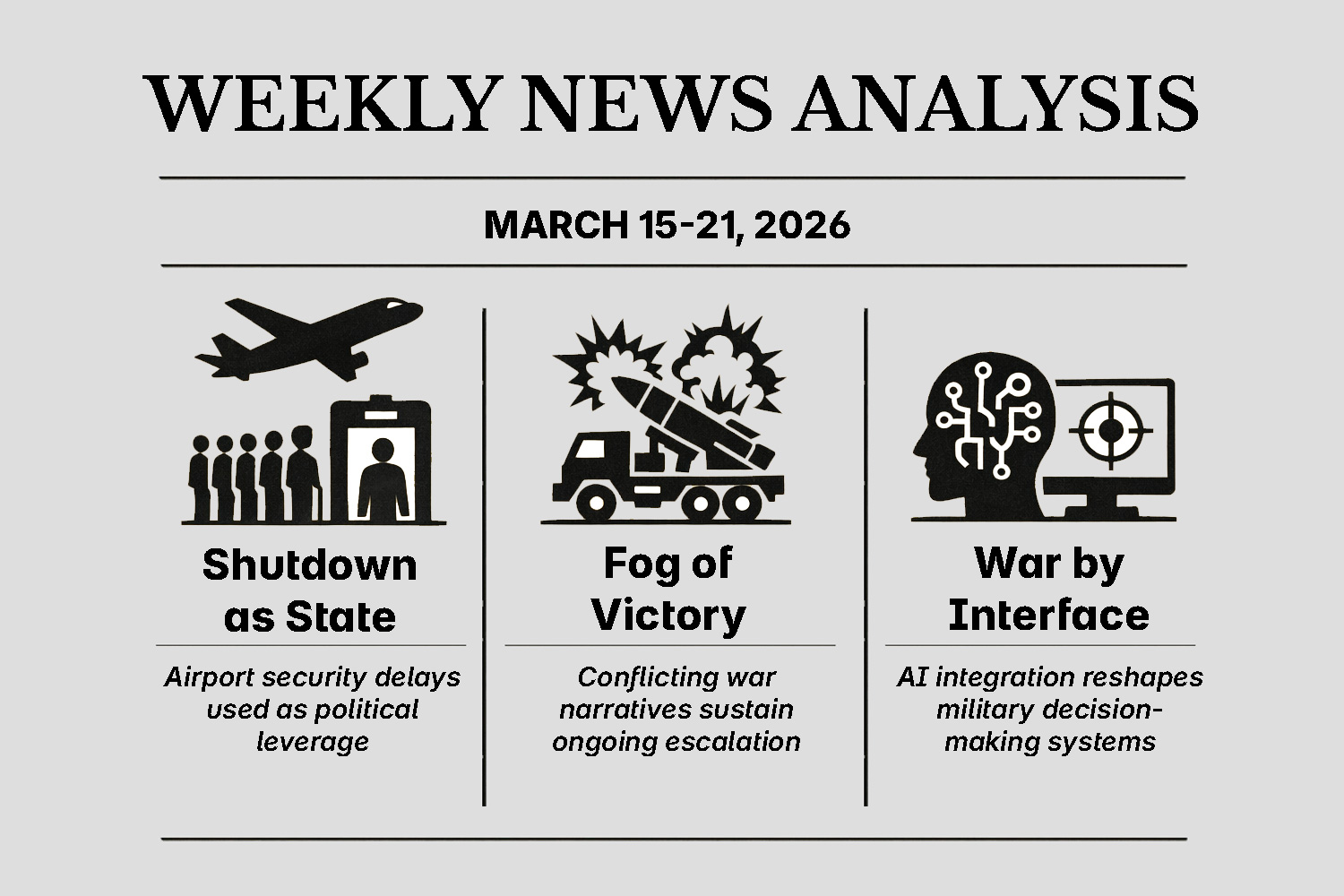
This week’s pattern was not merely a crisis but a carefully managed reliance. In one instance, airport queues served as a visible symbol of a “shutdown” that never truly stops the machinery of power—only the inconveniences faced by everyday people. In another, escalating tensions with Iran generated a complex fog of contradictory statements, ultimatums, and signals of escalation, turning confusion into a governance tool. Beneath these scenes, deeper structures continued to advance: policies on AI centralization, military automation, and Palantir’s official emergence within the Pentagon’s decision-making processes. The week highlighted how modern authority maintains itself through stress, ambiguity, and technological integration rather than individual headlines.
The common theme is rhetorical inversion, where “Security” shifts to signify disruption, “Victory” to endless escalation, and “Innovation” to command infrastructure. This inversion is crucial because it uncovers the underlying assumption supporting all three narratives: the public must accept growing disorder in daily life as long as authorities frame it as necessary. The language consistently revolves around emergencies, exceptionalism, and reassurance combined with threat. This pattern echoes the historical cycle described in the chapters Engineered Consent and Psychological Operations in The Fallacious Belief in Government: crises prompt intervention, which consolidates power, leading to new crises that justify ongoing expansion. Consequently, this results in more than policy drift; it fosters a political culture that confuses coercion with stewardship.
Shutdown as Stage
Airlines, TSA, DHS shutdown travel - CNBC
Spring break under siege Democrats reckless DHS shutdown forcing TSA officers work - DHS
Airport TSA wait time live updates - CNN
Airport security TSA lines travel tips - NPR
The story of the partial shutdown quickly exposed one of Washington’s oldest tactics: when politicians declare “government is shut down,” they often mean that the pressure will be directed primarily at the public. Airport security was targeted this time because it’s visible, emotionally charged, and broad enough to provoke immediate outrage. Reuters reported wait times of up to three hours at some airports, with about 50,000 TSA screeners working unpaid after DHS funding ran out, leading to increased absenteeism and the departure of hundreds of officers. The Guardian noted that Trump threatened to move ICE agents into airports as the standoff persisted. This isn’t accidental dysfunction; it’s a strategic use of public leverage. The government shields its essential functions, high salaries, and strategic stability, while ordinary travelers become pawns in a budgetary political game. Thus, “shutdown” acts as rhetorical misdirection—implying shared sacrifice—but in reality, it concentrates disruption on the public.
The story shouldn't be viewed solely as a partisan conflict between Democrats and Republicans. The core issue is the structure of dependence itself. A system that claims to prioritize public safety is structured so that its most effective political tactic is to disrupt the daily movements of harmless people. In practice, this means innocent individuals are compelled to justify why the very system that restricts them is necessary. The common refrain is: fund this infrastructure or chaos will ensue. However, the chaos isn’t external; it is generated internally by a top-down design that withholds normal functions unless lawmakers enforce compliance. Thus, the airport line becomes a lesson in statism, conditioning the public to see bureaucratic weakness as a reason for increased obedience, rather than recognizing that the centralized security system is itself fragile, coercive, and politically motivated.
Trump’s threat to deploy ICE agents at airports amplified the performative nature of the moment. ICE does not have training for airport screening, yet the proposal was portrayed as if any federal agent could be quickly reassigned to provide security like never before. That phrase exposes more than intended; it suggests that security is less about precise procedures and more about a symbolic assertion of authority. The core message isn’t about proper airport screening organization but about the visible display of power. The assumption is that a more conspicuous presence of enforcement officials will comfort the public, even if it blurs roles and normalizes the combination of immigration enforcement with domestic travel oversight. This is how emergency rhetoric functions: it blurs distinctions, accelerates substitution, and conditions citizens to accept institutional overlaps that might otherwise be alarming.
The TSA narrative also raises a broader question often overlooked: what real achievements has this agency made relative to the burden it carries? Created after 9/11 amid a security overhaul linked to the formation of DHS, the agency replaced a system in which airlines relied on private screening contractors and airports operated with less centralization. The current crisis shows that the post-9/11 framework is only about twenty years old, not an eternal fixture of civilization. Yet it is portrayed as indispensable, as if aviation could not function without this federal superstructure. In reality, commercial aviation existed long before DHS, TSA, shoe removal protocols, checkpoint queues, and behavioral conditioning at terminals. This system is recent, not timeless, and its short history exposes the myth that this form of “security” is the natural order.
This historical point naturally raises questions about responsibility. If airlines sell tickets, earn profits, manage routes, and bear the consequences of failures, it follows that they and airport operators should bear the main responsibility for the quality of service, rather than relying on broad federal oversight. This doesn't imply that private arrangements are perfect; rather, accountability becomes clearer. Currently, the public faces a monopoly that shifts inconvenience onto the public, politicizes staffing, and transforms budget disputes into national travel crises. In a decentralized system, failures would still be costly, but incentives to perform well would be stronger, and responsibility harder to evade. On the other hand, centralized government security disperses responsibility so broadly that no one is truly held accountable for poor or absurd experiences. This results in ritual compliance instead of genuine trust.
The argument of “protecting travelers” warrants deeper logical analysis. It depends on the fallacy of appeal to fear, implying that visible inconveniences indicate hidden necessities. However, long queues, overworked staff, missed flights, and mission drift are not evidence of a flawless system; they are symptoms of a structure that relies on chokepoints. When officials warn that delays will worsen without funding, they are not just describing a problem but also leveraging the public’s discomfort as political leverage. The public is encouraged to blame a partisan villain rather than recognize the shared underlying premise: that everyday movement is contingent upon a centralized security bureaucracy whose failures are always someone else’s fault. This creates a sense of theater, where the audience is split into sides, while the stage remains unquestioned.
Looking at this episode through a wider historical lens reveals a recurring pattern: fear prompts institutional expansion, which then becomes routine, leading to dependency and ultimately giving leverage to those in power. This is the core scandal of the shutdown story—not just that airports became unpleasant, but that the resulting misery was used as evidence to justify maintaining the current system. The public was given the illusion of choice between two managers of the same coercive system. One blamed the other, while the latter promised stricter enforcement. Neither addressed the fundamental misunderstanding: that a society conditioned from birth to see increasingly invasive control systems as synonymous with order will continue defending its imprisoning structures, even as their bars tremble. This exemplifies how engineered consent operates within a democracy—people aren’t asked if they want the system, only which faction should govern it.
Fog of Victory
Trump threatens Iran with power plant strikes over Hormuz oil blockade - Reuters
Three weeks in Iran war escalates beyond Trump’s control - Reuters
Trump gives Iran 48-hour ultimatum reopen Strait of Hormuz face strikes power plants - Fox News
Trump administration making heavy preparations for potential use of ground troops in Iran - CBS News
Trump considering ordering U.S. troops seize blockade Iran’s Kharg Island - Daily Mail
Automatic draft registration recruiting tweaks included in NDAA - Roll Call
This week’s continued war story was marked more by rhetorical excess than by strategic coherence. Reuters reported Trump threatening to “obliterate” Iran’s power plants if Tehran did not reopen the Strait of Hormuz within 48 hours, despite him having discussed “winding down” the conflict just a day earlier. Simultaneously, Reuters described the war as slipping beyond his control, with allies withholding support, imminent troop deployments, and no clear exit strategy. CBS reported that Pentagon officials had prepared detailed plans to deploy U.S. ground forces into Iran after saying from the beginning that it isn’t a war. Consequently, the public received conflicting messages: that the war was under control, escalating, victorious, requiring more action, or possibly ending after further coercion. This isn’t just mixed messaging; it’s a political operational strategy.
This approach serves a psychological function. By presenting all possible outcomes simultaneously, rulers preserve narrative flexibility. If bombing intensifies, it shows necessary strength. If talks restart, it demonstrates strategic restraint. If allies join, the coalition confirms policy. If allies refuse, America is shown as standing alone with righteous resolve. If the enemy weakens, victory seems certain. If the enemy retaliates, escalation indicates the enemy is more dangerous than previously believed. Throughout, the same ruler can later claim to have been right all along, as the rhetoric was never meant to clarify but to saturate. The public isn't being directed toward understanding; they are kept in a fog where contradictions become emotional appeals. This is classic narrative preemption: say everything so no future event can decisively disprove you.
This contradiction becomes especially evident when compared to the campaign's main premise. If the Iranian nuclear threat was supposedly “destroyed” in earlier strikes, why are there still calls for ultimatums, broader infrastructure targets, possible ground-force involvement, and appeals for allies to share the burden? Reuters highlighted analysts who pointed to Trump’s misjudgments, the lack of a clear exit plan, and tensions over Israel’s coordination versus Washington’s claims of ignorance. Logically, this creates a contradiction in the official narrative. Either the main objective was achieved, making further expansion hard to justify, or it wasn’t, rendering previous claims of success propaganda. The phrase “war for peace” has always concealed this contradiction. The campaign is described as solving a problem, yet operationally, it continually creates the conditions for its own continuation.
Iran’s retaliation intensifies its vulnerability. Reuters reported that Iran launched long-range missiles and attacked a U.S.-U.K. base, also highlighting that Iranian missiles are capable of reaching European capitals, as per Israeli military alerts. CNN’s coverage reflected this growing threat, noting uncertainty about naval escorts, a decline in tanker traffic, and U.S. fears that Hormuz could close for months. This is significant because the official narrative of controlled punitive measures conflicts with the reality of regional spillover. When energy chokepoints, allied bases, shipping routes, and civilian infrastructure become part of the retaliation, the conflict transforms from a targeted campaign into a systems war. Such wars tend to undermine transparency in modern democracies quickly, as each new vulnerability prompts emergency actions, troop movements, intelligence efforts, and calls for sacrifices—all under the guise of maintaining stability. As is with the lifecycle of government, after Democracy comes Tyranny.
This week's most revealing rhetorical move may have been the warning against Iranian power plants. Reuters pointed out that such strikes would expand U.S. actions to infrastructure vital to civilians' daily lives. This matters morally and linguistically. When civilian-support infrastructure is targeted under the pretext of restoring order, the language of war blurs the boundary between combatants and society. A power grid isn't merely a military target; it supplies heat, refrigeration, medicine, water treatment, and essential needs. Threatening such targets while claiming responsibility for containment is a euphemism. It employs the clinical term “infrastructure” to mask the reality: pressure on civilian life. Governments normalize escalation by shifting language from targeting individuals to systems, as if technical terms can morally justify collective punishment.
The domestic aspect of escalation also reveals itself in subtler ways. Roll Call highlighted NDAA provisions that would expand recruiter access to publicly funded high schools, mandate their presence at career fairs, and increase JROTC programs. While these measures do not constitute conscription, they demonstrate how the government subtly normalizes militarization in society even before the draft becomes a common subject of debate. As war expands, the public rarely receives immediate information about manpower requirements. Instead, the youth pipeline is integrated through administrative changes, patriotic rhetoric, and incorporation into educational systems. This pattern mirrors previous wars: the official narratives of the battlefield and the home personnel system evolve together, despite being presented as separate issues—one dramatic, the other bureaucratic—forming a foundation for a sustained military presence.
Historically, this marks the point where propaganda shifts from convincing the audience to exhausting it. People don’t need to believe every claim; they just have to be too tired to analyze them critically. That’s why disinformation now spreads from all directions simultaneously. Mainstream outlets frame events around alliance credibility and energy markets, while partisan sources interpret them through notions of strength and deterrence. State actors push their own narratives about casualties and legitimacy. Social media amplifies this chaos with fragments, clips, anonymous claims, and emotional appeals. The outcome isn’t an informed citizenry making transparent choices but a populace oscillating between panic, cynicism, and tribal instincts. Confusion isn’t just accidental—it’s a weapon in modern war rhetoric, as disoriented populations cling more tightly to authority figures who promise clarity, even if those figures are the ones creating the incoherence.
This is why the war should be viewed not only as a foreign-policy crisis but also as a domestic consciousness operation. The contradiction itself is actively being enacted. Trump may claim total victory, ongoing victory, no assistance needed, or a need for more help, since the objective isn’t consistency but dominance over the interpretive space. Control of the framing determines the emotional climate where consent is shaped. Iran's coverage this week exemplifies how a late-stage empire communicates: by inundating the field with conditional truths, speculative outcomes, and reversible declarations, blurring the line between analysis and psychological manipulation. Each development then becomes retroactively aligned with a ruler’s stance. This is a theatrical performance in the language of war.
War by Interface
Pentagon to adopt Palantir AI as core U.S. military system memo says - Reuters
National Policy Framework for Artificial Intelligence Legislative Recommendations - White House
Palantir Demos Show How the Military Could Use AI Chatbots to Generate War Plans - WIRED
Senate Republicans press national AI framework to preempt states - Biometric Update
Blackburn Coons Salazar Dean Colleagues Introduce NO FAKES Act - Blackburn Senate
This week’s biggest story was not just Palantir’s continued success, but also the Pentagon's move to make Palantir’s Maven Smart System an official part of its long-term military program, which Reuters described as securing sustained military use of Palantir’s weapons-targeting technology across the U.S. armed forces. The report also noted that Maven already serves as the military's primary AI operating system, used to analyze battlefield data and identify targets. Pentagon officials emphasized AI-enabled decision-making as the “cornerstone” of strategy. This indicates a decisive shift: AI is no longer seen as just supplementary or experimental but as part of military doctrine. Once software becomes central, warfare begins to reorganize around this interface, where sensors feed data into the model, which ranks targets, leaving human judgment mainly to approve options within a machine-driven system.
That shift also clarifies why Anthropic’s Claude lost its political relevance. Reuters reported that the Pentagon labeled Anthropic a “supply-chain risk” and banned contractors from using Claude in Pentagon projects following disagreements over safety measures. The dispute mainly involved Anthropic’s refusal to ease restrictions on autonomous weapons and widespread U.S. surveillance. Reuters also pointed out that Palantir’s Maven depended on Claude workflows and that Claude was likely used for intelligence analysis and operational planning in Iran. Put simply, the Department of War didn’t just want any AI; it required AI that matched battlefield speed and surveillance standards. A model that enforces strict boundaries becomes an obstacle, making a platform with tighter integration into targeting systems the preferred alternative. Replacing Claude with Palantir is more than just switching vendors; it signals the type of machine operation the military is aiming for.
WIRED’s coverage highlights a critical issue: the use of military chatbots to craft battlefield strategies. It details how companies train models for operational planning while defense officials and AI vendors discuss limitations, showing that this scenario is imminent. The main concern is clear. As war planning shifts to conversational AI, our relationship to strategy changes. Tasks that once needed staff, time, and effort are now reduced to prompts, outputs, confidence scores, and recommendations. This can create a false sense of clarity, as the machine appears to simplify uncertainty by ranking options. In bureaucratic settings, speed is often mistaken for wisdom. However, this strategic simplification can obscure biases in training data, assumptions embedded in prompts, and political agendas in the software’s design. The interface may seem neutral, but is often highly ideological.
This month, the White House released a framework that functions more as a constitutional blueprint for AI centralization rather than a neutral innovation memo. Its suggestions call for a federal AI policy framework, oppose a patchwork of state rules, promote broader data access for training models, accelerate infrastructure development, and expand AI use in education and workforce development. It also states that states shouldn't regulate AI in ways that could harm national competitiveness. Biometric Update observed that this approach would preempt much of state-level AI regulation. The language is polished: protecting children, defending speech, empowering creators, strengthening communities, and leading globally. However, the main operational message is clear—centralize standard-setting, increase computing power and datasets, lower regulatory barriers, and align AI governance with national security and industrial interests. This is not federalism in a distributed sense. It is managed consolidation.
Orwell’s relevance becomes clearer here. The enduring significance of 1984 isn’t just that it predicted a specific technology, but that it captured the core logic of a system where language, surveillance, and centralized interpretation intertwine. The White House document reveals a key paradox: it claims the government must defend free speech and prevent AI from censoring lawful dissent, yet it also advocates for greater federal control over AI regulations, expanded data access, and a unified national framework that minimizes state differences. This contradiction isn’t coincidental. Modern control relies less on outright bans and more on managed permissions guided by centralized standards. This approach creates a controlled environment that’s easier for computers to analyze and harder to escape. That’s why soft technocracy often uses language claiming to oppose censorship.
The NO FAKES Act aligns with this dual trend. Protecting against unauthorized digital reproductions may seem simple and justified, but the real challenge isn't the misuse itself. It’s about establishing a standard for identity management in an age when AI can generate likenesses, voices, styles, and, eventually, behavioral proxies at scale. Once a federal system for digital likeness regulation is in place, it will be interconnected with the broader authentication and trust frameworks developing around AI. Protection and verification are typically linked, fostering stronger identity systems. While lawmakers claim their goal is to defend artists and victims, this ecosystem is evolving toward a future in which verifying the authenticity of speech, media, and personhood becomes a critical political issue, managed through increasingly integrated technical systems.
The most provocative implication, often dismissed as fantasy until it materializes, is that warfare is transitioning toward algorithmic management. Reuters reported that UN experts warned about AI weapons that target without human control, raising ethical, legal, and security concerns, despite Palantir's stance that humans should remain involved. However, “human in the loop” can become a mere formality if the machine designs the process so thoroughly that meaningful refusal becomes rare, slow, or discouraged. After collecting intelligence, identifying the “optimal” strike options, ranking threats, and narrowing the decision window, the human operator often simply approves rather than deliberates. The political risk is significant: while responsibility stays legally with humans, real decision-making authority shifts into opaque systems built by companies whose interests depend on contracts, battlefield relevance, and continuous integration.
Palantir's significance extends beyond procurement, serving as a central hub for surveillance tactics, intelligence standardization, predictive analytics, and state authority. Recent updates reveal a shift in military strategy towards AI-led decision-making, coinciding with federal efforts to unify national AI policies and reduce resistance. The lines between battlefield operations and policy are blurring—one targets overseas missions, while the other governs domestic rules. Together, they envision a society where governance is increasingly predictive, data-driven, and centralized. This evolution doesn't suggest a sudden digital dictatorship but rather the acceptance of logical ideas: improved tools, smarter systems, quicker decisions, and safer results. When the infrastructure becomes evident, it appears as natural progress rather than a coup.
Empire of Managed Chaos
The three stories illustrate a common lesson: modern power is not solely about command but also about shaping perception. The airport shutdown highlights dependency by disrupting normal movement. The Iran war illustrates flexibility through overwhelming the public with conflicting victory narratives. The Palantir-AI initiative demonstrates inevitability by integrating centralized computation into warfare and governance. In each instance, the visible event reveals only part of the story; the real mechanism is behavioral conditioning. Citizens are conditioned to see bottlenecks as security measures, contradictions as signs of leadership, and automation as progress. That’s why the week felt like more than just a news cycle — it was a demonstration of how a system maintains itself by making chaos comprehensible only through the institutions that produce it.
The long-term trend indicates a rise in digital feudalism masked by democratic language. While not explicitly stated in official documents, the pattern is evident: centralized systems, AI-based judgments, integrated security functions, infrastructural leveraging, and information spaces filled with engineered ambiguity. Autonomy erodes not only through explicit bans but also through the gradual embedding of social, political, and military spheres within increasingly hard-to-challenge systems—systems often dismissed as reckless, disloyal, or anti-progress when questioned. As this enclosure becomes the norm, each crisis further consolidates control. The warning is urgent: if the public continues to see managed chaos as evidence of government necessity, the future order won't need to conquer a free society; it will inherit one already conditioned to accept only the authority of those managing the system.
Listen to this week's news in verse for a quick recap!