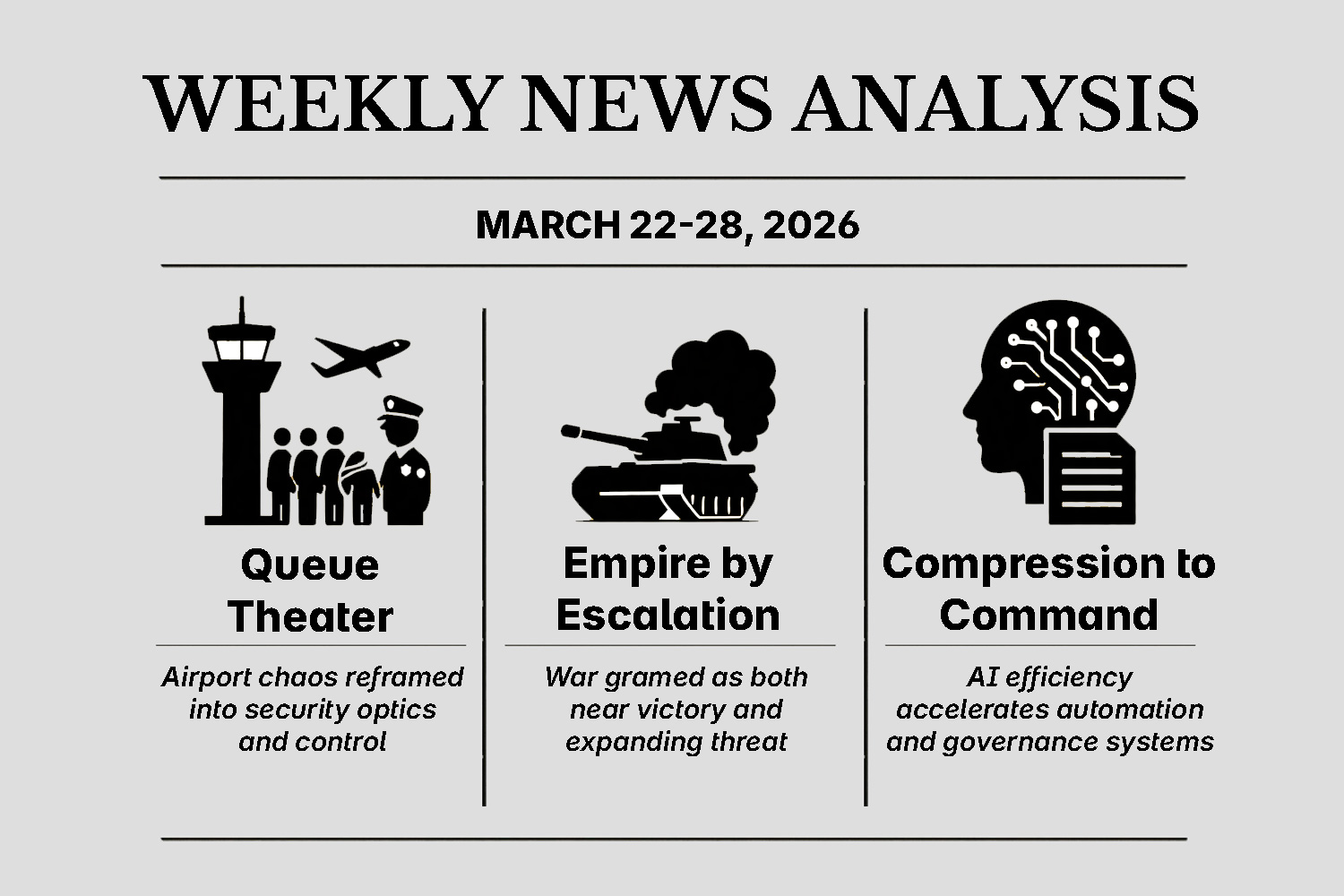
This week focused less on isolated incidents and more on coordinated attention management. One scene captured airport paralysis, unpaid security staff, and immigration agents caught in a civilian bottleneck. Another showed an expanding war with shifting official explanations to suit rhetorical needs. The third, under the guise of innovation, revealed that extreme AI efficiency, multimodal document systems, and quantum-resistant security all serve a deeper purpose: optimizing governance machinery to process society, not just information, more rapidly. The thread uniting these is not chaos alone but the strategic distribution of chaos.
The most notable pattern was rhetorical inversion. A shutdown became an opportunity to normalize a security substitution. Protest evolved into a spectacle, then a recruitment event, and finally a tribal sorting process. War was both limited and open-ended, nearly won but still dangerously unresolved. AI served as both a productivity miracle and a comprehensive systems layer. This contradiction is noteworthy. When rhetoric surpasses grammar and logic, narratives begin to influence reality more than facts. This is exactly the danger outlined in The Fallacious Belief in Government: politics increasingly relies on emotional framing, engineered consent, and control of public perception rather than on transparent truth-seeking.
Queue Theater
TSA lines stretch for hours as Trump deploys ICE agents to US airports - The Guardian
ICE at airports TSA fear - The Intercept
500 groups 3B revenues behind No Kings protests communist call revolution - Fox News
No Kings protests live updates - CNN
DHS TSA shutdown Congress - CNBC
The airport story continued this week, illustrating how modern state theater operates: institutional failure is acknowledged only after it is reframed as justification for a new security narrative. The Guardian reported hours-long TSA lines, unpaid screening staff, and ICE agents deployed in multiple cities, claiming they would help manage lines and control crowds. This detail matters because the true problem was clear: labor, payroll issues, and congressional dysfunction. However, the most visible “solution” wasn’t restoring normal civil procedures but creating a more politically charged enforcement image for the public. The line itself transformed into propaganda.
That rhetorical tactic deserves careful analysis. If airport security fails due to underfunding and unpaid staff, the genuine issues are administrative neglect and legislative irresponsibility. However, once immigration agents appear at the bottleneck, the language changes. The public is led to view the scene as one of discipline, readiness, and federal authority. This is a classic case of substitution rhetoric: replacing actual competence with an assertive stance, then promoting that stance as if it were competence. The state doesn't need to fix the problem before the cameras roll; it just needs to create a stronger visual impact than the ordinary workers asking for pay. This approach prioritizes optics over actual service.
The “No Kings” protests align with the attention economy but from a different ideological perspective. Fox News reported that around 500 groups, with a combined annual revenue of approximately $3 billion, supported the demonstrations. They also claimed that socialist and communist organizations exploited the visibility to promote explicitly revolutionary messages. Even if we overlook some partisan exaggerations in the coverage, the core point remains: contemporary mass protests are rarely purely spontaneous acts of civic expression. Instead, they often result from a complex mix of genuine grievances, donor-funded infrastructure, ideological opportunism, movement branding, and professionalized narrative management.
Not every protester may be insincere; rather, events operate on multiple levels. One is the authentic anger of citizens protesting against government overreach, immigration policies, war, or economic issues. Another is the recruitment effort by smaller ideological groups that join large crowds to gain visibility, making it easier to spread their message. A Washington Post report highlighted over 3,300 rallies across all 50 states and internationally, with participants motivated by diverse reasons. This diversity is the key point. A large coalition achieves scale, but it also allows for a more adaptable narrative, where different groups can interpret the same banner in varied ways.
The result resembles selective outrage acting like an operating system. Airport lines cause anger, but that anger is focused. Protest crowds evoke anger, yet it's managed. The same public that can be incited into moral outrage over immigration, federal overreach, or ideological foes can become quite indifferent to older elite scandals once a war spectacle takes over attention. Attention isn't just captured; it's prioritized. The crowd figures out which outrages are urgent, which are outdated, and which are too destabilizing to maintain. That's why the reemergence of “No Kings” now is more than just a protest; it serves as emotional redirection on an already saturated political stage.
The core contradiction is that both sides accuse each other of fabricating reality, yet they both engage in staged experiences. The administration claims ICE as a practical crowd-support measure, while critics view it as part of an evolving internal-security aesthetic. Protest organizers present themselves as representatives of democracy, while opposing outlets describe their actions as networked agitation and ideological infiltration. Both views may hold some truth. The crucial point is that rhetoric alone isn't enough. What truly matters is the underlying pattern: institutions fail, cameras appear, symbols replace real solutions, and the public is encouraged to side with one camp without understanding the true structure. This isn’t citizenship; it’s conditioning spectators.
This is where the Epstein issue becomes highly politically sensitive. When Iran dominates headlines and the domestic spotlight intensifies, the public’s capacity to demand transparency on the Epstein files and Trump’s long-standing connections to Epstein decreases. The matter doesn’t need to be conclusively disproven; it only needs to be overshadowed. That’s a crucial distinction. The elite scandal remains unresolved, not because it’s solved but because it’s periodically hidden behind more pressing stories. War is particularly effective at this, as it creates a moral crisis that renders previous questions inconvenient, divisive, or irrelevant. In such times, the truth isn’t denied; it’s simply pushed aside.
This week’s airport and protest photos illustrate how public feelings are shaped to be manageable. Fear at the airport, moral passion in the streets, and patriotic urgency regarding war all serve as catalysts. These emotions simplify thought, reinforce groups, and favor quick agreement over detailed analysis. Consequently, the week appeared loud but limited. Many details were visible, yet little was truly clarified. The public wasn’t guided to understand complexity; instead, it was directed to choose a side in relation to the spectacle.
Empire by Escalation
Ugandan military chief vows to back Israel against Iran - Fox News
Inside Iran’s military missiles militias force built for survival - Fox News
This week’s war narrative was filled with contradictions so obvious they almost stop hiding. Iran was depicted as collapsing, exhausted, and low on missiles, yet military reports and analyses consistently showed that the conflict was intensifying. Iran still maintained substantial capabilities, the Strait of Hormuz remained under threat, and proxy fronts might escalate regional tensions. Fox’s analysis emphasized that Iran’s military is designed more for survival than outright victory, and despite repeated strikes, it retains enough strength to launch missiles, harass shipping, and support proxy forces. New reports indicate that the Department of War is planning for weeks of ground operations, with tens of thousands of troops mobilized. These facts directly counter the simplified, celebratory summary.
This isn't just a minor media inconsistency; it's the primary rhetorical tool used to escalate. The public is led to believe that the enemy is weak enough to be defeated quickly, yet dangerous enough to justify ongoing expansion. These claims generate tension but also serve political goals. If the enemy appears too strong, fears of a quagmire intensify; if too weak, the justification for further violence diminishes. Consequently, the narrative shifts back and forth—portraying Iran as nearly defeated yet still a serious threat. Negotiations seem close, but are hampered by Tehran's refusal to surrender. This situation isn't a full-scale war but requires a wartime mindset. Such contradictory framing isn’t about precise analysis; it’s about emotional influence.
The human toll is often downplayed in this environment. Al Jazeera reported ongoing attacks on Iranian infrastructure, the killing of three journalists in a targeted strike in southern Lebanon, and the opening of another active front via Houthi attacks. The Guardian’s live coverage described the conflict as rapidly expanding, noting casualties in Lebanon and reporting Iranian strikes on Gulf infrastructure and bases. As the map widens like this, civilian displacement becomes a structural reality: transport routes are disrupted, urban centers are repeatedly hit, critical infrastructure deteriorates, and fear itself drives migration. When supply, energy, and psychological security all begin to weaken simultaneously, destruction spreads beyond local areas.
The list of states at risk of escalation is grounded in the regional network of bases, logistics, and alliances. Fox’s military analysis described Iran’s “Axis of Resistance” as a strategy to regionalize the conflict and threaten multiple interests. The Guardian reported attacks or threats reaching Saudi Arabia, the UAE, Kuwait, and Oman, while Al Jazeera noted the Houthis directly confronting Israel. Once the conflict affects shipping choke points, Gulf infrastructure, proxy groups, and allied facilities, countries such as Iraq, Jordan, Bahrain, Qatar, Saudi Arabia, the UAE, Oman, Syria, Turkey, Cyprus, and Azerbaijan become active participants in the war’s logistics network rather than bystanders.
The greater danger lies not only in regional spillover but also in entanglement with major powers via layered commitments, arms supply chains, and strategic patience. Even if China or Russia does not intervene openly, they may become involved through resource support, intelligence sharing, diplomatic shielding, technology transfer, sanctions evasion, or opportunistic actions in nearby regions. Portraying the war as an Axis struggle rather than a contained conflict fosters bloc behavior, causing “limited” wars to lose their boundaries. Instead of expanding through dramatic declarations, they grow by accumulating obligations, retaliatory strategies, and prestige traps. When enough actors feel humiliated or incur strategic losses, de-escalation becomes costly to their reputations.
The language of negotiation is often used as a guise for ongoing pressure. News reports described the administration waiting for Iran's response to peace proposals, while military deployments increased and more targets were reportedly struck. This creates a strategic advantage: diplomacy can be publicly emphasized while escalation occurs in the background. This dual approach enables leaders to present themselves as both moderate and strong simultaneously, and it also misleads the audience. If negotiations fail, blame can be assigned to the enemy’s irrationality. If strikes continue, they are justified as necessary for peace. This reflects one of the oldest contradictions in imperial rhetoric: war for stability, coercion for negotiation, destruction for order.
The phrase “war for peace” is more than just a philosophical concept; it describes a real contradiction. This contradiction reflects a flaw in political logic: violence is seen as a means to achieve peace, yet it actually undermines the conditions necessary for peace. Throughout this week’s coverage, this contradiction was clear. The more infrastructure was destroyed, the more the war was justified as necessary to restore stability. The more conflicts arose, the more the public was told victory was close. And as the outcome became more uncertain, officials expressed greater confidence. This system functions more as a morale booster than an information system.
The ultimate domestic threat is the impact of war, which consolidates narrative control domestically. It promotes obedience, portrays dissent as disloyalty, and shifts focus from domestic issues to the broader war effort. This is why the significance of this conflict extends beyond the Middle East—it acts as an attention hierarchy within the U.S. The scene is dominated by war rhetoric, rendering other issues like airport delays, protests, and Epstein-related pressures secondary. Crises become a tool for authority to ascend, with the foreign enemy justifying increased domestic control. Although this pattern is longstanding, the rapidity of modern media enhances its effectiveness.
Compression to Command
TurboQuant: Redefining AI efficiency with extreme compression - Google Research
RPA matters but AI changes how automation works - AI News
Automating complex finance workflows with multimodal AI - AI News
Quantum resilient AI needs migration and hardware protected data enclaves - AI News
VCs are betting billions on AI’s next wave so why is OpenAI killing Sora - TechCrunch
Google’s announcement of TurboQuant highlights a notable AI efficiency breakthrough, which is justified on its own terms. Google claims that TurboQuant reduces model size significantly without sacrificing accuracy in key-value cache compression and vector search. Its related QJL method produces a one-bit shorthand that requires zero additional memory. Without the marketing hype, this simply means devices can do more with less memory, face fewer bottlenecks, and incur lower operational costs. Lighter AI systems are easier to deploy, which is economically beneficial in terms of RAM usage, inference costs, embedded systems, and power consumption. Politically, this also means cheaper AI can be more widely distributed across various industrial layers.
The economic advantages are evident: improved compression enables more processing per memory unit, reduces infrastructure costs, and facilitates broader deployment across businesses and consumer markets. This increases semiconductor demand, impacts data-center architecture, and benefits industries aiming to incorporate more powerful AI into compact computing environments. Simultaneously, the political impact is equally significant. As reliance on large memory capacities diminishes, surveillance, optimization, and automated decision-making systems become more easily integrated into daily operations. Once efficiency shifts from experimental labs to organizational governance, its implications are profound. The same advancements that enhance search engines or virtual assistants can also empower bureaucracies, insurers, banks, defense contractors, and security agencies to automate processes more deeply.
The significance of concurrent automation stories is thus crucial. AI News outlined the shift from rule-based robotic process automation to AI-powered systems that can interpret context, manage unstructured data, and adapt activities involving text and images. The article emphasizes that companies are transitioning from fixed-rule sequences to flexible systems that handle variations in input media without frequent reprogramming. In essence, automation is moving beyond simple, repetitive tasks towards an interpretive stage. It now includes reading, sorting, extracting meaning, and deciding on subsequent actions. This represents a substantial societal transformation.
Finance offers the clearest near-term example because it relies heavily on documents, is risk-sensitive, and involves repetitive operations. The multimodal finance system describes tools that can analyze PDFs, nested tables, brokerage statements, and complex layouts, then generate human-readable summaries through multi-stage AI pipelines. This goes beyond simple keystroke automation; it automates the understanding of dense symbolic data. When a system can read a file, extract tables, understand their structure, summarize their meaning, and produce clean outputs for downstream tools, the boundary between assistance and management replacement blurs. Many white-collar processes become machine-directed rather than merely machine-supported.
The security layer then extends this concept into permanence. The part about quantum resilience highlights that current public-key cryptography could become vulnerable within ten years, that sensitive data might already be compromised for future decryption, and that organizations should begin transitioning to post-quantum methods along with hardware enclaves and crypto agility. On the surface, this is sound technical planning. At the system level, it means the AI stack is being bolstered for long-term institutional trust, compliance, and continuity. In essence, the emerging automated system is not designed as a temporary convenience but is being strengthened as a resilient infrastructure.
When these stories are combined, a clear pattern emerges: models are becoming lighter, automation is becoming more interpretive, financial and administrative tasks increasingly depend on machines, and security measures are being reinforced against future cryptographic threats. This isn't a single breakthrough but a layered system. Compression streamlines processes, multimodal automation expands abilities, and quantum-resistant security enhances robustness. Consequently, venture capital invests heavily in this next wave, as TechCrunch reports, because investors understand that controlling this stack means shaping the future of institutional technology. This goes beyond just “AI entering automation" — automation is becoming the core language of institutional life.
Public rhetoric often frames these developments mainly as conveniences: faster searches, streamlined workflows, reduced costs, improved summaries, and safer systems. However, the underlying premise is that more of reality should be comprehensible to machines, enabling societal actions at machine speed. Accepting this premise shifts control from forcefulness to optimization. Tasks like insurance decisions, hiring processes, financial reporting, document review, compliance, identity verification, and predictive governance all align with the idea that human ambiguity is inefficiency to be minimized. This core belief is the philosophical turning point for a technocracy.
This is why it's important to discuss the future of AI not just in terms of its capabilities but also in terms of who has the authority to deploy it widely and under what ethical standards. Technological advancement without wisdom only accelerates the exercise of control. The technical stack presented this week clearly emphasizes this warning. AI will become more integrated into our lives—not because a superintelligence suddenly emerges, but because many smaller systems quietly form the invisible infrastructure for work, finance, movement, access, and interpretation. Society is becoming governed by machines well before it realizes it.
The Managed Threshold
The three stories are not isolated events but serve as markers of thresholds. The first story highlights administrative chaos that increases perceptions of security threats. The second involves war rhetoric that normalizes contradictions and broadens the acceptable limits of escalation. The third depicts AI infrastructure nearing the status of the core framework through which institutions interpret, decide, and act. Together, they show a pattern: crises create opportunities, contradictions shape the narrative, and optimization guides governance. This sequence explains how society transitions from a chaotic republic to a regulated system—usually not via a single explicit doctrine but through a series of gradual, practical adjustments.
The core concern is autonomy, clearly tied to the language of natural rights. If movements can be suppressed or manipulated for political gain, wars can be used to distract the public, and AI can increasingly influence how institutions evaluate and judge individuals, then the focus shifts from whether power is centralizing to how rapidly and convincingly the public will perceive this centralization as inevitable. This pattern echoes the literary cycle: fear, intervention, consolidation, normalization, followed by a new fear. Although the names may change, the underlying mechanism remains the same.
This is the true warning of the week. The genuine danger isn't only that officials, activists, corporations, and media figures compete to influence perceptions. The greater risk is that the public becomes so accustomed to manufactured outrage, premeditated conflict language, and automated messaging that it confuses ongoing manipulation with normal political processes. Once this pattern takes hold, resisting no longer relies solely on censorship; it shifts to fatigue. People stop demanding the truth because the environment is constantly shifting. The machine doesn't require you to believe every statement; it simply needs your surrender to continuous narrative shifts. This is how modern empires maintain control: not just through force, but via an endless stream.
Listen to this week's news in verse for a quick recap!