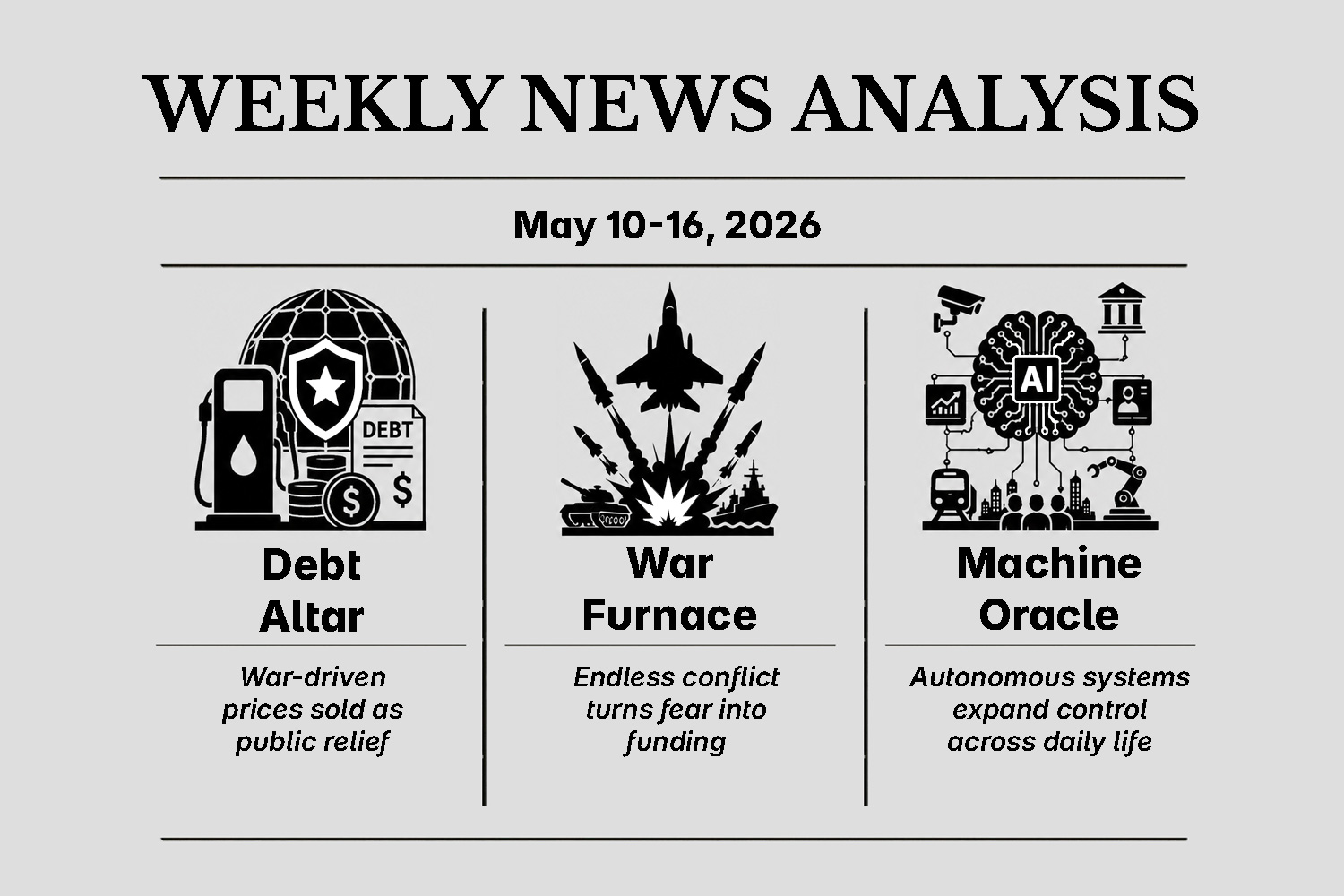
This week, we saw economic pressure, military escalation, and the strengthening of autonomous technology. Gas prices continued to rise amid the Iran conflict, while Trump proposed symbolic tax relief. Additionally, a nearly $2 billion political compensation scheme emerged around the IRS “weaponization,” and a trillion-dollar missile shield was promoted as essential for national security and grandeur. Simultaneously, the Pentagon requested more funding to sustain a war that has already revealed munitions shortages, fragile ceasefire language, and a shifting global chessboard involving China, Russia, Iran, and the Strait of Hormuz.
The pattern isn't random. It follows the known cycle of deprivation, intervention, consolidation, and automation. The public is pressured at the pump, told relief might come from a temporary tax suspension, then asked to pay for expanded war systems whose actual costs are much higher than public estimates. This resembles the Broken Window Fallacy wrapped in patriotic rhetoric: the government both creates or worsens the crisis and then promotes additional spending, new command structures, and military-industrial contracts as essential for the economy.
The third layer is AI. Autonomous systems are transitioning from software tools to roles in financial management, public-sector services, cybersecurity, enterprise decisions, and robotics. The discourse emphasizes efficiency, growth, safety, modernization, and sovereignty. In practice, there is a deeper integration of human actions with machine control. The trend is evident: the traditional systems of debt and conflict are not vanishing; instead, they are being enhanced with sensors, agents, banking access, humanoid forms, and automated decision-making.
Debt Altar
Gas prices and Iran war state national cost Trump - NBC News
Former Comptroller: the cost of living has risen 106% since 2001 - Fortune
Trump administration to create $1.776B Truth and Justice Commission to compensate allies - ABC News
Trump’s Golden Dome missile shield estimated to cost $1.2 trillion - Military Times
Gas prices became the most visible household expense of the week for imperial policy. The Guardian reported that Trump promised to pause the federal gas tax after the U.S.-Israel conflict with Iran increased fuel prices, with the national average reaching $4.52 per gallon and the federal gas tax at 18.4 cents per gallon for gasoline and 24.4 cents for diesel. The tactic is clear: the tax cut is presented as relief, but it only reduces the price spike by a few cents caused by a geopolitical move that consumers neither agreed to nor can influence. The state initially worsens the situation and then seeks praise for slightly easing one aspect of the extraction.
The underlying assumption is that citizens should separate the pump price from the war machine. They are encouraged to see the gas tax suspension as an act of kindness rather than an acknowledgment that war policies affect everyday costs such as groceries, commuting, credit card bills, and family budgets. Mainstream narratives frame the issue as simply a matter of affordability: how can Washington ease the price hike? However, the more profound and dangerous question is why the public must bear the economic fallout resulting from decisions made by rulers, military strategists, intelligence agencies, contractors, foreign allies, and energy corporations—entities whose incentives are detached from ordinary consequences.
The rising cost of living exacerbates this deception because official inflation figures often lag behind people's actual experiences. Fortune highlighted a warning from former Comptroller David Walker, who noted that newer measures of the cost of living reveal a much sharper long-term squeeze than traditional government inflation data suggests. This is significant because inflation is more than just a statistic; it acts as a political anesthetic. If the metric downplays the suffering, policies can assume the problem is smaller than it truly is. As a result, people's real experiences become anecdotal, while the official figures are treated as the absolute truth. This manipulation at the basic level involves controlling how inflation is defined, allowing the narrative of public suffering to be shaped before any rhetoric is even constructed.
The proposed “Truth and Justice Commission" was introduced, with ABC News reporting that the Justice Department was close to finalizing a deal to establish a $1.776 billion compensation fund for alleged victims of government “weaponization” in exchange for Trump dropping his IRS lawsuit. The commission was expected to have five members, mostly appointed by the attorney general, with Trump having the authority to remove them. The process for distributing the funds might not be fully transparent. The symbolism is striking: the number references 1776, and the mechanism seems to transform a personal and political grievance into an executive-controlled compensation system.
The core issue isn't that the IRS can be used as a weapon, but that it was intentionally designed to target the entire productive class. Meanwhile, the political class only exposes abuse when it serves their personal interests. Taxation is touted as a civic duty, yet ordinary workers face targeted audits, penalties, and threats. When political allies claim to be harmed, the state quickly adopts a rhetoric of justice, truth, and compensation. This isn't about preventing weaponization; it's the weaponization of anti-weaponization language itself. Rather than dismantling this coercive tool, the government creates a new political instrument that employs moral claims of victimhood to justify the redistribution of public funds.
The Golden Dome missile shield follows a similar pattern. According to Fox Business and Military Times, the Congressional Budget Office estimated that a national missile defense system based on the Golden Dome concept could cost about $1.2 trillion over 20 years, with initial acquisition expenses just over $1 trillion. The CBO’s analysis considered multiple interceptor layers, sensors, communications, battle-management systems, and a space-based element, all of which would contribute significantly to the overall cost. Military Times also noted that this system might not effectively counter a large-scale attack from a peer or near-peer adversary such as Russia or China.
The obsession with “gold” is more than mere rhetoric. The gold symbolizes power, wealth, sanctuaries, empires, and sacred structures. When rulers repeatedly use golden imagery in public projects, it becomes symbolic theater—like a dome over the nation, a shining shield protecting the people, or a sacred canopied promise of technological salvation. However, the actual reality is debt. A national debt of $39 trillion cannot be separated morally from projects that borrow future labor to uphold current political narratives. The public is encouraged to admire the shield while overlooking the underlying expenses: future taxpayers, reduced purchasing power, contractor profits, and the transformation of fear into lasting control.
The Trivium reveals the deception. Grammar investigates the literal meanings of words: relief, justice, defense, protection, cost, tax, and compensation, while determining objective versus subjective truths. Logic examines whether the premises hold together: if the state causes economic hardship, why is symbolic relief seen as kindness? If taxation is oppressive when aimed at political allies, why is it justified against others? If the missile shield can't prevent major peer attacks, why is its billion-dollar promise sold as national security? Rhetoric then exposes the illusion: pain becomes patriotism, debt transforms into defense, gold is equated with safety, and extraction is justified as justice. This cycle illustrates how the government shifts toward Tyranny through spectacle and fiscal manipulation, rather than solely by police force or censorship.
War Furnace
Pentagon seeks additional funding as cost of Iran war tops $29 billion - Military Times
Trump says war on Iran not done but concerns rise about munitions shortages - Military Times
Iran allowing transit of Chinese vessels in Strait of Hormuz, Fars news reports - Reuters
Iran says Chinese ships passed through Hormuz overnight - DW
How extensive is Russia’s military aid to Iran? - Al Jazeera
Global crises and State Department cuts - CNN
The Iran war now fulfills the typical role of prolonged conflicts: turning uncertainty into appropriations. Military Times reports that the U.S. has spent about $29 billion on the Iran conflict, with the Pentagon requesting more funds as senior defense officials testifying before Congress. This estimate has increased from $25 billion two weeks prior and excludes unknown costs related to damaged installations or future military projects. Thus, the war budget often exceeds the initial announced amount. The first figure is merely the starting point, marking the beginning of a cycle of escalation.
The language surrounding the ceasefire reveals much. Military Times referred to a “tenuous month-long ceasefire” hanging by a thread, noting ongoing limited fire near the Strait of Hormuz. This isn't a typical ceasefire; it's more of a rhetorical pause that allows officials to claim reduction in conflict while keeping options open for escalation. Defense Secretary Pete Hegseth’s statement that “for the most part, ceasefire means fire is ceasing” highlights the absurdity of bureaucratic war language. This phrase softens the apparent contradiction, offering flexibility—fire can still occur, but the term “ceasefire” remains useful.
The previous assertion that the war was essentially over now seems more like a narrative strategy than a reflection of actual strategy. Military Times reported separately that both Trump and Netanyahu clarified that the war was not “done,” with Trump stating that U.S. operations are still ongoing and Netanyahu highlighting remaining nuclear materials, enrichment sites, proxies, and ballistic missile capabilities. The message conveyed is that while the war can be officially declared over for procedural reasons, it continues for strategic reasons, remains restrained for public perception, and can be expanded for budget considerations. This exemplifies the logic of endless war: each conclusion becomes the basis for the next phase.
The munitions issue reveals a deeper fragility behind the appearance of dominance. Military Times reported concerns that U.S. stocks of Tomahawks, ATACMS, SM-3 interceptors, THAADs, and Patriots had been significantly reduced, while Hegseth publicly challenged the claim that munitions were depleted. The report also included an analysis indicating that, during the first 39 days of the campaign, the U.S. military used almost half of several critical munitions stocks, with replenishment possibly taking years. This contradiction is key: officials deny any weakness yet request funds to address the issue.
Iran’s selective opening of the Strait of Hormuz to Chinese vessels adds a layer of complexity to the situation. Reuters reported that Iran has begun allowing some Chinese ships to pass after reaching an agreement on Iranian management protocols. Notably, a Chinese supertanker carrying 2 million barrels of Iraqi crude recently traversed the strait after being stranded for over two months. This situation is symbolically significant: while the U.S. invests billions to maintain control, Iran leverages maritime access as diplomatic leverage, and China becomes a key player, redirecting about 20% of the world's oil and natural gas transit through this strategic choke point.
Russia’s involvement acts as a secondary catalyst. According to Al Jazeera, Moscow has historically supplied Iran with weapons and might also be offering satellite and intelligence assistance. Additionally, Iran has supported Russia during the Ukraine conflict, and Russian drone tactics and parts could be re-entering Iran’s arsenal. This cycle is recursive: one war influences another, battlefield lessons are transferred, sanctions create new pathways, and drone networks spread across alliances. While the public is led to see each conflict as separate, the logistics reveal a unified global conflict market.
This excerpt reveals how the government's lifecycle becomes apparent. Tyranny quietly manifests by normalizing emergency spending, exaggerating foreign threats, expanding executive powers, increasing secrecy, and channeling public wealth into permanent military infrastructure. In the realm of engineered consent, fear is a deliberate budgeting tool, not a chance occurrence. War transforms taxpayers into collateral damage, soldiers into disposable tools, supply shortages into reasons for industrial growth, and oil chokepoints into psychological pressure points on households. The state claims to be a protector, but in doing so, it continually demands greater sacrifices from those it shields.
The analogy to history is Rome’s late-imperial frontier strategy. Rome didn't fall solely because of external enemies; it collapsed due to the enormous costs of maintaining an illusion of invincibility across countless borders, dependencies, internal contradictions, and elites whose power relied on continuous expansion. The American equivalent is more dependent on technology, finance, and media management, yet its structure is similar. War justifies debt. Debt justifies control. Control fuels more war. The crisis isn't limited to foreign lands; it fuels the domestic system as well.
Machine Oracle
Deloitte: Scale autonomous intelligence for real growth - Artificial Intelligence News
JBS Dev: On imperfect data and the AI last mile - Artificial Intelligence News
OpenAI launches ChatGPT for personal finance, will let you connect bank accounts - TechCrunch
Anthropic’s Mythos sends US banks rushing to plug cyber holes - Reuters
Agentic AI to fuel public sector digital transformation - AI Magazine
AI’s public messaging has evolved from emphasizing novelty to emphasizing authority. According to Deloitte’s perspective, as reported by AI News, there’s a progression from assisted intelligence to artificial intelligence, and then to autonomous intelligence, where systems make decisions and act within set boundaries. The phrase “defined boundaries” is crucial because whoever sets these boundaries also defines the system’s moral framework. The public perceives benefits like convenience and productivity, businesses focus on increasing profits, and governments see workforce expansion. However, the fundamental change is deeper: human judgment is shifting from being the primary decision-maker to a safety measure, and eventually to an occasional exception handler.
The enterprise pitch claims that autonomous systems can navigate internal networks, perform complex multi-step tasks, and complete transactions without continuous human input. While this appears efficient, the same logic is often extended to areas like benefits administration, banking, legal screening, credit scoring, policing, tax enforcement, public-sector triage, and medical authorization. The logical error here is equivocation: “autonomy” suggests freedom when talking about people, but it signifies delegated authority when describing machines. As systems become more autonomous, citizens become more dependent. Meanwhile, the machine gains decision-making power, and humans are reduced to mere ticket numbers.
JBS Dev’s remarks on the flaws in data highlight why this transition will speed up despite clear risks. AI News reported that data quality doesn't need to be perfect before deploying generative and agentic systems, as modern tools can handle lower-quality data with human-in-the-loop adjustments. While financially appealing, this approach is politically risky. The more imperfect the data, the more influence the designers of the correction process hold. In private sectors, this might lead to billing mistakes, while in government, it could result in automated denials, surveillance alerts, incorrect risk assessments, or bureaucratic accusations, all with machine credibility.
Physical AI applies similar principles to bodies. AI News reports that humanoid robots are approaching factory deployment, with British company Humanoid set to introduce robots at Schaeffler manufacturing sites. Other firms are collecting worker motion data from hotels, logistics, and retail sectors. This process extends beyond simple automation; it involves capturing embodied knowledge. Workers are recorded, modeled, transformed into training data, and eventually replaced or managed by machines trained on their movements. In this process, the worker becomes both the data source and the outdated interface.
The financial layer becomes even more personal. TechCrunch reported that OpenAI has introduced preview-based personal finance tools for ChatGPT Pro users in the U.S., enabling them to link their financial accounts through Plaid and inquire about spending, subscriptions, portfolio performance, upcoming payments, and future financial planning. The main advantage is convenience, while the main concern is complete behavioral tracking. When financial information is integrated with conversational AI, the model does more than just answer money-related questions; it can reflect a person's consumption habits, debt levels, risk appetite, family plans, housing ambitions, and economic vulnerabilities.
Cybersecurity is increasingly evolving into rapid, machine-speed warfare. Reuters reported that Anthropic’s Mythos AI prompted U.S. banks to accelerate repairs after it identified numerous vulnerabilities. Experts warn that cyber threats now unfold at machine speed, while many banks still rely on human-paced defenses. The tool reportedly links minor vulnerabilities into more serious ones and can reduce patching times from weeks to days. The core issue is the asymmetry: if AI can find and chain vulnerabilities faster than institutions can address them, every legacy system risks becoming a hidden crisis ready for automation.
The public sector is also preparing for this transition. According to AI Magazine, IDC research funded by Dell and NVIDIA shows that 71% of government rulers believe agentic systems will greatly accelerate AI adoption, and 51% plan to invest in such systems within 12 to 18 months. Official statements focus on security, sovereignty, modernization, and workforce limits. However, the term “sovereign AI” can easily serve as a euphemism for state-controlled automation infrastructure. When governments claim they need autonomous systems because workers cannot keep up, the underlying premise is not just about efficiency; it suggests that governance itself may increasingly rely on machine mediation.
AI could potentially replace both government and religious institutions because it provides prediction, judgment, confession, planning, surveillance, behavioral correction, and moral outsourcing. People are already relying on machines for decisions about what to eat, buy, believe, write, diagnose, invest in, and fear. Governments will increasingly turn to AI to decide whom to audit, monitor, deny, classify, approve, or target. Similarly, corporations will depend on AI to make hiring, firing, sales, lending, and replacement decisions. Since the AI oracle exists in every device, account, vehicle, workplace, school, hospital, and agency portal, it doesn't need a temple. This phenomenon represents digital feudalism, but with a conversational interface.
The real risk isn't AI's existence but humanity's integration of it into a collapsing moral framework driven by debt, war, surveillance, and engineered consent. A society founded on voluntary participation could leverage AI for coordination, research, decentralization, and creative problem-solving. In contrast, a coercive regime might use it to control permissions, restrict access, manipulate behavior, score, and automate enforcement. This technology can either free or enslave, depending on ownership models, incentives, transparency, and the ability to refuse. AI remains a double-edged sword, and the ruling class is already using it against us.
Empire Engine
In all three topics, a recurring pattern emerges: a crisis serves as a catalyst for action. The gas-price shock paves the way for symbolic tax relief. The affordability crisis opens the door for more centralized interventions. The narrative of IRS weaponization justifies a politically managed compensation fund. The missile threat justifies a trillion-dollar shield. The Iran war justifies additional funding. The munitions shortage prompts industrial replenishment. AI risk fosters the development of AI governance systems. Conversely, AI opportunities encourage autonomous systems to penetrate finance, labor, banking, and government sectors.
The rhetoric always sounds benevolent—promoting relief, justice, defense, modernization, sovereignty, safety, and efficiency. However, Logic reveals the contradiction between these stated goals and actual outcomes. The public faces higher prices, increased debt, greater military commitments, more fragile infrastructure, increased machine oversight, and less genuine consent. Meanwhile, the ruling class benefits from new funds, contracts, authorities, datasets, and narrative shields. This cycle reflects the government lifecycle, where instability justifies consolidation, and consolidation, in turn, breeds the next wave of instability.
The emerging future isn't just authoritarian in the traditional sense. It is shaped by algorithms, financial systems, militarization, and spirituality through symbols of safety and salvation. The golden dome symbolizes security from above, while debt erodes the ground beneath people's feet. The war machinery consumes resources, weapons, and attention as global alliances become more rigid. The machine oracle provides convenience while understanding the subtle language of human existence. The key question now isn't whether the empire is growing, but whether people can still tell the difference between a tool and a ruler, between protection and domination, and between intelligence and wisdom.
Listen to this week's news in verse for a quick recap!