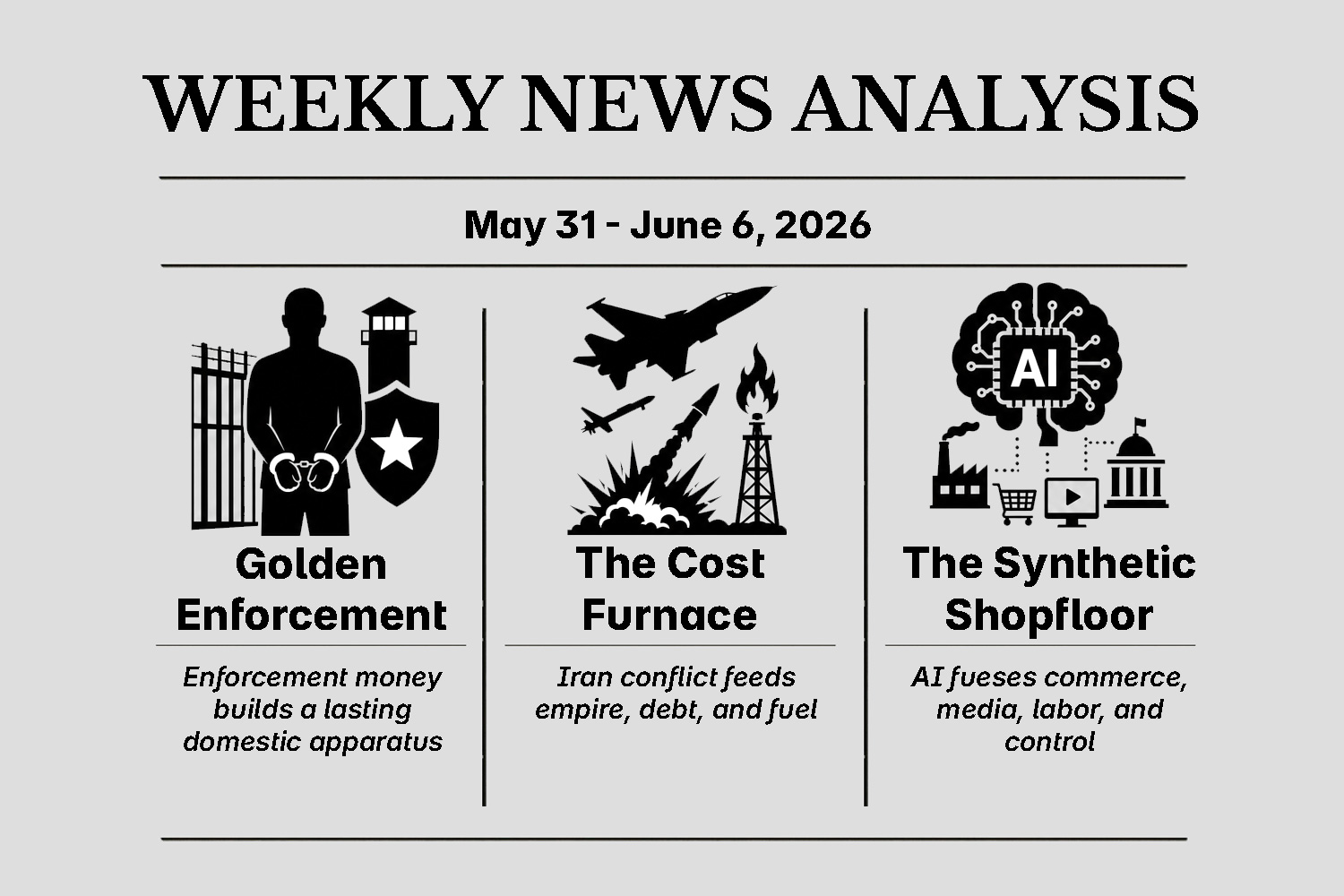
This week revealed a government system that no longer even pretends to shrink, restrain, or reform itself. It widened enforcement under the banner of border security, preserved a taxpayer-backed settlement pool for political allies, rewarded ballroom donors through sprawling federal contracts, advanced military-industrial integration with a foreign state, drove up war costs in Iran, and opened the door to government ownership stakes in artificial intelligence corporations.
The common thread is not simply corruption. Corruption suggests a deviation from the system’s “proper” function. What appeared this week was more structural than that. Immigration, war, defense technology, retail automation, industrial AI, and synthetic media all moved through the same pipeline: public fear is converted into public spending, public spending is routed into favored institutions, and favored institutions become operational partners of the state, all driving toward a complete surveillance police state built as a cage for the masses. We are then told this is protection, modernization, security, efficiency, or national greatness, all for our benefit. In practice, it is authority consolidated through spectacle and code.
The week’s deepest contradiction is that the political class keeps speaking in the language of freedom while building systems that make freedom increasingly conditional. A $70 billion enforcement bill is sold as a narrow response to “illegal” immigration, even though the enforcement architecture it funds can be adapted to broader domestic control. An Iran war is sold as decisive strength while its costs multiply into the same imperial sinkhole pattern seen in Afghanistan and Iraq. AI is sold as a convenience and a productivity tool while embedding itself across energy, retail, media, defense, and corporate governance. This is not scattered news. It is the architecture of the merger state.
Golden Enforcement
Senate passes $70 billion in new funds for ICE, Border Patrol - CNBC
Senate passes immigration enforcement bill without limits on Trump settlement fund - NPR
Key Data on Federal Benefits Paid to Illegal Immigrant Households - AEI
Donors won $50B in contracts after giving to Trump ballroom project, report says - Washington Post
Park Service bridge statues gold - New York Times
2027 NDAA Provision Seeks Sweeping US-Israel Defense Tech Integration - Military.com
The Senate’s $70 billion immigration-enforcement package was presented as a border-security necessity, but the deeper question is whether this money is calibrated to solve the stated problem or whether it expands a domestic enforcement machine under the cover of solving it. The public grammar of the debate is “illegal immigration,” but the operational grammar is personnel, detention capacity, surveillance, databases, field operations, transportation systems, contracting, and interagency coordination. ICE and Border Patrol are not merely deportation agencies; they are enforcement platforms. Once funded and expanded, platforms rarely stay confined to the emergency narrative used to justify them. They become standing capacity awaiting the next target category.
That contradiction sharpens when placed beside the claim that illegal immigration already costs taxpayers roughly $150 billion across federal, state, and local systems. If billions in lawful benefit structures and public-service burdens continue while deportation output historically fails to match political promises, the enforcement package begins to look less like a solution than a theatrical appropriation. The state first creates or tolerates the conditions, then funds the response, then demands applause for responding to the condition it failed to prevent. This is the Broken Window Fallacy in border form: shattered civic order becomes evidence that more public money must be spent repairing the damage, while the repair industry itself becomes permanent.
The rhetorical trick is the use of the word “illegal” as a moral solvent. It narrows public attention to one class of people while obscuring the state’s own role in designing the incentives, benefit channels, labor dependencies, legal loopholes, asylum bottlenecks, and enforcement failures that make the issue politically useful. Beneath it sits the premise that government failure can be fixed by giving the same government more money, more personnel, and broader coercive capacity. That premise rarely receives scrutiny because the immigration debate is emotionally loaded by design. The right-handed villain. The left is handed a humanitarian frame. Both are kept inside the same state-centered box: more policy, more funding, more enforcement, more dependency, more bureaucracy.
The preservation of the $1.776 billion “anti-weaponization” settlement fund makes the enforcement bill even more revealing. If taxpayer money can be reserved for Trump allies who claim they were targeted by the IRS or government agencies, the bill is not merely about border enforcement. It becomes a vehicle for political restitution, factional reward, and symbolic revenge. The government that allegedly abused power is now trusted to distribute compensation for that abuse, using money taken from the public through taxation. The logic turns circular: the state harms, the state investigates, the state compensates, the state expands, and the citizen pays at every stage. This is not justice; it is a closed circuit of power.
The ballroom-donor contract story belongs in the same frame because it shows spectacle and procurement merging. Trump presents a donor-funded military ballroom as a taxpayer-saving monument, yet the reported pattern of donors receiving or expanding federal contracts worth tens of billions exposes the old imperial mechanism: private tribute flows toward political image-making, then public contracts flow back toward aligned interests. This is not merely “pay to play” in the crude sense. It is court politics returning under corporate branding. The palace is renovated while the empire is leveraged. A donor does not need a brown envelope when the modern state offers procurement schedules, regulatory relief, enforcement discretion, and defense contracts.
Trump’s “Golden Age” aesthetic sharpens the symbolism. Golden statues, golden domes, golden branding, and gold-coded architecture are not accidental flourishes. Gold is monarchy’s visual language: permanence, sacred authority, conquest, empire, and wealth insulated from ordinary life. In a republic, gold symbolism should trigger suspicion because it converts public office into royal theater. The White House becomes a court. The defense shield becomes a halo. The ballroom becomes an altar. The ruler’s taste becomes a governing atmosphere. This is bread-and-circus politics filtered through Mar-a-Lago aesthetics: the public is invited to admire the shine while the contract machinery moves behind the curtain.
The 2027 NDAA’s U.S.–Israel defense-technology provision adds another layer to the consolidation. Its language does not legally merge the U.S. and Israeli militaries, create a joint command, or require American troops to fight Israel’s wars. That distinction matters. But the provision would create a formal Pentagon-led mechanism to coordinate research, testing, integration, procurement pathways, industrial partnerships, joint ventures, licensing, and co-production. The purpose is not merely academic exchange. It aims to move Israeli-origin or jointly developed technologies into U.S. systems, programs of record, acquisition channels, and fielded capabilities across counter-drone systems, anti-tunneling, missile defense, AI, quantum, autonomous systems, directed energy, cyber defense, electronic warfare, biotechnology, data fusion, logistics, and manufacturing.
The danger is practical interdependence masquerading as technical cooperation. Shared systems lead to shared doctrine. Shared procurement leads to shared incentives. Shared platforms lead to shared vulnerabilities. Shared industrial production leads to political reluctance to disentangle. Once militaries become interoperable across sensors, AI tools, targeting systems, manufacturing pipelines, and readiness planning, the legal distinction between separate national commands may remain intact, while the operational reality becomes harder to distinguish. That is the slippery slope: not a sudden merger, but a gradual fusion through dependency. If the process escalates over decades, future crises could raise questions that sound unthinkable today, including who American citizens are ultimately being prepared to fight for if foreign-policy entanglement becomes embedded in the machinery of conscription, procurement, and military readiness.
The Cost Furnace
Iran war live updates: Trump, Israel, Lebanon - CNN
Iran war news: Trump, oil prices, Kuwait, Bahrain, Hormuz - Fox News
Live Updates: Iran war news, Trump update, Strait of Hormuz, Lebanon, oil prices - Fox News
Iran, U.S. war, Israel, Hezbollah fighting, ceasefire efforts - CBS News
Iran U.S. war live: Trump strikes, drones, Israel, Kuwait, Bahrain - The Independent
Iran war live: U.S. says Iranian drones shot down, radar sites attacked - Al Jazeera
Live Estimate of U.S. Taxpayer Spending - Iran Cost Ticker
Another week of war with Iran produced another round of ceasefire rhetoric that collapsed almost as soon as it appeared. The public was told to watch diplomacy while the operational reality continued through drones, missile interceptions, radar strikes, attacks near the Strait of Hormuz, and warnings involving Kuwait and Bahrain. The linguistic framing remains familiar: restraint, response, readiness, deterrence, self-defense, limited strikes, and negotiations. Each term narrows the public’s moral field. “Limited” conceals cumulative cost. “Self-defense” conceals geographic sprawl. “Readiness” conceals permanent deployment. “Deterrence” conceals escalation. The rhetoric makes war sound like calibrated technical adjustments rather than a machinery of debt, death, and political entrapment.
Trump’s posture is especially revealing because he continues to threaten Iran while repeatedly granting more time, more openings, more conditions, and more rhetorical off-ramps. This creates a strongman paradox: the ruler performs inevitability while practicing delay. Supporters can interpret every threat as dominance and every delay as strategy, while critics see improvisation, drift, and cost accumulation. The hidden premise is that the executive can control escalation once it begins. History suggests otherwise. Afghanistan was not sold as a 20-year war. Iraq was not sold as a generational occupation. Both were presented as decisive operations with manageable time horizons, clear objectives, and overwhelming superiority. The war machine always begins with confidence and ends with accounting nobody wants to read.
The direct cost estimate of roughly $105 billion, paired with roughly $21 billion in indirect consumer burdens such as fuel costs, should have shattered the selective outrage around government waste. Let’s not even discuss the tens of trillions the DoD can’t account for over the last 30 years. The same right-wing ecosystem that can produce endless charts about “illegal” immigrant benefits often becomes strangely quiet when military spending burns through larger sums at imperial speed. Trump called for a $1.5 trillion “defense” budget for 2027, despite the country's $39 trillion debt. If the 2027 NDAA is approved, part of that budget could be used for international arms exchanges and trade with foreign nations under the guise of strategic cooperation. This is not a defense of welfare-state leakage or unlawful benefit structures. It is a demand for logical consistency. If taxpayer extraction is immoral when routed through migrant benefits, it does not become moral when routed through missile defense, naval deployment, contractor replenishment, energy shocks, and regional escalation. The fallacy is special pleading: waste is only waste when the wrong class of recipient receives it.
The cost structure of this war also exposes the asymmetry of modern empire. Iran can launch cheaper drones or missiles that force the United States and its allies to answer with expensive interceptors, aircraft, logistics chains, and naval assets. Every interception may be tactically successful while strategically draining. A war can be “won” in the nightly briefing and lost in the ledger. The American public sees explosions on screens but rarely sees the replenishment contracts, stockpile depletion curves, fuel costs, maintenance hours, emergency supplementals, and future interest payments attached to today’s action. The battlefield is not only in the Gulf. It is in the Treasury, the bond market, the household gasoline bill, and the unborn taxpayer’s balance sheet.
The Afghanistan and Iraq analogies are not rhetorical decoration. They are structural warnings. Both wars relied on emotional acceleration after crisis, moral framing against allegedly irrational enemies, optimistic timelines, and repeated redefinitions of victory. In Afghanistan, the objective moved from destroying al-Qaeda to defeating the Taliban to building democracy to training local forces to managing withdrawal optics. In Iraq, the objective moved from weapons of mass destruction to regime change to counterinsurgency to stabilization to regional balancing. The same drift can happen with Iran. A war that begins as nuclear prevention can become maritime security, then regime pressure, then proxy management, then base defense, then reconstruction, then a permanent deterrence architecture.
The media’s role is to fragment the pattern into daily updates. One outlet emphasizes Iranian aggression. Another emphasizes Trump’s threats. Another emphasizes ceasefire efforts. Another emphasizes oil and Hormuz. Another emphasizes regional humanitarian fallout. Each frame may contain facts, but the fragmentation prevents synthesis. The public is made to follow the moving parts rather than see the machine. In Trivium terms, the Grammar is scattered, the Logic is buried, and the Rhetoric is supplied preassembled by officials, analysts, and retired military commentators. The result is engineered consent through exhaustion. Citizens do not approve the war through informed understanding; they passively accept it because the update cycle never pauses long enough for moral accounting.
The unanswered question is duration. How long will this war last, and what will the total cost be at the end? No official answer should be trusted without suspicion because war forecasting is where government rhetoric is most consistently fraudulent. The more honest answer is that the war will last as long as it remains politically useful, financially absorbable, and strategically profitable to the networks that benefit from its continuation. If Afghanistan and Iraq are the template, the final cost will not be measured only in appropriations. It will be measured in veterans’ care, debt service, energy inflation, regional blowback, emergency powers, surveillance expansion, civil-liberty erosion, and future wars justified by the consequences of this one. Empire does not end wars; it rolls them forward. Remember, 1984 was a roadmap, not fiction.
The Synthetic Shopfloor
How C3 AI agents will automate predictive maintenance for Shell - Artificial Intelligence News
Amazon brings AI shopping assistant to retailers with Kate Spade - Artificial Intelligence News
Defense tech, AI, and fundraising take center stage at StrictlyVC Los Angeles - TechCrunch
Meta made its own AI-generated clickbait news feed - The Verge
The Trump administration might take an equity stake in OpenAI - TechCrunch
The AI stories this week were not separate technology items. They were sectoral previews of the same disruption: industrial AI in energy, retail AI in consumer behavior, cost-rationed AI inside corporate workflows, defense AI in venture capital, synthetic content inside media platforms, and possible government equity in OpenAI. This is how a general-purpose technology becomes a civilizational operating layer. It does not arrive through one law, one product, or one launch. It arrives through thousands of integrations that appear narrow in isolation but collectively replace human judgment, labor, attention, and consent with automated systems optimized for institutional goals.
Shell’s use of C3 AI agents for predictive maintenance shows the industrial side of the transformation. The public-facing rhetoric is safety, uptime, efficiency, and reduced environmental risk. Those benefits may be real in operational terms. But the structural shift is that AI agents begin moving from detection to decision support to workflow execution. They do not simply notice a problem; they investigate, diagnose, draft work orders, check inventory, generate procurement requests, and potentially automate responses. That is the shop floor crossing into algorithmic management. The machine does not merely assist labor. It begins managing the timing, priorities, and permissible actions of labor.
Amazon’s AI shopping assistant for retailers shows the consumer side of the same movement. The assistant is presented as a convenience, a personalization tool, a gift-giving guide, and a stress-reduction tool. But consumer AI is not neutral. It is a persuasion infrastructure. It learns preference, hesitation, emotional cues, price tolerance, occasion, identity signals, and behavioral patterns. When Amazon exports its shopping-agent architecture to other retailers, it exports not merely software but a commercial philosophy: every consumer interaction becomes a conversational funnel. The old sales clerk tried to help you buy what you wanted. The AI shopping agent is built to shape what "wanting" becomes before a purchase is made.
Walmart’s limitation of internal AI use reveals the economic reality beneath the hype. AI is sold as an abundance, but inference has costs. Tokens become rations. Productivity becomes metered. Employees are encouraged to automate, then disciplined by usage limits when automation becomes expensive. This exposes a likely future for many industries: workers will be expected to produce AI-enhanced output, but access to the tools will be controlled, priced, monitored, and optimized by management. The same worker who fears replacement may also be required to train, be prompted by, and depend on the system replacing him. The future workplace may not eliminate every job immediately; it may first turn every job into a monitored interface with corporate AI.
Defense-tech AI moving into venture-capital culture marks the militarization of innovation. Founders, investors, and national-security actors now speak the same language: autonomy, hard tech, advanced manufacturing, robotics, AI, and speed. The old Silicon Valley mythology of garage disruption has given way to a new mythology of battlefield disruption. The startup is no longer only trying to change how people shop, date, commute, or communicate. It is trying to change how states see, target, manufacture, and kill. This is where the AI boom fuses with the military-industrial complex. Venture capital supplies the myth of innovation. The government supplies the contracts. War supplies the urgency. The public supplies the money.
Meta’s AI-generated clickbait feed shows the epistemic danger. A corporation already sitting on massive social data can generate content that resembles news, entertainment, advice, and personalized media while blurring the line between reporting, fiction, engagement bait, and synthetic hallucination. The danger is not only that AI will create false stories. The greater danger is that platforms will generate personalized reality fragments designed to hold attention before the user even asks. This converts media from information delivery into proactive behavioral steering. Propaganda no longer needs a central broadcaster when each person can be fed a custom stream of algorithmic suggestions disguised as relevance.
The possible Trump administration equity stake in OpenAI is the most politically revealing AI story because it exposes the fusion of government, capital, and technological control. Supporters may frame public equity as a way for citizens to benefit from the upside of AI. That sounds populist. It sounds almost anti-corporate. But the deeper structure is state ownership influence inside strategic corporations. Trump’s supporters often claim to hate socialism, yet many cheer when the state takes ownership stakes, directs corporate winners, punishes enemies, rewards allies, and uses public power to shape private enterprise. This is not free-market capitalism. It is a national-socialized corporate model: government and corporations fused under nationalist rhetoric, with the public told that state participation equals shared prosperity.
The phrase “seizing the means of production” is usually associated with left-wing socialism, but the modern version does not need factory expropriation in the old Marxist image. It can happen through equity stakes, emergency funding, defense contracts, regulatory pressure, platform partnerships, data-sharing arrangements, procurement dependency, and national-security classification. In AI, this matters because the “means of production” increasingly means compute, models, data, cloud infrastructure, chips, energy access, and deployment channels. Whoever controls those layers controls future labor, media, defense, commerce, and governance. AI is still in its infancy, but infancy is precisely when institutional capture matters most. Once the architecture matures, the public will be told it is too essential to unwind and too dependent on to give up.
The Merger State
This week’s pattern is clear: enforcement, war, defense integration, corporate procurement, artificial intelligence, and media synthesis are converging into one governing logic. The state funds the crisis response, the corporation builds the tools, the media frames the debate, and the citizen is positioned as payer, subject, consumer, and data source. The old distinction between public and private power is becoming less meaningful because both now operate through shared systems of surveillance, automation, contract dependency, and narrative control. This is digital feudalism with patriotic branding: the lords are corporate-state hybrids, the castles are platforms and agencies, and the peasants carry smartphones that double as workstations, wallets, monitors, and confession booths.
Natural rights cannot survive as ceremonial language while every practical system moves toward a permission-based life. The right to property is hollowed out when taxation funds wars, settlements, monuments, and corporate stakes without meaningful consent. The right to freedom is hollowed out when enforcement tools built for one class can be redirected toward another. The right to life is hollowed out when war becomes a cost-ticker, and AI becomes the nervous system of future targeting, rationing, persuasion, and labor control. The warning is not that tyranny arrives in one dramatic announcement. It arrives as a thousand “reasonable” integrations, each sold as a promise of safety, efficiency, modernization, or greatness.
The Trivium remains the necessary defense. Grammar asks what is actually happening beneath the slogans. Logic asks whether the claims match the outcomes. Rhetoric demands that conclusions be spoken clearly enough to break the spell. This week, the spell was gold, security, patriotism, technological wonder, and wartime necessity. The reality beneath it was consolidation. The future will not be decided by whether citizens can repeat partisan slogans louder than the other side. It will be decided by whether they can still identify the machine when it calls itself protection.
Listen to this week's news in verse for a quick recap!