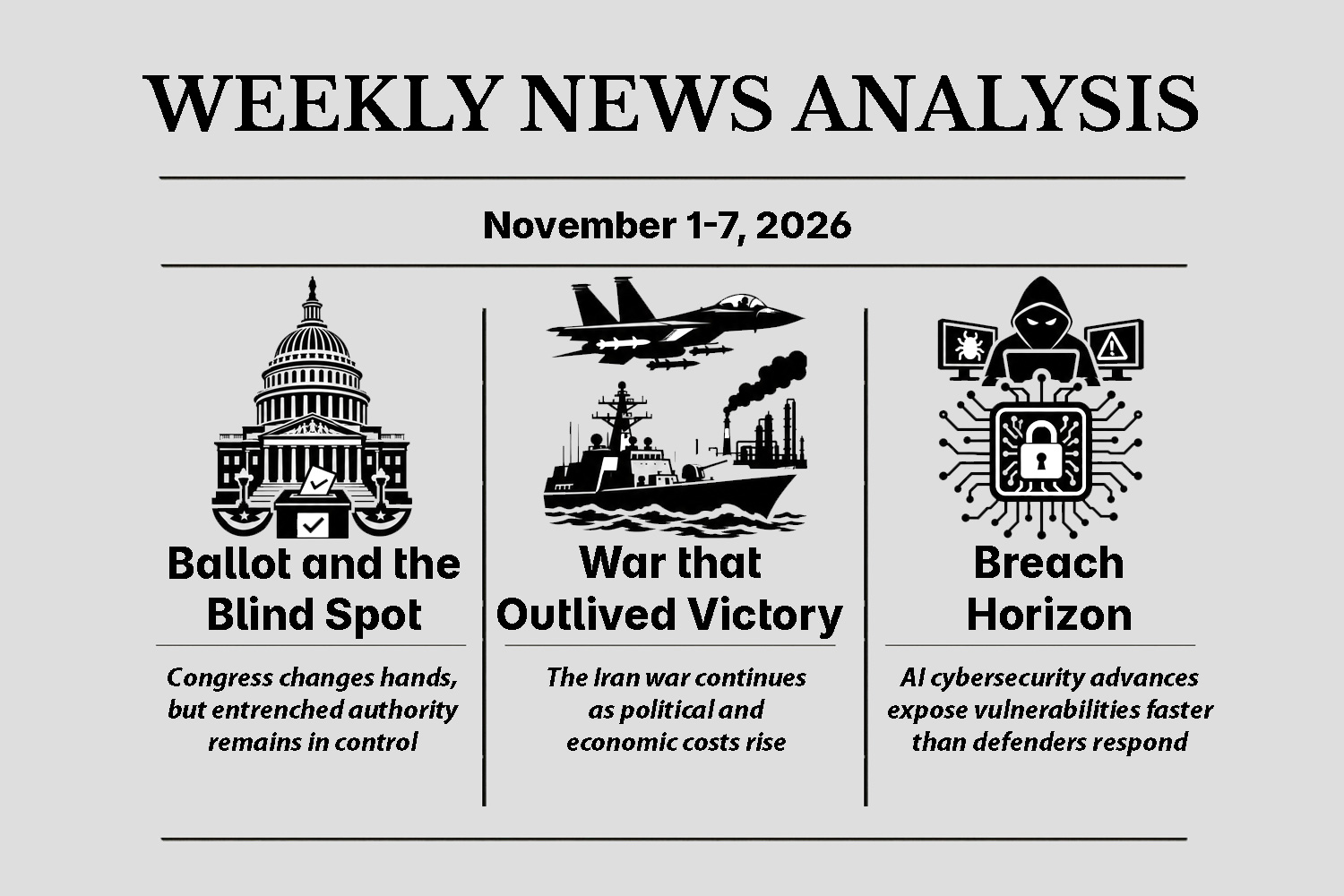
This week brought a decisive electoral reversal to the American political machine, yet the institutions that run political power remain firmly entrenched. Democrats gained control of both chambers of Congress, President Donald Trump faced the political repercussions of an increasingly unpopular war with Iran, and advances in artificial intelligence exposed how quickly technology is outpacing the institutions charged with overseeing it. Together, these developments reveal a persistent contradiction in modern governance. Citizens are periodically permitted to replace those who represent them, while the machinery of coercion, surveillance, economic dependency, and technological control continues to expand regardless of the faction occupying office. Elections may replace the individuals authorized to operate that machinery, but replacing its operators does not necessarily alter the machinery itself.
Political accountability, military intervention, and digital infrastructure no longer function as separate concerns, a relationship made increasingly apparent by the events of this week. Trump's electoral defeat has diminished his legislative influence without ending the war with Iran. At the same time, increasingly capable AI cybersecurity systems raise questions about who will direct and control the next generation of digital infrastructure. The tragic Florida plane crash that killed the founder of an identity-data company also demands a distinction between the evidence emerging from an unfinished investigation and the broader consequences of technologies that identify and profile individuals across digital environments. Beyond the question of who holds political office lies a more consequential issue: how extensively governments and corporations can exercise control over populations through systems that function without meaningful individual consent.
Ballot and the Blind Spot
Midterm Election and Congress Live Updates - CNN
2026 Midterm Election Day Live Updates - The New York Times
Democrats' Historic Wins in Midterm Blue Wave - Fox News
Trump Says Democrats Did a Good Job and Blames Republican Candidates - PBS NewsHour
White House Won't Comment on Trump's Midterm Promises Including $5000 Checks - CNN
Tech Entrepreneur Wife Kids and Friends Among Victims in Florida Plane Crash - The Independent
Identity Resolution Platform - Retention.com
The November 3 midterm elections dealt a sweeping defeat to Republican congressional control, placing Democrats on course to command majorities in both the House of Representatives and the Senate. Their gains were not confined to traditionally competitive districts. Republicans lost seats in Texas, Kansas, South Carolina, Iowa, Ohio, Maine, and North Carolina. By November 6, Democrats had won at least 54 Senate seats, while House Democratic Leader Hakeem Jeffries projected a majority of approximately 255 seats, potentially higher once unresolved races were decided. Although the new Congress will not exercise its authority until January 2027, the results represent a substantial political setback for the Trump administration. Their implications extend beyond electoral arithmetic. Voters have shifted the balance of institutional power while the presidency seeks to sustain military operations overseas and preserve its domestic policy accomplishments. Yet a change in congressional control does not dismantle centralized authority. Federal agencies, intelligence organizations, financial institutions, and military infrastructure will remain in operation regardless of which party directs Congress.
The election exposed a particularly revealing contradiction in Trump's approach to political responsibility. In rallies and interviews before November 3, he repeatedly told supporters to imagine they were casting a ballot for him personally, contending that Republican turnout rose dramatically whenever his name appeared before voters. He framed the contest as a judgment on his presidency, economic policies, immigration agenda, and accomplishments since returning to office. Once Republicans suffered devastating losses, however, Trump stressed that he had not actually been on the ballot and argued that his popularity had not carried over to Republican candidates. The distinction allows political influence to be claimed when useful and political responsibility to be disclaimed when the outcome becomes unfavorable. Republican victories could reasonably have been credited, at least in part, to Trump's campaigning. Defeat instead became a question of inadequate candidates and his absence from the ballot. Such selective reasoning demonstrates how political rhetoric can be reshaped to preserve personal authority after the very strategy an individual promoted has failed.
Trump's response to the election was marked by surprise, criticism, congratulations, and an effort to preserve institutional leverage. Although he credited Democrats with running effective campaigns, he faulted Republican candidates for failing to mobilize his supporters and cited the economic consequences of the Iran war. Even Fox News drew his criticism, illustrating how politically sympathetic media can become convenient targets when expectations are not met. Trump also expressed a willingness to engage with Democratic congressional rulers, yet coupled that offer with an unmistakable reminder of presidential veto power. The contradiction deserves scrutiny. Genuine cooperation requires negotiation, compromise, and an acceptance that the outcome may differ from one's preferred agenda. Emphasizing the ability to veto legislation instead underscores the power the presidency retains after losing Congress. Both positions are constitutionally compatible, but together they expose a familiar strategy: promise cooperation while warning that legislation still requires executive approval or enough congressional support to overcome a veto. The resulting struggle may limit new legislation without substantially weakening executive authority.
The electoral reversal has also coincided with changes inside Trump's administration. On November 6, Stephen Miller, among Trump's most influential and ideologically committed advisers, replaced Susie Wiles as White House chief of staff. A principal architect of the administration's immigration agenda thereby assumed one of its most consequential operational roles. Senior Justice Department departures included Civil Rights Division leader Harmeet Dhillon, National Security Division chief John Eisenberg, and Southern District of Florida U.S. Attorney Jason Reding Quiñones. Changes after a significant political defeat tend to reflect uncertainty about the administration's new position. Aggressive congressional oversight, subpoenas, budget disputes, and investigations of activities formerly protected by unified Republican control may lie ahead. The departures could therefore reflect routine succession, political realignment, or an effort to tighten executive discipline in anticipation of an adversarial Congress.
Among Trump's pre-election promises, perhaps none exposed the transactional nature of political campaigning more clearly than the offer of $5,000 to every adult American citizen if Republicans maintained control of both chambers. The proposed Trump dividend made a financial benefit conditional upon an electoral outcome favorable to the president's party. Other state-specific commitments included intervention in North Carolina water contamination litigation, investment in a Kentucky drug manufacturing facility, agricultural fuel policies affecting Kansas and Iowa, and continued support for Alaska. After the election, the White House did not definitively explain whether these pledges remained in effect. The $5,000 payments were especially doubtful: no credible financing method, enacted appropriation, or workable administrative distribution plan existed. Depending on eligibility, paying the adult population would cost more than one trillion dollars. Republican defeat rendered the stated condition unattainable, allowing the administration to escape the promise. Whether Trump would have delivered the payments after a victory remains unknowable, but the lack of a concrete funding plan made the proposal questionable even had Republicans retained unified control.
Beneath these campaign promises lies a more persistent problem: cultivating electoral dependency through government-distributed benefits. As living expenses rise, citizens are encouraged to seek financial relief from political institutions that also influence inflation, taxation, fiscal deficits, economic restrictions, and international conflicts that contribute to those burdens. This is precisely the contradiction examined in The Fallacious Belief in Government: Warp Speed Toward Tyranny: governments portray themselves as necessary solutions while retaining power over the circumstances that create the problems. The cycle is politically advantageous. Financial instability creates demand for assistance; politicians help in return for support; authorized benefits require government administration; and dependence survives. Democrats must now confront the same contradiction through promises of affordability and accountability constrained by a divided federal government. If the underlying mechanisms remain untouched, their electoral victory may simply produce another temporary reset within the same governmental lifecycle.
The tragedy of November 1 warrants serious examination, but speculation must not displace established evidence. A Learjet 60 flying from Austin, Texas, to the Bahamas crashed near Greenacres in Palm Beach County, Florida, killing nine people. The victims included Adam Robinson, technology entrepreneur and founder and chief executive of Retention.com and RB2B; his wife, Helen Sharp; their two young children; family friends; their nanny; and the flight crew. Available reports describe icing conditions, precipitation, and severe turbulence before the aircraft rapidly descended and crashed. The crew reported distress to air traffic controllers, while investigators collected wreckage at and around the impact site. In its November 5 update, the National Transportation Safety Board confirmed that recovery efforts and physical examination of the debris were continuing. Investigators had reached no final determination of cause. Weather, aircraft performance, and possible structural failure therefore remain substantial grounds for investigating a conventional aviation emergency. The available evidence, however, does not justify declaring that every other possibility has been ruled out.
Questions about a possible missile strike emerged from the violence of the crash, including speculation about an accidental launch or targeting error at a nearby military installation. Florida Governor Ron DeSantis compared the descending aircraft to a missile. Yet describing what something looked like is fundamentally different from establishing what caused it. An aircraft falling at extraordinary speed may resemble a projectile without having sustained a weapons strike. Supporting a missile hypothesis would require verifiable evidence, such as military radar records, documented launch activity, air-defense telemetry, recognizable weapon fragments, blast signatures, or damage incompatible with an ordinary aircraft failure. Public findings available through November 6 have established none of these indicators. The missile theory consequently remains unsupported and considerably less compelling than the documented circumstances surrounding an aviation emergency. Government secrecy and historical military misconduct deserve examination in their own right, but neither can be substituted for evidence that a weapon played a role in this incident. Observation must precede interpretation, particularly when the allegation is as consequential as military involvement.
The tragedy also brings attention to the growing digital identity and behavioral-data industry through Robinson's work at Retention.com. The company developed methods to identify website visitors who had previously remained anonymous, enrich those identities, and associate online activity with consumer and professional profiles. Its platform includes hashed email identifiers, mobile advertising identifiers, internet protocol addresses, demographic characteristics, professional information, behavioral signals, and purchasing intent. RB2B and related products allow businesses to associate visitor behavior with identifiable individuals or organizations and feed that information into marketing and sales systems. Retention.com names Adam Robinson, Tate Blahnik, and Diana Ross as founders. Its commercial network also encompasses marketing platforms, data customers, CRM integrations, and partnerships, including RB2B's relationship with Demandbase. The company characterizes its practices as consent-aware and provides privacy and opt-out options. Legitimate commercial applications nevertheless coexist with substantial privacy concerns when accumulated personal data can be shared, combined, or redirected in ways the people being identified did not anticipate. With the direction the world is heading, questions should be asked: was this plane crash a tragic accident or a conspiracy assassination? The greatest conspiracies are ones that can’t be proven, even if real.
Sustainable Development Goal 16.9 of the United Nations–Agenda 2030–seeks legal identity for everyone by 2030, including birth registration. Establishing legal identity is not synonymous with universal commercial surveillance, and no verified evidence links Retention.com to a covert United Nations or World Economic Forum control program. However, the structural risk remains significant, which must drive the question: could there be more to the plane crash? As identity systems become interoperable with financial services, employment, healthcare, consumer activity, and government records, the opportunities for centralized profiling and coercion expand. Artificial intelligence compounds those dangers by transforming otherwise disconnected records into predictions about individual behavior. An identity graph originally developed for commerce can become useful for surveillance without being designed for that purpose. The critical issue is functional convergence: technologies separately justified by marketing, administration, security, or convenience may collectively support behavioral classification and influence without the informed understanding or meaningful consent of those affected.
Questions of motive, capability, and evidence must govern any hypothetical assassination theory rather than allowing the theory to become an assumed explanation for Robinson's death. It is fine to theorize about different possibilities, but before accepting any as truth, that acceptance must be grounded in Grammar, Logic, and rhetoric. Could acquiring Retention.com's identity-data assets after a founder's death be a reasonable motive? Examination would then have to address ownership, voting rights, succession arrangements, contractual obligations, acquisition interests, intellectual property, and access to the company's data infrastructure. A founder's sudden death can alter corporate governance and open legitimate avenues for succession, investment, or acquisition; it does not, by itself, hand control to an adversary. Robinson publicly described the business as bootstrapped. An allegation of deliberate killing would require independently verifiable evidence of sabotage, financial interests, suspicious communications, or comparable indicators of criminal activity to confirm as true. None has been publicly established, and it probably never will be.
In this hypothetical assassination scenario, the potential aim would be to acquire an existing identity-resolution infrastructure and expand it into AI-powered behavioral analytics, political advertising, institutional monitoring, or other forms of data exploitation. An organization with these capabilities could infer political or social affiliations, purchasing patterns, professional connections, geographic behavior, and individual vulnerabilities. The demonstrable concern lies elsewhere and does not depend on the circumstances of Robinson's death: private companies already control technological capabilities that would have been extraordinary surveillance tools just decades ago. As AI becomes more valuable to powerful institutions, it becomes increasingly important to ask whether these systems can remain subject to meaningful consent, transparency, and individual control. Investigators should pursue the tragedy rigorously, while the identity-data environment Robinson helped create warrants separate scrutiny for its own capabilities and consequences. Most likely, this was simply a tragic accidental plane crash, even if an assassination theory seems more plausible than an errant missile.
War that Outlived Victory
Republicans Turn Against Pete Hegseth After Iran War and Midterm Defeat - CNN
Trump Weighs Resuming Iran War as CENTCOM Prepares for Possible Strikes - Fox News
Iran War Updates and Strait of Hormuz Developments - CBS News
Iran War Updates as Trump Discusses Tehran Negotiations - Al Jazeera
Iran Submits Nuclear Proposal as Hegseth Defends War - Fox News
Iran's IRGC Told Americans to Vote Out Trump's Party - The Gateway Pundit
The confrontation involving the United States, Israel, and Iran has entered a politically extraordinary stage. Promises of rapid military victory have given way to a prolonged conflict with no apparent lasting settlement. The U.S.-Israeli campaign began February 28, 2026; by November 7, 252 days had elapsed, making it the 253rd calendar day when the opening date is counted as day one. The distance between early declarations of a brief operation and the continuing conflict exposes the danger of confusing political optimism with attainable military objectives. Initial attacks devastated Iranian military facilities and infrastructure, but destruction on the battlefield failed to produce an enduring political agreement. Months of reduced direct attacks, periodic escalation, maritime clashes, sanctions, and diplomatic maneuvering followed. Those consequences have now reached Washington itself, where the electorate has substantially weakened the administration that launched the campaign. Military achievements, however extensive, cannot substitute for a sustainable political outcome.
The midterms illustrate how an overseas military campaign can become a liability at home once its economic consequences reach ordinary citizens. The Iran war contributed to higher energy prices, disrupted maritime commerce, and created uncertainty across the American economy. Households struggling with rising costs encountered an administration still defending an expensive foreign intervention while failing to deliver the affordability gains it had promised domestically. Yet assigning the Democratic victory entirely to Iran would be an analytical error. Economic discontent, demands for government accountability, candidate quality, administration conduct, and domestic policy all shaped the results. Vice President JD Vance stressed the political damage the war caused, while Trump conceded its influence without withdrawing his justification for initiating the intervention. Electoral defeats are seldom attributable to a single factor. Nevertheless, political rulers often have an incentive to substitute one convenient explanation for a complex reality, especially when doing so transfers responsibility to a subordinate or to an international crisis portrayed as unavoidable.
Despite diplomatic discussions, the week's military activity made clear that the confrontation remains dangerous. U.S. forces launched limited attacks against Iranian military targets on Qeshm Island near the Strait of Hormuz on November 2. American officials described those strikes as defensive responses to incidents involving Iranian surface-to-air missiles and threats against U.S. aircraft and regional shipping. On November 6, President Trump confirmed additional limited American strikes on an Iranian air-defense target near the same strategically significant island. Iranian authorities separately asserted that they had intercepted American unmanned aircraft near the strait. Determining which party attacked most recently requires identifying the specific engagement and evaluating independently verified accounts; competing official statements cannot be accepted as fact. Direct military confrontation has plainly continued beyond the election. The language used to justify it is equally instructive. Washington calls its actions defensive, while Tehran describes American operations as aggression and its own actions as resistance. Each government thus attempts to secure moral legitimacy before the circumstances of individual encounters have been independently established.
Few locations carry a greater risk of international escalation than the Strait of Hormuz. British maritime reporting documented eight attacks on vessels in or around the strait during the week, together with three incidents elsewhere in the Arabian Gulf. Of the eleven vessels affected, the weekly account stated that three continued sailing, five needed assistance, and three sank. Responsibility for individual events remains uncertain. Iran's Islamic Revolutionary Guard Corps attributed damage to multiple tankers to mines encountered on unauthorized routes, but maritime authorities had not independently confirmed every incident reported by Iranian state media. A tanker near the Omani coast also reported a waterline explosion, while a suspected missile attack on the MT Velos Sapphire in the Persian Gulf killed one crew member. Confirmed damage must be distinguished from disputed explanations for its cause. Even where responsibility cannot be conclusively established, insecurity at sea carries real economic costs. Higher insurance costs, rerouted vessels, delayed shipments, and shifting market expectations can turn localized incidents into broader commercial pressure.
Negotiations have proceeded under the continuing threat of further devastation, exposing the distance between diplomatic assurances and military conduct. Qatar has mediated exchanges between Washington and Tehran, while Iranian representatives advanced proposals addressing sanctions relief, compensation for wartime damage, frozen-asset releases, diminished American military activity, and an end to regional hostilities. Trump has maintained that a settlement remains possible even as he warns that renewed strikes could destroy much of Iran's remaining infrastructure. Washington further announced rewards of up to $20 million on November 6 for information about Iran's nuclear program. Rather than eliminating coercion, these efforts reveal how both governments employ it to improve their bargaining positions. Iran demands recognition of its sovereignty and relief from economic restrictions; Washington seeks limitations intended to prevent Iranian nuclear weapon development. Neither side wants its concessions to resemble surrender. Diplomatic discussions therefore coexist with military threats, encouraging displays of strength whenever either government believes negotiations may benefit the other.
Following the administration's electoral and military setbacks, Defense Secretary Pete Hegseth has become a possible focus for redirected political blame. Republican lawmakers began questioning his rulership both privately and publicly after the midterms, while Representative Thomas Massie prepared to renew an impeachment effort. Criticism concerns the war's strategic course, Pentagon management, dismissals of senior military officers, and demands for greater defense spending. Hegseth defended the campaign and urged Congress to approve at least $350 billion in additional defense-related funding as part of a broader spending initiative. Yet attributing the administration's military decisions primarily to its defense secretary creates an institutional contradiction. Under the applicable constitutional framework, the president serves as commander-in-chief and ultimately authorizes military operations. Hegseth's advice, conduct, and operational supervision warrant their own scrutiny, but his removal would not absolve Trump of responsibility for beginning and continuing the war. Scapegoating serves political interests when blame can be shifted from the institution that made the decision to a replaceable official whose departure might protect the administration.
Iranian rulers have interpreted the Democratic congressional gains as evidence that their ability to withstand military pressure has generated political consequences in the United States. Political figures in Iran characterized the result as a public rejection of Washington's war policy; the IRGC had earlier called on Americans to vote out those responsible for the conflict. Tehran can readily exploit this interpretation for propaganda, portraying Republican losses as evidence that military superiority does not ensure political success. Democratic control of Congress could also increase demands for oversight, war-powers limits, funding restrictions, and negotiated de-escalation. Nevertheless, claiming outright Iranian victory would distort the picture. Iran has sustained serious destruction of military assets and infrastructure, continues to face substantial economic sanctions, and remains confronted by American forces throughout the region. The incoming Congress cannot immediately dictate policy, and Democratic legislators themselves may differ on acceptable settlement terms. Iran may have acquired additional negotiating leverage, but its practical value depends on subsequent political events rather than following automatically from the election.
Several paths remain possible during the rest of 2026, and none assures a lasting peace. Qatar could mediate a limited agreement that decreases maritime attacks, establishes inspection measures, and temporarily eases sanctions or military pressure. Negotiations might instead stagnate, leaving both governments to employ economic coercion and threats of force amid occasional direct attacks. A far more dangerous course would involve extensive new American or Israeli strikes and Iranian retaliation directed at regional military facilities, shipping lanes, energy infrastructure, or allied interests. Such an escalation could quickly destroy the economic optimism surrounding prospects for a negotiated settlement. Political incentives further complicate the situation: Trump may want a recognizable foreign-policy success after the election, while Iranian rulers may calculate that continued resistance can secure additional concessions. Afghanistan, Iraq, and other prolonged military interventions demonstrate that tactical advantages alone do not ensure sustainable political results. Ending a war becomes especially difficult when each side insists upon defining peace as an admission of defeat by the other.
Breach Horizon
How a Blue Wave Midterm Might Reshape the AI Industry - TechCrunch
House Bill Revives OTA as AI Reshapes Legislative Expertise - Artificial Intelligence News
Hundreds of Artex AI Hacking Tools Found Publicly Exposed to the Web - TechCrunch
OpenAI Released a New Cybersecurity Model Is That Enough - TechCrunch
OpenAI Cyber Model Found 948 Linux Kernel Exploits - Artificial Intelligence News
Democratic control of Congress has raised expectations of significant changes to federal artificial “super” intelligence policy, particularly in data center development, corporate oversight, and regulation of advanced AI systems. The election also revealed public resistance to parts of the industry's physical expansion. According to TechCrunch, voters faced 41 ballot measures concerning data centers and supported tighter development restrictions in all but one case. Concerns over electricity consumption, water supplies, land use, infrastructure costs, and how AI investment benefits are allocated appear central to that resistance. Yet rejecting particular projects is not the same as opposing artificial intelligence altogether. Regulating the consequences of new facilities differs fundamentally from challenging the distribution of technological power. Democrats may favor more demanding disclosures, environmental limitations, and corporate oversight, but the economic, military, and strategic interests sustaining AI development are not confined to either party. Consequently, Congress is more likely to set the terms of continued expansion than to halt it.
Artificial intelligence has become a strategic priority for both political parties because its applications extend across military operations, cybersecurity, intelligence collection, industrial competitiveness, healthcare, transportation, financial systems, and government administration. These interests allow technological development to be promoted simultaneously as an economic imperative and a matter of national security. Such framing restricts the space for meaningful opposition. Legislators who question the concentration of AI infrastructure risk accusations of undermining American technological leadership; those who favor development without restrictions can instead be charged with disregarding workers, communities, privacy, and environmental resources. As a result, political disagreement often centers on the terms of regulation while overlooking the deeper issue of who owns and controls systems that can influence social conduct. Democrats and Republicans may dispute corporate liability, algorithmic discrimination, and development limits, yet still endorse the concentration of computing resources and institutional power the industry increasingly depends on. The arguments differ, but the underlying structure of authority may remain unchanged.
Congress has begun confronting the gap between its technical understanding and the pace of technological development. In a bipartisan effort, representatives introduced H.R. 10946, the Congressional Office of Technology Improvement and Enhancement Act, which would restore the functions of the long-defunded Office of Technology Assessment through a new Congressional Office of Technology. Established under the Technology Assessment Act of 1972, the earlier office was effectively abolished when funding ended in 1995. The proposed replacement would provide lawmakers with technical research, analysis, and policy recommendations on complex emerging technologies, including artificial intelligence. It would also create a fourteen-day turnaround for designated technical assistance requests, enabling congressional committees and offices to obtain faster evaluations. This proposal offers a potentially useful improvement, yet its necessity reveals an institutional failure. For more than three decades, Congress operated without the independent technical expertise it now recognizes as essential, even as corporations created increasingly complex systems and legislative understanding struggled to keep pace.
Reestablishing a congressional technology assessment function, however, does not by itself ensure independent judgment or effective oversight. Its value will depend on qualified staffing, research freedom, access to reliable information, disciplined analytical practices, and safeguards against political and corporate pressure. Major technology companies command financial resources and specialized knowledge that public institutions may be unable to match. That imbalance invites regulatory capture: an agency responsible for evaluating a sector becomes reliant on that sector's data, explanations, and preferred methods of analysis. A comparable problem emerges when lawmakers use AI tools to assess proposals intended to regulate AI. Such systems may speed legislative research, but their conclusions must be transparent, reproducible, and independently verifiable. Otherwise, technical assistance advertised as objective merely creates another institutional dependence. The Trivium Method of Critical Thinking remains relevant here through its separation of evidence gathering, examination of reasoning, and communication of conclusions. Accessing information more quickly does not guarantee understanding when those providing it have a stake in the resulting policy.
This week's cybersecurity reports expose dangers that extend far beyond familiar discussions of consumer protection and market competition. Researchers discovered more than 800 instances of Artex, a Chinese-developed autonomous penetration-testing system, publicly reachable on the internet. Capable of sophisticated security operations, Artex was distributed as open-source software so organizations and individuals could run independent deployments. Many of those installations, however, were reportedly exposed without authentication. The problem was therefore not simply the availability of offensive security software or the decision to release its code. Operational tools had been configured in ways that could allow unauthorized parties to use them. Security investigators and prominent technology companies have also associated Artex with earlier cyber incidents involving financial institutions and enterprise cloud services, including attacks affecting ConnectWise customers. Together, these developments show how automated offensive functions, weak deployment controls, and freely distributed code can expand the opportunities for malicious activity. Software intended to support authorized penetration testing can become a serious threat without essential safeguards.
OpenAI's release of GPT-6 Cyber marks another consequential shift in the relationship between artificial intelligence and offensive cybersecurity. Access to the specialized model was restricted to vetted users, with authorized vulnerability research, exploit validation, and remediation identified as its intended purposes. The accompanying research showed that autonomous systems can inspect extensive software projects and expose security weaknesses on a scale that previously demanded extraordinary human labor. During a mid-October examination of the Linux kernel, OpenAI's pipeline produced 2,308 candidate findings, dynamically reproduced 1,724 vulnerabilities, and developed working local privilege-escalation exploits for 948 distinct vulnerabilities. The effort required approximately $1.2 million in API credits. Although significant, these findings require careful interpretation. Local privilege escalation generally presupposes some degree of initial system access; the results do not demonstrate 948 remotely exploitable entry points across the internet. Nor does the discovery of hundreds of vulnerabilities establish that malicious actors have already exploited them. The research shows an extraordinary expansion of investigative capacity, along with an equally pressing need to strengthen defensive processes.
The central cybersecurity concern is the shrinking interval between vulnerability discovery and exploit development, disclosure, and potential malicious use. Finding sophisticated flaws once demanded extensive manual investigation, specialized knowledge, and repeated testing. Advanced AI can increasingly automate these tasks by inspecting codebases, tracing suspicious execution paths, validating weaknesses, and evaluating whether they can be exploited. Yet the institutions responsible for defense remain constrained by slower processes involving verification, patch development, regression testing, coordinated disclosure, deployment approvals, and software compatibility. An AI system may uncover a flaw within hours, while affected organizations require weeks or months to deploy a reliable correction. The danger, therefore, extends beyond faster discovery. It lies in the growing disparity between how quickly vulnerabilities become known and how slowly organizations can eliminate them. As accessible commercial models improve and open-source capabilities proliferate, methods once reserved for technically sophisticated attackers may become practical for a much broader population of malicious actors.
These developments suggest an approaching period in which systemic cyber incidents may arise from vulnerabilities identified and exploited at extraordinary speed. A critical flaw in a widely deployed operating system component, authentication service, cloud platform, software dependency, or critical infrastructure product could expose enormous numbers of organizations before defenses can be coordinated. Such an event is plausible, not inevitable; its scope would depend upon exploit prerequisites, the systems exposed, attacker access, and the effectiveness of remediation. The more fundamental problem is society's increasing reliance on interconnected digital environments. Financial services, transportation, energy, communications, healthcare, and government operations depend on overlapping software supply chains and identity infrastructure. A widespread compromise could therefore disrupt far more than the confidentiality of individual records. Under these conditions, cybersecurity is no longer simply a responsibility assigned to IT management. It becomes a measure of societal resilience, institutional accountability, and the risks of concentrating essential functions in systems on which entire populations depend.
The risks are not confined to malicious hackers. Those same technical advances can also expand the reach of corporate and governmental surveillance. Automated vulnerability discovery, identity resolution, behavioral analytics, and autonomous decision-making have legitimate applications, yet each can strengthen the capacity to monitor and control populations. The issue is not whether AI itself has political intentions, but who directs its deployment, what safeguards restrict its operation, and whether individuals can meaningfully challenge decisions that affect them. Governments and industry will likely respond through expanded cybersecurity standards, mandatory controls, reporting obligations, technical oversight, and closer government-industry partnerships. These measures may be necessary to protect essential infrastructure, but they can also deepen reliance on centralized certification systems and dominant technology providers. Security must be verifiable without allowing the promise of safety to justify unrestricted surveillance. Decentralized infrastructure, independent auditing, data minimization, meaningful consent, and transparent technical accountability demonstrate that the choice need not be between insecurity and ever-greater concentrations of institutional authority.
Conclusion: The Machinery Beyond the Vote
The week's events reveal a recurring pattern across political governance, military intervention, and technological development. Crises generate demands for action; action expands institutional authority; and the consequences can establish conditions for another crisis. The Democratic electoral victory has transformed the congressional balance of power without dismantling the administrative, military, financial, and intelligence structures accumulated by successive governments. The war with Iran continues to impose costs upon populations even as its architects confront political consequences. Meanwhile, AI has accelerated defenders' and attackers' ability to uncover vulnerabilities faster than established institutions can respond. These developments reflect the structural argument explored in COVID19 – Short Path to ‘You'll Own Nothing. And You'll Be Happy.’: managing crises can normalize extraordinary interventions and reinforce dependency on the institutions claiming to resolve them. That argument identifies a potential trajectory. It does not establish that every crisis originates from deliberate manufacture or centralized coordination.
What follows will depend less on partisan rhetoric than on decisions about the reach of institutional authority, the concentration of technology, and preserving individual autonomy. Congressional investigations can reveal misconduct, but oversight has little meaning when findings fail to produce accountability. Negotiations may restrain the violence of war, yet peace cannot be measured solely by a temporary suspension of attacks. Artificial intelligence can improve cybersecurity and administrative efficiency, but those benefits do not justify surrendering privacy, decentralization, or meaningful human control. The more consequential danger is a society in which citizens continue selecting political representatives while losing practical control over the systems directing their economic opportunities, digital identities, information, and freedom of movement. Changing who operates an increasingly powerful machine does not limit what that machine can do. Society must decide whether technological progress will advance individual independence or make centralized control more efficient, less visible, and increasingly difficult to resist.
Listen to this week's news in verse for a quick recap!