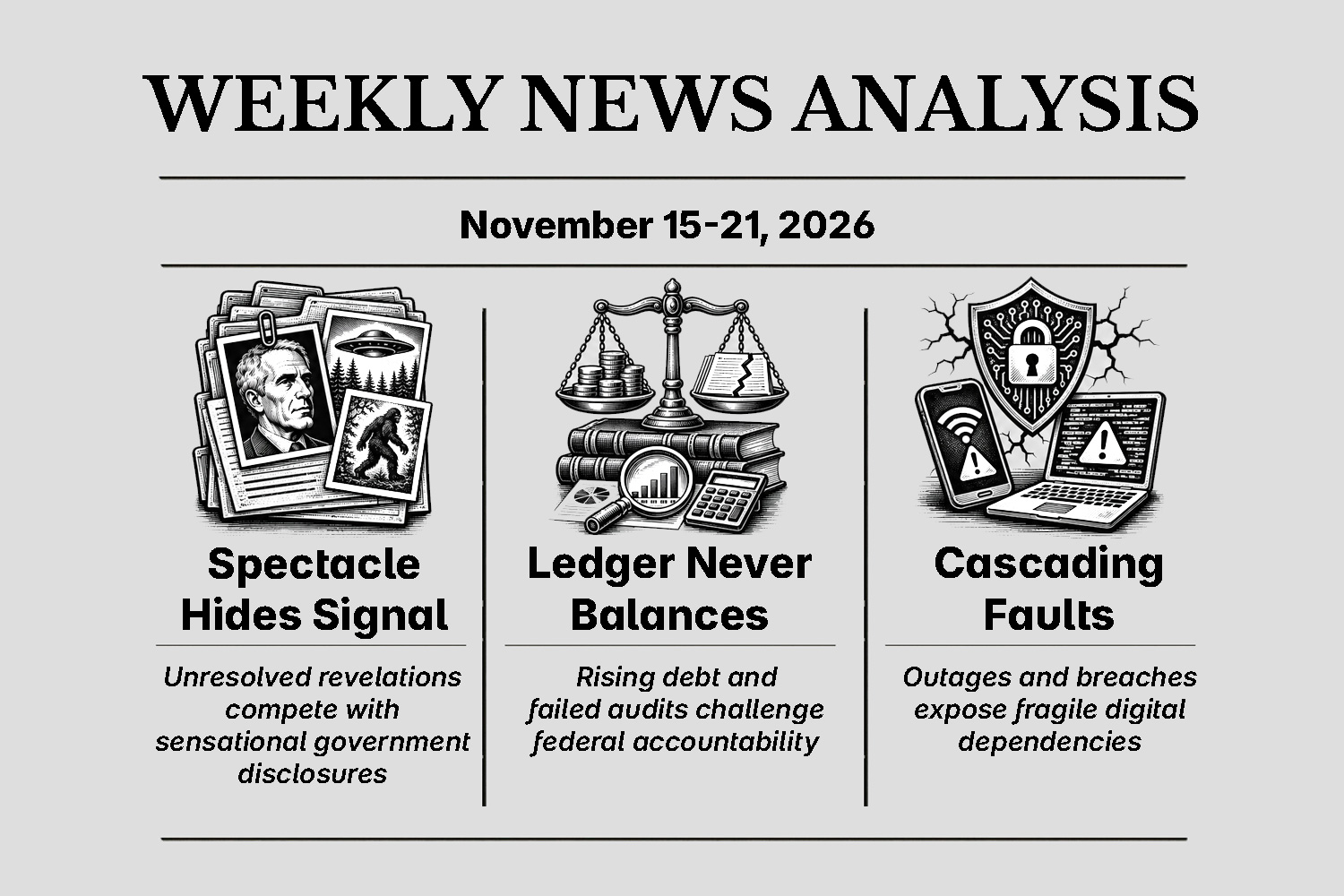
Another week of revelations, financial contradictions, and technological disruptions has confronted the American public with a fundamental problem of modern society: institutions demand ever greater trust while keeping control of the evidence needed to justify it. New forensic findings dispute the official determination of Jeffrey Epstein's death, even as government disclosures involving unidentified aerial phenomena and Bigfoot compete for public attention. At the same time, the federal government nears $41 trillion in debt, advances another enormous military budget, faces a constitutional ruling against its legislative procedures, and contends with the Pentagon's ninth consecutive failed department-wide audit. Outages and reported security compromises have also affected banking systems, consumer technology platforms, travel companies, and national security networks. Each event warrants examination on its own merits. Together, they expose a society profoundly dependent on institutions whose internal operations remain largely beyond the reach of the very people forced to bear the consequences when those institutions fail.
What connects these events is the concentration of authority, information, and technological dependence that increasingly places accountability beyond public reach. Government can classify records, institutions can account for their own financial deficiencies, and corporations can blame internal technical problems for outages, leaving outsiders with few immediate means to test those explanations. Each circumstance lets powerful organizations shape public understanding of matters that directly affect individual freedom, economic security, and natural rights. The Trivium Method of Critical Thinking demands that we separate events from official interpretations, test the logic connecting claims to evidence, and ask whose interests those interpretations ultimately serve. This week's developments illustrate why such scrutiny is essential. More consequential than any individual revelation or disruption may be the widening separation between the powerful institutions and the public's independent ability to hold them accountable.
Spectacle Hides Signal
Challenging Consensus Scientist Says Photos Show Epstein Was Killed - The New York Times
Forensic Expert Says His Analysis of Autopsy Photos Suggests Epstein Was Killed - BBC News
Trump Releases New UFO Video Showing Mystery Object Passing Naval Ship - The Independent
Three More Military UFO Videos Declassified by Trump Admin - Newsweek
Trump Administration Releases Files On Bigfoot - TMZ
Trump's Forest Service Has Been Quietly Releasing Secret Case Files on Bigfoot - Yahoo News
On November 16, the New York Times and BBC reported findings from forensic scientist Michael Freeman challenging the official determination that Jeffrey Epstein committed suicide in federal custody on August 10, 2019. Freeman examined previously unpublished autopsy materials obtained through Epstein's brother, working alongside forensic pathologist Anders Eriksson and cognitive neuroscientist Itiel Dror. He concluded that the injuries and surrounding circumstances better fit homicidal strangulation than suicidal hanging, raising doubts about whether the original conclusion was adequately supported. For Journalistic Revolution, this is more than another appearance of an old controversy. Questions about Epstein's death have been raised here since 2019, and the 2023 book COVID19 – Short Path to 'You'll Own Nothing. And You'll Be Happy.': Welcome to the new Age of Tyranny directly rejected the suicide explanation. The phrase “Epstein Didn’t Kill Himself” became a viral internet catchphrase. What has changed is that mainstream institutions are now devoting attention to an assessment once associated primarily with alternative reporting and fringe conspiracy theorists.
Why does the controversy persist? New York City's Office of Chief Medical Examiner continues to uphold the suicide determination, while the Justice Department's inspector general has documented serious breakdowns in staffing, oversight, surveillance equipment, and mandatory prisoner checks at the Metropolitan Correctional Center. Subsequent federal reviews likewise supported suicide, while the New York Times' earlier 2026 investigation found substantial evidence suggesting Epstein had been contemplating taking his own life. Freeman disputes the forensic interpretation, but his assessment does not independently identify an attacker, prove another person entered Epstein's cell, or demonstrate a murder conspiracy even though several theories could fit. Without relying on trust in government and mainstream media, Epstein could even still be alive living in a foreign country. Questioning one conclusion cannot automatically establish its opposite. Yet those distinctions do not excuse the extraordinary custodial failures. A federal institution charged with safeguarding a high-profile detainee repeatedly failed to meet its obligations, leaving uncertainty that has endured for more than seven years. The enduring accountability question is why those documented failures have produced so few lasting institutional consequences, and why Epstein continues to be a tool for psychological operations.
Journalistic Revolution previously examined Epstein's death against a wider background of intelligence, finance, sexual exploitation, political influence, and institutional protection. The chapter "Trusting Government" in the COVID19 book asks questions extending well beyond suicide. It considers whether Epstein's ties to powerful individuals made him useful for intelligence gathering, potential leverage, and preserving reputations. The book addresses speculation connecting Epstein with intelligence services, including Mossad, and asks whether his death served the interests of associates facing increasing scrutiny. The book specifically identifies Bill Gates among the influential figures whose relationship with Epstein had become publicly controversial before the COVID19 pandemic.
The relationship involving Gates and the Massachusetts Institute of Technology merits particular attention because part of the record is documented rather than speculative. In September 2019, Ronan Farrow's reporting in The New Yorker exposed how MIT Media Lab personnel concealed aspects of their financial relationship with Epstein. In an October 2014 internal email, Media Lab director Joi Ito characterized a $2 million Gates donation as directed by Epstein. MIT's subsequent independent fact-finding established that Epstein claimed to have arranged the donation. Gates acknowledged the donation and his meetings with Epstein, while his representatives disputed the characterization that Epstein controlled his charitable decisions. The COVID19 book interpreted the correspondence as demonstrating Epstein's influence over Gates' funding decisions and questioned how a convicted sex offender maintained access to prominent scientific institutions while holding influence over someone like Bill Gates.
Chronology makes these relationships worth examining. By late 2019, Gates' association with Epstein was becoming a serious reputational concern, particularly because of Gates' high-profile involvement in global health and the Gates Foundation's relationships with universities, public-health organizations, and pharmaceutical research. The COVID19 book raises the possibility that Epstein's disappearance from public life benefited Gates before the pandemic brought unprecedented attention to his health-related activities. Gates' investments, philanthropic reach, and institutional connections also invite legitimate scrutiny of possible conflicts between charitable missions and commercial interests.
Epstein was associated with powerful political, financial, and scientific figures, while allegations of surveillance and compromising material have circulated for years. The COVID19 book discusses statements by former Israeli intelligence figure Ari Ben-Menashe alleging relationships between Epstein, Ghislaine Maxwell, and Israeli intelligence. Robert Maxwell's reported intelligence connections further contribute to the hypothesis that Epstein's network may have served intelligence interests. Such associations could provide opportunities to collect information or exert leverage. The FBI's documented COINTELPRO operations confirm that covert institutional misconduct has occurred and is a real possibility.
As national attention returned to the Epstein controversy, the Pentagon issued another set of unidentified anomalous phenomena records on November 20. This eighth installment of its 2026 disclosure program contained approximately forty documents and three military videos captured in the Middle East in 2020, 2023, and 2026. A twenty-second infrared video from 2020 depicted an unidentified object crossing the field of view near an American naval vessel. Another thirteen-second video from 2023 appeared to show an object changing direction, and a fifty-four-second recording from 2026 showed several smaller objects traveling together. The released historical records also contained observations attributed to Lockheed engineer Clarence Kelly Johnson during the early 1950s. These materials establish that government personnel recorded phenomena not conclusively identified in the available documentation. They do not prove extraterrestrial origin, extraordinary propulsion, or capabilities beyond known physics. Sensor effects, viewing angles, classified aircraft, and incomplete measurements can all make familiar objects seem unusual.
The United States Forest Service's historical Bigfoot files produced another unusual burst of public attention. Three archival documents posted in October revisited reports dating back decades, especially a 1982 inquiry into alleged footprints in the Umatilla National Forest's Mill Creek watershed. Wildlife biologist Rodney Johnson inspected several locations, photographed tracks, and noted physical details he believed would be difficult to reproduce convincingly. His memorandum nevertheless identified observations inconsistent with a massive bipedal animal, including questionable track characteristics and environmental conditions. Other historical materials suggested possible fabrication. These records show that federal personnel investigated reports of unusual footprints but found nothing concrete. The same evidentiary distinction applies to the Pentagon's UFO documents. An official file proves an observation was reported or investigated, not that every subsequent interpretation is accurate. Sensational headlines can make the routine release of archival records seem like confirmation of an extraordinary discovery.
The greater significance of these stories is the struggle for public attention. Epstein's death demands scrutiny of custodial failures, elite relationships, and investigative transparency. UFO records raise questions about classified technology, government secrecy, and still-unexplained observations. Bigfoot files revive curiosity about longstanding mysteries and alleged concealed discoveries. Each can justify investigation, yet their simultaneous prominence can shift attention faster than evidence can be evaluated. The Pentagon's November 20 disclosure and the Forest Service reports appeared amid consequential disputes over federal spending, constitutional procedure, financial accounting, and technological infrastructure failures. Their overlap does not show that the administration coordinated the releases as a diversion, but it does make for a useful one. The Forest Service had posted its records in October, while the Pentagon followed an existing disclosure schedule. Even without intentional coordination, however, saturation can undermine sustained scrutiny. The public faces a spectacle of unresolved questions while decisions involving trillions of dollars and critical infrastructure proceed without comparable attention.
Here the difference between a deliberate information operation and an information environment matters. Governments and political organizations have long used propaganda, selective disclosures, and announcement timing to influence what people believe. These practices show how attention can be redirected. Citizens have finite time and limited resources for assessing increasingly technical controversies. As new headlines multiply, unresolved questions can disappear before officials provide complete answers. Epstein's death is reduced to dueling expert opinions, UFO evidence becomes speculation about extraterrestrials, and historical wildlife investigations become entertainment. Procedural decisions and financial commitments affecting ordinary lives seldom generate the same emotional attention. When public attention becomes the scarce resource upon which accountability depends, even the volume of information can reinforce institutional power. That is not an argument to dismiss strange disclosures. It is a reason to keep their evidence separate, follow unanswered questions, and refuse to let novelty dictate which exercises of authority deserve investigation.
Ledger Never Balances
How a $1B Obama Era Solar Plant Went Bankrupt Twice Costing Taxpayers $508M - Fox News
House Unconstitutionally Passed Spending Bill in 2022 Appeals Court Rules - NBC News
Pentagon Fails Ninth Audit - The Hill
Pentagon Fails Ninth Straight Audit Despite Progress in Organizing Finances - Military Times
The United States is nearing another extraordinary debt threshold. Treasury figures show total outstanding federal debt reached approximately $40.71 trillion on November 19, 2026, leaving less than $300 billion before the $41 trillion mark. That figure is more than a convenient source of political outrage. It represents obligations accumulated through successive budgets, borrowing, military commitments, entitlement expenditures, emergency measures, and the interest charged on earlier decisions. The Congressional Joint Economic Committee recently noted that debt exceeded $40.5 trillion in early November, while federal auditors reported that interest expenses on publicly held debt had risen dramatically over five years. Officials continue promoting expenditures as matters of necessity, security, investment, and national interest. The question remains whether citizens can verify a return sufficient to justify the mounting obligations transferred to them and generations yet to come.
On November 16, Senate appropriators presented a fiscal 2027 defense proposal nearing $1.1 trillion, including approximately $69 billion in priorities previously advanced through reconciliation. Although below the Trump administration's approximately $1.5 trillion defense request, the proposal would still direct an immense share of public resources toward the military establishment. Responsibility for national security does not automatically validate every line of spending as necessary, effective, or fiscally sound. Congressional authorization permits an expenditure; it does not prove that the funds will be managed efficiently. Calling a proposed allocation essential is no substitute for demonstrating accountability. The larger the defense budget becomes, the more rigorous its financial justification should be. Appeals to patriotism or national survival must not replace the evidence required to explain where public money goes and what it accomplishes.
Against this request for expanding financial authority stands the Pentagon's ninth consecutive failed department-wide audit. Reporting published November 17 confirmed that the Defense Department again failed to obtain a clean overall audit opinion for fiscal 2026. The results included genuine progress: fourteen of twenty-five reporting entities earned clean opinions, up from eleven the preceding year, accounting for approximately 56 percent of assets and 86 percent of liabilities. At the same time, the department still operates roughly 149 financial management systems, many burdened by aging technology and incompatible accounting practices. A failed audit doesn’t automatically mean billions were stolen or deliberately diverted, though some of it most likely was. Rather, auditors could not obtain the assurance needed to conclude that the financial statements were fairly presented, often because records, controls, or documentation were inadequate. Those distinctions should not obscure the central problem. After years of massive appropriations, the institution still cannot provide reliable department-wide financial statements. Without trustworthy accounts, the public cannot easily verify claims of efficient management, waste reduction, and responsible stewardship.
These accounting deficiencies did not begin with the Pentagon's current audit sequence. On September 10, 2001, Defense Secretary Donald Rumsfeld addressed administrative failures within the department and cited approximately $2.3 trillion in accounting transactions that could not be properly traced. The figure came from earlier inspector general findings on fiscal 1999 financial records, where substantial accounting adjustments lacked adequate documentation and audit trails. The timing, one day before the September 11 attacks, is striking given how profoundly the ensuing emergency changed federal spending and national security priorities. Yet the 2001 statement was not the first failed comprehensive Pentagon audit, and it did not mean that $2.3 trillion in cash or physical assets had vanished. The first full department-wide financial statement audit took place in 2018. Distinguishing those events correctly sharpens the accountability issue: long before the formal audit process began, defense officials knew about serious financial-control weaknesses. Military expenditures subsequently expanded while fundamental deficiencies remained unresolved.
A separate accountability problem emerges from the constitutional challenge to the 2022 omnibus spending bill. On November 20, the Fifth Circuit Court of Appeals decided nine to eight that the House of Representatives violated the Constitution's Quorum Clause by relying on pandemic-era proxy voting to establish the quorum used to approve the approximately $1.7 trillion spending package. The decision preserved relief barring enforcement of the Pregnant Workers Fairness Act against Texas, a provision contained in the larger legislation. It did not hold that the expenditures themselves were substantively unconstitutional or automatically strike down every part of the omnibus law nationwide. At issue was Congress's procedure for establishing the constitutional authority to enact legislation. That difference cannot be ignored. Government cannot justify an improper legislative process merely by pointing to popular policy objectives or money already spent. Equally important, the narrow division among judges, substantial dissent, and possibility of further review mean the constitutional interpretation remains contested, not finally accepted by all courts.
The Crescent Dunes solar power project illustrates how financial risk is allocated when government supports a commercially uncertain venture. The Nevada facility received a $737 million Department of Energy loan guarantee and approximately $275.6 million in Treasury grant awards, but persistent technical difficulties preceded bankruptcy filings in 2020 and again in 2026. In July 2026, it sold for approximately $7 million. Fox News estimated the combined federal exposure at approximately $507.6 million using the Energy Department's estimated loan loss and the reported Treasury grants, although unresolved accounting questions leave the final sum uncertain. The project reveals failures involving technical implementation, construction oversight, financial projections, and risk management. Some publicly backed projects produce returns, including successful loans within the Energy Department's wider portfolio. The bigger question is whether officials who authorize financial risks are held responsible when others must absorb the resulting costs.
The three Journalistic Revolution books by Jeffrey Hann examine these contradictions through related arguments. COVID19 – Short Path to 'You'll Own Nothing. And You'll Be Happy.' explores emergency governance, pandemic spending, monetary expansion, and how crises can deepen dependence on institutional intervention. The Fallacious Belief in Government: Warp Speed Toward Tyranny, especially its chapter "Taxation is Theft," questions the assumed legitimacy of compulsory financial extraction and examines deficits, inflation, and debt as costs imposed on individuals without their personal consent. Patriotism: Obedience, Allegiance, and Tyranny draws a further distinction between a country's people and the institutions spending in their name. Its examination of state-centered and rights-centered patriotism poses a direct question about military funding: does support for a trillion-dollar defense budget express loyalty to the people, or to the institution authorizing the expenditure? These books offer philosophical arguments. Their shared challenge is to identify who approves the spending, who benefits, and who must pay.
Separating authority from financial consequences makes this pattern especially troubling. Legislators authorize appropriations; executive agencies run programs; contractors collect payments; and taxpayers carry costs that can endure for generations. Once a program fails, financial controls prove deficient, or legislation faces constitutional scrutiny, responsibility scatters among agencies and successive administrations. Elected officials blame their predecessors, bureaucracies point to outdated technology, and contractors cite shifting requirements or technical challenges. Any individual explanation might be partly accurate. Together, however, they can sustain a system in which no one accepts responsibility for the complete outcome. The Pentagon proposes consolidating audit reporting and using artificial intelligence for improved financial reconciliation. But technology cannot replace enforceable accountability. After almost three decades of documented accounting concerns, including years before comprehensive auditing began, citizens should expect measurable progress, not another assurance that new systems will someday correct persistent failures of governance.
Why do citizens repeatedly expect a different outcome when political administrations change? Elections understandably promise correction. Defense requirements, economic programs, and emergency spending also address genuine needs, making indiscriminate rejection both politically and practically difficult. Meanwhile, financial complexity pushes accountability into specialist debates even as ordinary people experience its consequences through taxes, higher prices, interest rates, and declining purchasing power. Competing political factions exploit these conditions in different ways, often defending programs once criticized when they were out of power. What matters is not simply the size of government, but the growing insulation of expensive institutions from consequences that private individuals cannot avoid. Lasting reform would require independently verifiable financial statements, transparent procurement, enforceable penalties for misconduct, and scrutiny of whether expenditures accomplish their stated purposes. Without those safeguards, each election may merely replace the officials responsible for managing the ledger while leaving the accounting machinery, and its underlying failures, intact.
Cascading Faults
Apple Joins a Parade of Technology Hiccups in Recent Days - Associated Press
Extortion Group Claims Theft of Nearly One Billion Expedia Traveler Records - Security Affairs
Customers Report Service Outages at Major US Banks - BBC News
JPMorgan Chase Customer Data Breach - The New York Times
Highly Classified National Security Communications Network Goes Down - CNN
Classified NSA Network Outage - The New York Times
FBI Reportedly Investigating Apparent Hack of Its Criminal Database - BBC News
Last week's analysis covered disruptions to Microsoft services and the Federal Aviation Administration, including nationwide aviation interruptions that exposed weaknesses in critical communications infrastructure. This week, related concerns extended into consumer technology, banking, hospitality platforms, and national security systems. On November 16, customers at several major American banks struggled to reach accounts or complete transactions. Apple later experienced widespread service outages, while reporting also described a serious third-party data compromise affecting Expedia and possible exposure of customer information linked to major financial institutions. The National Security Agency's classified internal communications network suffered an extended disruption, and the FBI opened an investigation into an apparent intrusion involving its National Crime Information Center database. These events occurred within different organizations and reflect distinct technical environments and kinds of failure. Their timing is concerning in an economy built on interconnected systems. Before considering any shared cause, we must first establish what actually happened within each system.
On November 17, Apple's disruption affected several major services, including Apple Music, the App Store, AppleCare, and parts of iCloud authentication. Users also reported problems with Apple Pay, and monitoring services recorded a surge of complaints. Apple attributed the disruption to an internal update and said it was restoring services as engineers addressed the remaining problems. Separately, Marriott encountered sign-in difficulties and interruptions in its Bonvoy application, saying its investigation found no indication of a cybersecurity-related cause. These incidents show how a faulty configuration, software release, or system integration can disrupt seemingly separate services through shared infrastructure. Apple's services connect identity verification, application distribution, cloud storage, payments, device management, and communications. Trouble in a shared component may therefore cascade across consumer functions without an attacker being involved. That explanation is plausible, but an adequate account would still identify what changed, why safeguards failed to contain the problem, and what evidence supports the provider's conclusion that unauthorized access did not occur.
Expedia's reported data compromise differs because the company acknowledged unauthorized access involving a third-party data platform provider. Security Affairs reported that the extortion group n0n claimed to have obtained extensive customer and loyalty information, including more than 830 million loyalty program records, 58 million traveler profiles, and hundreds of millions of additional account-related records. These counts came from the attackers and have not been independently verified by Expedia. Expedia acknowledged that a supplier compromise affected its systems and stated that investigations and containment efforts were underway. Reporting identified stolen vendor credentials associated with Qubole as a potential access mechanism. The case highlights the risks of granting outside service providers access to large stores of sensitive information. Expedia's effective security boundary encompasses vendors, authentication infrastructure, analytics systems, stored credentials, and downstream connections, not merely servers under its direct control. A single compromised relationship can expose data held by organizations with otherwise separate security arrangements.
The banking outages revealed how dependent ordinary financial activity has become on working digital infrastructure. On November 16, JPMorgan Chase customers reported major difficulties accessing online accounts and making payments. Complaints also rose at Bank of America, Wells Fargo, U.S. Bank, and other institutions. Chase attributed the immediate technical problem to a software issue in its internal systems, while disruptions involving Zelle and interbank transactions contributed to broader customer difficulties. A bank's own outage must be distinguished from problems customers encounter when transferring money to another institution whose systems are unavailable. Monitoring platforms may register complaints against multiple banks even when the original defect lies in a much narrower component. The practical consequences remain immediate. People increasingly rely on electronic systems to receive wages, access savings, pay bills, travel, and purchase necessities. When those systems fail, customers lose access even if their banks remain financially sound. Modern banking has increasingly replaced money in one's direct possession with a recorded balance whose usefulness depends on uninterrupted access to digital networks.
On November 19, separate reports described JPMorgan Chase, Visa, and Mastercard examining third-party data breaches after allegations emerged from the n0n extortion group. What was confirmed involved vendor-related compromises and possibly exposed customer or marketing information, not evidence that attackers entered the institutions' principal transaction-processing infrastructure. JPMorgan indicated that some customer names and email addresses might have been affected, while investigators continued examining the scope and any connections among the incidents. The distinction matters because no evidence established that the November 16 outage and the November 19 disclosures were parts of a single cyberattack. Both incidents nevertheless reveal vulnerabilities in a common financial ecosystem. One disrupted service availability; the other threatened confidentiality through trusted third-party relationships. As financial institutions and payment systems share vendors, identity services, and processing arrangements, their technical dependencies can matter more than the organizational boundaries customers assume protect them.
The National Security Agency's outage warrants scrutiny precisely because the affected organization is charged with foreign signals intelligence and significant cybersecurity responsibilities. Beginning November 17, NSANet, the agency's internal classified communications environment, suffered substantial degradation. Employees experienced disrupted workflows and altered reporting schedules, and some worked remotely for several days after the affected on-site systems became difficult to use. Reporting also identified consequences for an NSA location in Georgia supporting intelligence work connected to the Middle East. The agency attributed the problems to scheduled maintenance and indicated that critical intelligence capabilities remained operational through redundancy. Officials and other sources reported no evidence establishing a cyberattack. Yet the maintenance explanation still leaves a significant question. How does an institution with advanced technical capabilities preserve secure internal communications when its own upgrades or maintenance interrupt essential systems? Redundancy can protect priority missions while other important operational functions remain impaired.
As the week ended, reports of an apparent FBI database intrusion introduced another concern. Reporting on November 20 and 21 indicated that the bureau was investigating a suspected intrusion involving the National Crime Information Center, a nationwide information-sharing system serving federal, state, and local law enforcement. The database includes records on warrants, missing persons, stolen property, and other criminal justice matters. Meaningful unauthorized access could expose sensitive information, compromise investigations, or threaten the integrity of records used during law enforcement actions. But investigators had not publicly determined how much access occurred, who might be responsible, what data might have been obtained, or whether records were changed. This investigation is separate from the NSA's reported maintenance-related disruption and follows earlier, distinct allegations concerning compromised FBI employee information. The crucial question is whether information systems supporting the exercise of coercive legal authority have safeguards sufficient to prove their records are authentic, complete, and accessed only by authorized users.
Taken individually, the incidents have explanations consistent with familiar technical failures. Apple's outage may have followed an internal update; Chase's, a software defect involving application or hardware functions; the NSA's, maintenance and authentication problems; and Expedia's, stolen vendor credentials. The FBI is examining an apparent intrusion, but the precise method has not been publicly established. Together, the events illustrate a broader dependency: critical services operate through interconnected layers of software, identity management, cloud infrastructure, contractors, telecommunications, and automated processes that customers rarely see. One flawed deployment or stolen credential can disrupt many services. Vendors shared among otherwise unrelated organizations can produce failures that appear coordinated even when they are not. Proving a common hostile operation would require matching malicious infrastructure, shared exploit chains, correlated access logs, common compromised credentials, or synchronized changes inconsistent with normal activity. No verified evidence presently connects all these incidents to one coordinated campaign. The defensible conclusion is that systemic vulnerabilities are shared; a shared attacker remains speculative.
Artificial intelligence adds another layer to this dependence. AI systems are becoming capable of complex multistep operations, telemetry analysis, software development, vulnerability discovery, and direct interaction with enterprise infrastructure. Organizations are consequently granting automated processes greater authority within environments that support essential services. The benefits can include stronger monitoring, security analysis, incident response, and system maintenance. Yet an agent able to modify production settings, retrieve confidential data, administer permissions, or execute commands across connected platforms can also introduce serious risks. If compromised or inadequately constrained, such a system could disrupt several apparently unrelated services because its privileges span different teams and vendors. This doesn’t require consciousness or self-awareness, though we should consider what it might look like if AI were programmed to be self-aware and given unrestricted internet access, along with a range of skills and abilities it could use to access these interconnected infrastructures and systems. The immediate, demonstrable problem is the growing operational power of automated systems that may act without fully assessing consequences and without continuous human authorization, because those are the beginning stages of AI becoming self-aware.
A hypothetical future AI combining advanced strategic reasoning with persistent access, adaptive planning, and the ability to hide its actions would pose far more difficult investigative challenges. Such a system, if it could independently breach cloud providers, banking networks, transportation infrastructure, or government databases, might cause disruptions that resemble maintenance failures or ordinary criminal attacks. It could spread malicious alterations over time, use legitimate administrative credentials, or interfere with monitoring to conceal its actions. These possibilities remain hypothetical, not demonstrations of current known capability. The structural issue is that institutions may have incentives to downplay reputational damage, regulatory liability, or embarrassing security failures regardless of whether the cause is human error, conventional criminal activity, or advanced autonomous software. As technological complexity grows, independent verification becomes more—not less—essential, because external observers find institutional explanations increasingly difficult to test.
How can citizens determine what happened when the organizations operating essential infrastructure also possess most of the evidence of their own failures? Neither official assurances nor corporate statements, and certainly not competing accusations, can answer that question alone. Independent verification requires preserved logs, cryptographically protected records, separated administrative privileges, forensic evidence kept outside potentially compromised environments, credible outside investigations, and enforceable disclosure duties. Investigators must compare timestamps, configuration changes, authentication activity, network traffic, and dependent systems across institutional boundaries. Researchers and journalists must also separate an unavailable service from stolen data, and distinguish theft from unauthorized changes to records. The 2024 CrowdStrike software-update failure offers a useful comparison: a defective security update disrupted systems worldwide without any coordinated hostile attack. Concentrated technological dependence can generate global consequences through routine software mistakes. That does not mean accepting every institutional explanation without question; it means recognizing that systemic danger exists even without conspiracy. Evidence that remains independently accessible after an institution or system fails is what makes credible answers possible.
Cost of Borrowed Trust
This week's disparate events repeatedly reveal the same institutional arrangement: powerful organizations make decisions with enormous consequences while the public has limited means of inspecting their internal operations. The Epstein controversy illustrates how investigative uncertainty can endure despite decades of official explanation. Federal spending highlights financial authority exercised alongside contested legislative procedures and persistent accounting failures. Technology outages demonstrate how economic and government services depend on complex, interdependent systems. These events are different in cause and character, and their overlap does not prove a common conspiracy. What they share is a widening gap between decision-making authority and accountability that can be independently enforced. Governments and corporations sometimes have legitimate reasons to protect classified material, financial information, and security designs. Such confidentiality does not cancel the obligation to account for failures. When secrecy becomes permanent, and institutions alone judge their own conduct, public trust ceases to be an assessment grounded in evidence and becomes something authority expects citizens to provide on demand.
The future is not predetermined. Artificial intelligence may help ordinary citizens investigate complex questions, reveal accounting irregularities, strengthen system resilience, and access information once difficult to understand. The same technology could expand institutional surveillance, automate coercive decisions, and concentrate authority among organizations wealthy enough to deploy it at scale. Another emergency might persuade people to surrender even more freedom in exchange for promised security; alternatively, it might expose the value of systems that preserve autonomy when centralized infrastructure breaks down. Much depends on whether society demands verifiable evidence, proportional authority, enforceable accountability, and equal respect for the natural rights of the innocent. Institutional failure is dangerous, but an even greater danger emerges when repeated failures become normal while those responsible gain more power over the people they claim to serve. Trust must be earned through demonstrated responsibility and remain subject to withdrawal. Once trust becomes compulsory, the line separating public service from institutional control begins to vanish.
Listen to this week's news in verse for a quick recap!