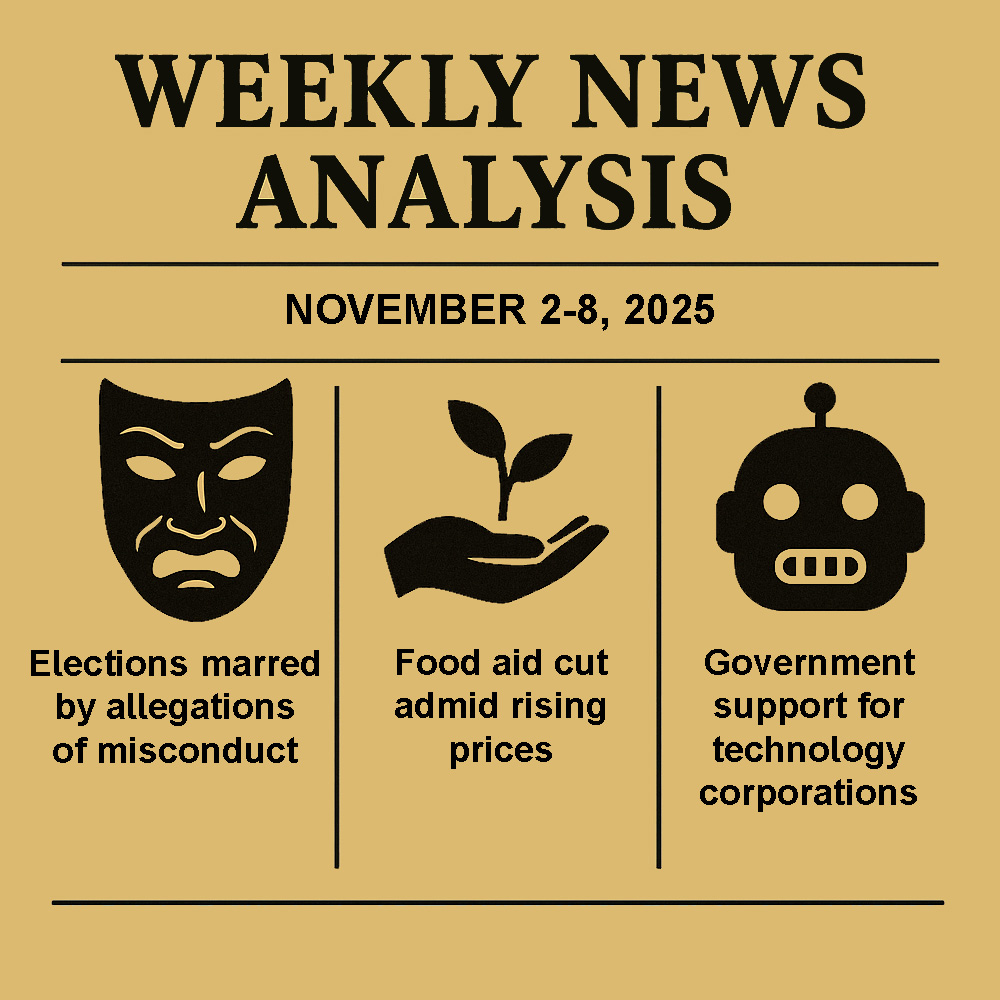
The week’s stories follow a pattern. Elections come with the usual mixture of legitimacy and suspicion. The media says confidence is patriotic; partisans claim doubt is patriotic. Both sides fight over who corrupts the process, but agree quietly that the process itself shouldn't be questioned. That’s the trick: frame fraud as a team sport so the audience never sees who owns the scoreboard. History shows that these cycles are predictable: contested ballots in 2000, internal party fraud in 2012, foreign interference stories in 2016, the “Stop the Steal” movement in 2020, the “All Clear” narrative in 2024, and a new round of selective skepticism in 2025. The pattern is more important than the players.
Meanwhile, the “shutdown” became a stage cue, not a constraint. Congress rehearsed symbolic pain (docking our pay!), then shelved it; food aid was cut after the votes were counted; and prices at the meat counter were blamed on the villains of convenience. The state’s response to crises of its own making was predictable: more command, more corporate deputization, more identity scaffolding. Link it all, and you get the modern operating system of control: elections to authorize, welfare to condition, and artificial intelligence to enforce—stitched together by digital identity and programmable money. That arc—from ballot to benefit card to behavioral score—has been described in detail as the path from democracy to the administered consent of tyranny.
Fraud Claims, Power Consolidates
2025 Election Results - AP News
Tuesday’s results pose fresh challenges - National Catholic Reporter
Democrats notch wins in GA & PA – NPR
Officials bat down interference claims – New York Times
Newsom answers Trump’s Prop 50 fraud claims – KCRA
The messaging frame was pre-installed: AP presents itself as the nonpartisan metronome of American elections—“no spin, no bias, just facts”—which is less a description than a rhetorical shield against the very doubts it anticipates. When “trust the counter” is the headline, the story is not who won; it’s why you should accept the call. In information warfare, asserting neutrality is itself a manipulative act because it shifts the burden of proof to those who doubt it.
After analyzing the ballots, the machine identified the losses as “candidate problems,” “local dynamics,” and “split-ticket nuance.” NCR summarized the partisan lesson: Democrats hold the stronger position; Trump will fluctuate between denial and blame. It’s a clear framing because it turns doubt into a personality trait rather than a structural issue. Personalize the skepticism, and you never have to question the system.
Yet the system’s vulnerabilities aren’t a myth exclusive to the Right or the Left; they’re a bipartisan issue. The record includes disputed counts, opaque vendor ecosystems, and unresolved cyber concerns—much of which Democrats themselves highlighted before 2020. The deeper critique from The Fallacious Belief in Government isn’t just “this election was stolen,” but rather “the process is built for selection.” When the Right cried fraud in 2020 and claimed 2024 was immaculate solely because their candidate won, they illustrated the book’s point: team-based epistemology. The power play remains the same; the jerseys just change.
Types of fraud are plural, not singular: party machinery that rigs primaries, vendor opacity in electronic systems, illegal ballots, non-citizen voting in local contexts, and foreign leverage campaigns. The book catalogues these as parallel channels that cumulatively erode consent, regardless of which claim trends on TV. The important move is to keep the public arguing over which channel mattered last Tuesday, so no one asks why the architecture is never audited to the public’s standard.
This year’s “fraud talk” followed a predictable pattern. California’s Prop 50 became a symbol: Trump claims, the governor refutes, and the media’s fact-checker returns to “nothing to see here.” The debate is ritualistic—accusation versus dismissal—while the fundamental question (who owns and audits the black boxes, who sets the rules of observation, who verifies the chain of custody) is dismissed as conspiracy by default. That, too, is a tactic well-documented since the CIA’s use of “conspiracy theory” as a stigma strategy.
The only truly reliable winner in this argument is not the Left or the Right, but the institution itself. Every news cycle that reduces integrity to mere partisan spectacle reinforces the core belief: the government maintains authority because the ritual of voting sanctifies it—regardless of how contested the ritual becomes. The book’s blunt conclusion is that electoral turmoil is strategic: it renews consent while strengthening administrative power. Tyranny progresses whether the map is red or blue.
Shutdown Theater, Rationed Welfare
Release: Paul and Democrats block pay-stop bill - Sen. Jonn Kennedy
GOP kills bid to fully fund SNAP - The Guardian
Admin will partially fund November SNAP - Politico
DOJ probing meatpackers after Trump request - Reuters
Trump threatens crackdown over beef prices - Newsweek
Trump orders DOJ probe into meatpacking - Fox Business
The “shutdown” once again served as a narrative tool: dramatizing crisis, highlighting pain, and negotiating optics. Senator Kennedy’s release draws attention to a failed attempt to stop Congress's pay while still funding workers, then shifts blame between Rand Paul and Democrats. What matters is not which side shows sincerity; it’s that performative austerity never truly limits the core institutions. The scene highlights virtue as the system continues to move forward.
SNAP shifted into leverage. A Democratic effort to fully fund it was blocked; the administration then approved partial payments for November. If you want a clear example of “rationed consent,” it’s this: food aid becomes a dimmer switch. And it arrives—curiously—after ballots are counted. The lever is behavioral: teach the public that essential benefits depend on political choreography, and you can orchestrate almost anything.
The White House then framed soaring beef prices as a cartel issue and tasked the DOJ with investigating packers. Will there be collusion in concentrated markets? Often. However, the move also shifts the blame for money creation and fiscal shock therapy onto convenient corporate scapegoats. As The Fallacious Belief in Government argues, the 2020 COVID19 relief package and subsequent policies introduced an inflationary wave that eroded purchasing power; replacing macro-causality with a corporate villain-of-the-week is rhetoric, not a solution.
Notice the pattern: crisis (shutdown) → conditional welfare (partial SNAP) → punitive spectacle (industry probe). Each step pushes governance toward command-and-control economics where agencies control prices, police supply chains, and—most importantly—tie aid and access to identity systems. That last part is not hypothetical. Digital IDs, along with programmable money, form an increasingly advanced policy stack, linking eligibility and spending to centrally enforced rules. Once combined, food becomes a permissioned token.
From there, the slope is steep: benefits are limited by carbon scores, dietary rules, or penalties for “misinformation”; category codes automatically block merchants; and quotas restrict travel. It is a shift from chaotic plural markets to an administered economy with scores and gates—an American social credit system, in all but name. That is why “shutdown theater” matters beyond just this past month. It normalizes the lever leading into the future.
AI Bailouts, Control Grid
Microsoft’s ‘humanist’ superintelligence bet - AI News
OpenAI spreads $600B cloud bet across AWS, Oracle, Microsoft - AI News
Altman backtracks CFO’s backstop talk - NBC News
Trump team sacks federal bailout for OpenAI - CNBC
Altman, the AI race, and the state - BBC
“Humanist superintelligence” is the new slogan—an anthropomorphic cover for planetary computing. Microsoft promotes a benevolent overseer, while OpenAI spreads a $600 billion cloud footprint across hyperscalers, as if it’s diversifying counterparty risk. The language is healing (“humanist”) and inevitable (“next big bet”). In rhetoric, that’s called teleology: presenting a technological end-state as destiny so governance debates turn into procurement schedules.
The bailout discourse—reworded, rephrased, and softened—exposes the true dynamic between frontier AI and the government: privatize the benefits, socialize the risks. When companies propose government support for model risk, they follow a banking tradition: too important to fail. Whether or not a support program is put in place, the story shifts the Overton window toward “public guarantees for private models.” That is the policy goal.
You should now be able to see the framework, which includes identity rails (Real ID → digital ID), programmable money (CBDC pilots), and ambient inference engines that assess risk, truth, and trust. Fit these pieces into benefits (SNAP), energy, mobility, and speech platforms, and you’ve created a network of nudges and restricted zones—governance through dashboards. The marketing term is “safety.” The real operation is centralized discretion that is far from safe.
The term "Humanist” also acts as a clever reversal. Genuine humanism prioritizes consent and boundaries. A superintelligence guided by government incentives is essentially post-humanist: it favors populations over individuals. Once digital IDs and controllable currency become the norm, AI becomes the judge deciding who can transact, travel, post, and eat. This isn't a distant dystopia; it’s a detailed plan awaiting policy decisions.
Finally, recognize the monoculture risk: a few cloud vendors, a few foundation models, and a few state partners. Concentration breeds fragility and compliance. If you want a system that can silence dissent easily, you don’t need censors—you need single points of integration. The “humanist” promise diminishes as the procurement process starts.
The Ritual of Control
Across ballots, budgets, and bots, the core process stays the same: maintaining the tradition of making choices while centralizing control tools. Election stories oscillate between fears of fraud and denial; budget debates shift between fears of shutdown and partial relief; AI stories fluctuate between fears of extinction and the inevitability of a bailout. This oscillation is not a mistake — it drives the system. It keeps people engaged as the framework of digital identity and programmable limits becomes more solid.
The antidote isn't faith in the next referee, bill, or model. It's the discipline to test premises (Grammar), expose contradictions (Logic), and refuse manipulative framing (Rhetoric). History shows that government, left to itself, will turn crises into leverage. Instead, transform yourself: decentralize trust, demand verifiable systems, and stop letting teams decide what is true. That's how you break the loop.
Listen to this week's news in verse for a quick recap!