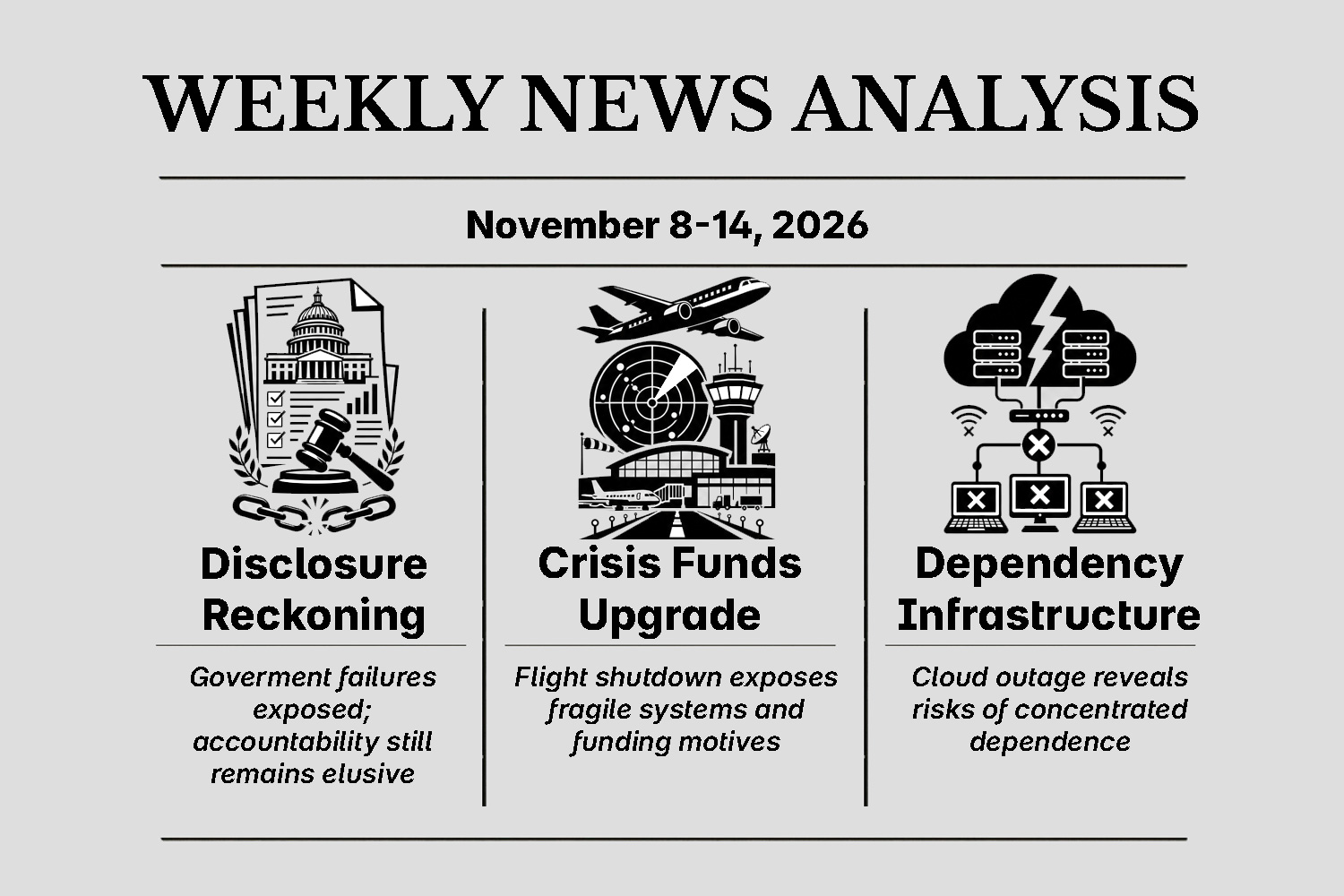
Three stories that appeared unrelated converged this week on a difficult question: when institutions fail, disclose those failures, and then ask the public to entrust the remedy to the same institutional architecture, what has actually changed? Congress released a sweeping report documenting decades of governmental failure surrounding Jeffrey Epstein, even as it assured the public that certain politically sensitive questions had been adequately resolved. Days after announcing an expanded artificial-intelligence system to improve traffic management, the Federal Aviation Administration stopped departures nationwide when a telecommunications malfunction spread through the air-traffic network. Meanwhile, a global Microsoft infrastructure outage disrupted Outlook, Teams, Copilot, external services dependent upon Microsoft 365, and even Claude's Microsoft integrations. These events expose what happens when institutions, infrastructure, and public trust become concentrated in systems whose failures reach far beyond their own boundaries.
The Trivium demands that we resist moving from an unsettling coincidence directly to whatever explanation we prefer. Grammar establishes the events themselves; Logic examines whether the claimed causal relationships hold; Rhetoric considers how institutions describe those events and which responses their descriptions encourage. This week's events illustrate how skepticism can fail in opposite ways. Accepting an agency's denial simply because it comes from an agency is no more rigorous than rejecting that denial for the same reason. Neither response constitutes analysis. The question is not which account provides the most satisfying answer, but which one withstands the evidence presently available—and what further evidence would justify changing that judgment.
Disclosure Reckoning
4 key findings in the Jeffrey Epstein report from GOP-led House Oversight panel - PBS NewsHour
Federal government failed to hold Epstein accountable Republican committee says - NPR
On November 10, Jeffrey Epstein returned to the news cycle when the Republican-led House Oversight Committee released the results of a fifteen-month investigation built upon nineteen transcribed interviews and depositions, federal and financial records, documents from Epstein's estate, and tens of thousands of publicly released pages. Even without speculation, the majority report reaches a devastating conclusion: federal authorities repeatedly failed Epstein's victims. The committee concluded that investigators and prosecutors could have prevented crimes after 2005 if they had acted differently. It condemned the 2007 non-prosecution agreement, challenged the extraordinary work-release arrangement following Epstein's state conviction, and found that survivors were not adequately informed. It also criticized subsequent document disclosures, including improper redactions that exposed survivors. These findings are not allegations originating in alternative media. They come from the government's own congressional oversight body, which is now describing years of institutional failure in its own records.
Viewed as institutional mechanisms rather than isolated errors, those failures become even more consequential. The report describes possible prosecutorial conflicts of interest, investigative leads left insufficiently pursued, and a justice arrangement under which Epstein served roughly thirteen months while regularly leaving jail for work release. It recommends renewed investigation of longtime assistant Lesley Groff and specifically asks the Justice Department to investigate sexual-assault allegations made by Sarah Kellen against former Miami Beach Mayor Philip Levine and celebrity hairstylist Frédéric Fekkai. These remain allegations. The structural concern is that Congress, in 2026, is asking investigators to revisit matters that warranted rigorous resolution years earlier. The report also says financial institutions held substantial information about Epstein's criminal history and suspicious activity but failed to respond adequately until after his 2019 arrest. The breakdown thus extended through prosecutorial, correctional, financial, and oversight systems, rather than being confined to a single office.
Among those the committee interviewed or deposed were former President Bill Clinton and former President Donald Trump's attorney general William Barr, Hillary Clinton, Leslie Wexner, Commerce Secretary Howard Lutnick, Bill Gates, Leon Black, former Obama White House counsel Kathryn Ruemmler, former JPMorgan executive Jes Staley, Douglas Band, Sarah Kellen, Groff, and others. NPR emphasized Gates and Lutnick among the influential individuals questioned, while the report's transcript list establishes the broader scope. An interview, a reference in correspondence, a place in Epstein's social circle, or even an ongoing relationship does not, by itself, establish involvement in his crimes. But we need to ask serious questions and scrutinize the facts. The distinction matters because Epstein's influence relied partly on that very uncertainty. At this point, no one should have a free pass for associating with Epstein in any way.
The question of Donald Trump places that evidentiary standard directly against partisan rhetoric. The Republican majority report says every witness who discussed the matter stated that, to their knowledge, Trump had no involvement in Epstein's crimes, and the committee says it found no document among the estate, Justice Department, U.S. Virgin Islands, JPMorgan, or Deutsche Bank materials it reviewed implicating him in Epstein-related criminal activity. Those findings matter and cannot be dismissed solely because Republicans produced the report. Yet they neither constitute a judicial finding of innocence nor establish that every possible record has been examined. Separately, a New York Times analysis cited by members of Congress reportedly identified more than 38,000 Trump-related references across more than 5,300 files in a substantial DOJ release. References to Trump, Melania Trump, Mar-a-Lago, and related terms contribute to that total. It does not represent 38,000 accusations, let alone 38,000 established offenses. Turning a striking statistical count into evidence of guilt would be logically indefensible.
The reverse error deserves equal scrutiny. An investigative majority's statement that it found no evidence implicating Trump does not erase documented connections between Trump and Epstein. Parts of the report employ openly partisan language, describing Democratic efforts to examine Trump as a politically motivated “witch hunt,” while incoming Democratic committee leaders call the Republican inquiry incomplete and pledge public hearings. NPR reported that Democrats will gain control of the House and intend to continue examining Epstein's relationships, including Trump's. A defensible conclusion must therefore be narrower than either faction's preferred narrative. A Republican congressional investigation reports that the material it reviewed did not implicate Trump in Epstein's crimes. At the same time, extensive Trump-related references and a documented social relationship remain part of the record and merit the scrutiny, which should be applied to everyone. Evidentiary standards become partisan sophistry when they shift with the name under examination.
The phrase limited hangout has value here. In intelligence terminology, it generally describes admitting or revealing enough truth to relieve pressure while withholding information that could prove more damaging. The current Epstein disclosures have a similar effect: millions of pages are released, Congress acknowledges remarkable institutional failures, old and new names emerge, recommendations follow, yet the fundamental question of criminal accountability beyond Epstein and Maxwell remains. NPR noted that Maxwell remains the only Epstein associate convicted in the federal trafficking case, while DOJ says the matter is not closed. The volume of disclosure can therefore climb even as actual accountability moves very little. The familiar phrase “We’ve invested ourselves, and found we did nothing wrong” seems fitting here.
Journalistic Revolution's earlier Epstein coverage described much the same continuity. The JULY 12–18, 2026 (Week 28) article described the recurring pattern as “Epstein Recycled,” observing that each release brings another round of documents, indignation, partisan positioning, and assurances that the truth is coming, without final resolution. The Fallacious Belief in Government advances a broader institutional critique: government continues to present itself as the guardian of the public interest even as its failures deepen concentrations of authority and dependence. The less coordinated, less likely explanation of inept failures at every level, rather than a grand conspiracy driving toward the collapse that seems increasingly likely, is troubling enough. Prosecutors guard discretion, politicians defend their factions, corporations preserve their reputations, bureaucracies avoid liability, and news organizations pursue attention. Each actor can follow an individual incentive while contributing to an outcome that resembles organized protection, even without a central command. What matters is still the test of accountability: who suffered harm, who possessed knowledge, who refused to act, and who ultimately faces consequences?
Crisis Funds Upgrade
FAA Statement on Nationwide Ground Stop - Federal Aviation Administration
F A A Declares Rare Nationwide Ground Stop - The New York Times
Live updates on FAA ground stop Order lifted after hourslong halt to US departures - CNN
Trump administration seeks $30 billion to upgrade airports air traffic control - FOX 32 Chicago
Duffy Mullin call for $50B air travel overhaul in fiery ground stop briefing - The Hill
FAA expands AI advice to manage air traffic congestion across entire US airspace - Ars Technica
Friday's aviation disruption was extraordinary in both scale and duration. At roughly 3:36 p.m. Eastern time on November 13, FAA radar data and aircraft-communication systems began behaving erratically across multiple centers and terminal-control facilities. A nationwide halt to departures followed and remained in effect until about 8:15 p.m., more than four hours later. Officials said more than 3,500 aircraft already airborne landed safely, while approximately 12,000 flights scheduled for Friday could not depart. Reopening the airspace did not restore normal operations: aircraft and flight crews were now scattered across the country, extending the disruption well beyond the initial shutdown. By Saturday night, more than 6,400 of roughly 41,000 scheduled Saturday flights were canceled, with hundreds of Sunday cancellations already recorded. The central issue is not simply that the FAA temporarily suspended departures. It is that a potential technical failure propagated across a connected national transportation system, creating consequences that lasted for days.
The government's explanation has since moved beyond the original reference to vague “communications issues.” Transportation Secretary Sean Duffy said contractor L3Harris was transitioning a remote FAA telecommunications link from aging copper/TDM systems to fiber/IP when defective equipment or installation error caused one router to flood others. Plausible. According to the Transportation Department, more than 1,000 connection attempts every four to five seconds overwhelmed communications links and interfered with radar feeds. Isolating the affected work allowed the wider network to recover. Authorities said they had found no evidence of a cyberattack or foreign interference, although the technical inquiry remains underway. This sequence matters. The initiating problem was not simply aging equipment failing on its own; it arose during an effort to modernize a vulnerable legacy environment. Again, plausible. It is explained that obsolete infrastructure contributed to fragility, but that does not excuse how the change was executed. Contractor performance, change management, network architecture, isolation boundaries, and testing practices all warrant examination. Is that what really happened, or is it a cover story for something else?
The national outage quickly became the basis for a new funding demand. Duffy used the Friday evening briefing to demand $50 billion to overhaul air-traffic infrastructure, arguing that piecemeal improvements had failed and noting that President Trump had earlier sought approximately $30 billion. Administration officials presented the failure as grounds for Congress to finance new communications systems, hardware, software, towers, and airport infrastructure without delay. That argument is not inherently illegitimate. The FAA's aging technology has been a documented concern for years, and the infrastructure guiding tens of thousands of aircraft every day should not rely on obsolete components. But a separate question remains: why was a recognized weakness allowed to persist until a nationwide emergency generated support for a far larger appropriation? Urgency cannot replace sound architecture, disciplined procurement, thorough testing, or accountability for the failure. Also, why do we keep moving away from privatized solutions in these industries when government continues to cause problems?
The chronology invites additional questions because the FAA had announced a significant artificial-intelligence expansion just days before the ground stop. Its $875 million SMART system evaluates weather, flight routes, traffic patterns, airport conditions, and controller staffing to anticipate congestion and suggest routing or sequencing changes. Following an initial Washington-area deployment that began September 21, the FAA announced on November 10 that SMART would expand to all twenty-two air-route traffic-control centers. The agency says the system had already helped reroute 180 flights, with estimated average savings of about ten minutes and eighty gallons of fuel on those flights. SMART, however, is not an autonomous air-traffic controller. FAA specialists review its recommendations, local controllers may reject them, and the agency states explicitly that the system cannot replace controllers or control aircraft. A separate governance concern persists: the National Air Traffic Controllers Association told Ars Technica that it had no involvement in SMART's design, testing, or implementation.
The three-day interval between SMART's nationwide expansion and the ground stop makes an AI-related explanation tempting. Perhaps the deployment added network traffic, exposed an existing bottleneck, or interacted unexpectedly with legacy infrastructure. Such a mechanism is technically plausible. Officials claimed to have traced the initiating event to router behavior during L3Harris's copper-to-fiber conversion. Establishing an AI-load connection would require telemetry placing SMART traffic on the affected network path, unusually heavy loads aligned with the failure, SMART-related resource exhaustion, or logs identifying an interaction between its cloud systems and the overloaded router. Without that evidence, the sounder conclusion is that modernization revealed the FAA's legacy vulnerabilities, while the documented causal work involved telecommunications rather than the AI deployment. These types of records will likely never be open to public review.
The Fallacious Belief in Government describes a broken-window dynamic: when an institution fails, the damage itself becomes grounds to grant that institution more resources, while the public struggles to distinguish genuine repair from further expansion. Friday illustrates those incentives. The federal government maintained and financed aging air-traffic systems, entrusted critical telecommunications functions to a long-standing contractor, initiated modernization, experienced a cascading national disruption during the work, and promptly intensified its appeal for tens of billions in new funding. Some expenditure may indeed be justified. That possibility is not a substitute for identifying responsibility. Before Congress allocates $30 billion, $50 billion, or more, it should establish the architectural cause, the contractor's role, weaknesses in testing and network segmentation, and how a single router malfunction spread nationwide.
Dependency Infrastructure
Outlook outage updates Microsoft apologizes for email disruption says there was no hack - ABC News
Microsoft outage updates Attempts to fix global outage not going as expected follow live - BBC
United and JetBlue take different approaches to AI flight booking - AI News
Before the FAA shutdown, Microsoft's outage had already demonstrated the danger of concentrated infrastructure. Starting around midday November 12 in the United States, Microsoft 365 users experienced disruptions to Exchange Online, Outlook, Teams, Copilot, and related services. Downdetector reports surged into the tens of thousands, eventually reflecting problems across more than seventy countries and territories. Restoration continued well into November 13: some users regained access before others, while delayed email remained in processing queues after services began recovering. This was far more than an inconvenience to office workers. Courts, police organizations, healthcare providers, pharmacies, banks, government offices, businesses, and airlines reported interruptions because Microsoft services had become embedded beneath their own operations. By November 14, Microsoft said full service had been restored. The episode revealed the difference between losing one application and losing an infrastructure layer. Microsoft 365 now functions as infrastructure because thousands of organizations that appear independent can stop functioning when it fails. This could be considered too big to fail in the near future.
Microsoft's preliminary findings said the outage was not caused by a cyberattack or by AI agents. It traced the preliminary fault to an earlier network-capacity upgrade whose consequences emerged after a subsequent network change. Engineers faced increased infrastructure load, repaired and restarted affected resources, adjusted traffic routing, and gradually restored flows while clearing backlogged mail. Thus, within roughly twenty-four hours, two major systems, including the FAA incident, displayed a similar engineering failure pattern. Changes intended to modernize or expand highly interconnected networks produced effects far exceeding the scope of the individual changes. AP explicitly described the Microsoft outage and FAA ground stop as unrelated. A good question to ask now is: when is a coincidence not a coincidence? When are two or more unrelated events actually related? Regardless, their shared lesson is architectural. When essential services depend on centralized infrastructure, a localized technical mistake can travel outward until the failure affects an entire continent or even the world.
Claude shows how these dependencies now extend across companies. Microsoft's failure did not take down Claude entirely. Anthropic reported slow responses and elevated errors specifically in its Microsoft 365 connector and Claude for Outlook. Because the upstream Microsoft 365 services were unavailable, many requests involving mail, calendars, SharePoint searches, Teams-related functions, and new Microsoft connector sessions failed. Anthropic explicitly attributed that connector incident to Microsoft's service disruption. Other Claude service problems occurred during the same general period. The bigger takeaway is that AI platforms increasingly serve as interfaces to other companies' cloud services. A model can function normally while a user's workflow becomes unusable because identity systems, email, documents, search indexes, connectors, or enterprise records depend on another provider.
AP framed the Microsoft disruption as a warning about this concentration, pointing to renewed European discussions of digital sovereignty and alternatives to dependence on a few major American technology providers. That concern extends well beyond the familiar question of when Outlook will work again. Cloud consolidation offered a compelling list of efficiencies: fewer administrators, no local Exchange server, unified identity, integrated collaboration, automatic updates, centralized security, and growing use of AI-assisted workflows. Yet every convenience transfers another operating dependency outside the organization. Genuine resilience requires choices that consolidation often eliminates: independent communications, alternate identity mechanisms, offline records, multiple providers, tested failover, and procedures that sustain essential work if the principal platform fails. Because redundancy appears unnecessary in normal conditions, its cost is easy to question. Organizations reduce expenses by removing alternatives until an exceptional outage demonstrates what those alternatives were worth. Microsoft's failure transformed an abstract concern about vendor concentration into a direct loss of institutional autonomy.
Aviation is advancing into this same interconnected environment. SMART provides FAA personnel with AI-generated recommendations drawn from traffic-flow and other operational data, while the broader modernization effort replaces analog communications and disconnected legacy systems with digital infrastructure. What matters is the difference among monitoring, advising, and controlling. SMART currently observes conditions, forecasts congestion, and recommends responses; trained specialists validate those suggestions, and controllers retain final authority. Aircraft are not under autonomous AI control, even though that is coming in the near future. Nonetheless, institutions often progress from decision support toward greater automation as performance improves, personnel pressures grow, and machine-speed coordination offers increasing economic benefits. The governing question is whether future designs will protect human decision-making, independent fallback systems, explainable recommendations, auditable records, isolated networks, and safe continued operation when a model, data feed, cloud provider, or telecommunications connection fails. Those safeguards must remain effective even as automated capabilities expand.
Commercial airlines are confronting a related shift in how customers interact with their systems, but their responses differ. United announced November 11 that it is restricting unauthorized third-party AI agents from accessing its booking infrastructure. It cited risks of compromised credentials, accidental purchases, account changes, spending MileagePlus points, and regulatory requirements for travelers to personally acknowledge prohibited baggage during check-in. United is not preventing AI tools from informing customers about available United flights; the restriction concerns bots executing transactions within its systems. JetBlue President Marty St. George described the competing pressure: as travelers increasingly want AI agents to organize and book trips, airlines may have little choice but to adapt. JetBlue has not simply transferred booking authority to autonomous agents, and St. George recognized another risk—that an AI intermediary might charge airlines for directing passengers their way. The argument is therefore not “AI or no AI.” It concerns control over the customer relationship, credentials, transactions, information, and profit margins.
Other AI developments this week reveal the same struggle over control in critical infrastructure. Google Cloud launched Gemini for healthcare, an agentic platform intended to connect electronic health records, claims systems, clinical guidance, administrative workflows, Microsoft 365, and other enterprise systems, coordinating multistep tasks under human supervision. At nearly the same time, Public Citizen and other nonprofits sued OpenAI, Anthropic, Google, Meta, and SpaceX's AI operation under California law, seeking to stop the development of advanced frontier models over what they describe as unacceptable public risks from rapidly expanding capabilities. On the surface, the stories pull in opposite directions: one places agents deeper within healthcare operations, while the other seeks to suspend further frontier development. The shared question is where machine authority belongs before dependency becomes difficult to undo. Microsoft's outage illustrated the stakes in practice. Sophisticated AI offers little operational benefit when the identity, records, communication systems, and permissions it depends upon are inaccessible. Without resilient architecture, intelligence can become another mechanism for automating dependence.
Failure Becomes Mandate
Epstein involves prosecutorial discretion, institutional protection, powerful social networks, justice for survivors, and accountability delayed. The FAA crisis involves fragile infrastructure, contractor oversight, modernization, aviation safety, public appropriations, and expanding AI decision support. Microsoft's disruption concerns the concentration of private infrastructure and the cascading effects on public and private organizations that depend on one technology provider. Yet these different cases reveal a common structural problem: concentration makes it harder for the public to exit. Survivors cannot choose another federal justice system when the Justice Department fails them. Airlines cannot bypass the FAA when national air-traffic systems break down. Organizations relying on Microsoft for identity, communication, productivity, and connectors may find that the freedom to select a vendor disappears once their architecture becomes dependent on it. An institutional failure then becomes everybody's burden.
The danger becomes political when each failure is used to justify still deeper concentration. In the Epstein matter, institutions responsible for years of failure are entrusted with examining their own conduct and determining whether anyone else should face consequences. In aviation, a national breakdown is already supporting demands for tens of billions in additional spending on centralized infrastructure and advanced digital systems. Microsoft will respond through more engineering work, greater resilience, added automation, and likely further investment within the ecosystem that already anchors its customers' operations. The problem is presenting expansion and collapse as the public's only available choices. The Fallacious Belief in Government argues that emergencies can become opportunities to concentrate authority under the language of safety and service. A crisis does not have to be deliberately manufactured for others to exploit. Maintaining that distinction allows warranted institutional skepticism without converting every failure into an unfalsifiable conspiracy.
A meaningful alternative starts with autonomy, not blanket opposition to technology. Natural rights are grounded in Life, Freedom, and Property independent of state permission, with voluntary cooperation as the ethical foundation. For today's infrastructure, that principle points toward genuine ways to exit: diversified providers, decentralized records when practical, independent auditing, transparent procurement, open standards, human override, dependable fallback procedures, survivor access to evidence, enforceable institutional accountability, and spending linked to measurable results rather than emergency appeals. AI can improve aviation safety, make healthcare more efficient, accelerate research, and simplify routine transactions, but it can also do the opposite if implemented poorly. Those same capabilities can also increase the power and reach of centralized systems. The decisive question, then, is not whether tomorrow's infrastructure possesses intelligence. It is whether the people who depend on it can still operate when it breaks, refuse its demands when it exceeds its proper function, and hold its operators accountable when they cause harm.
Listen to this week's news in verse for a quick recap!