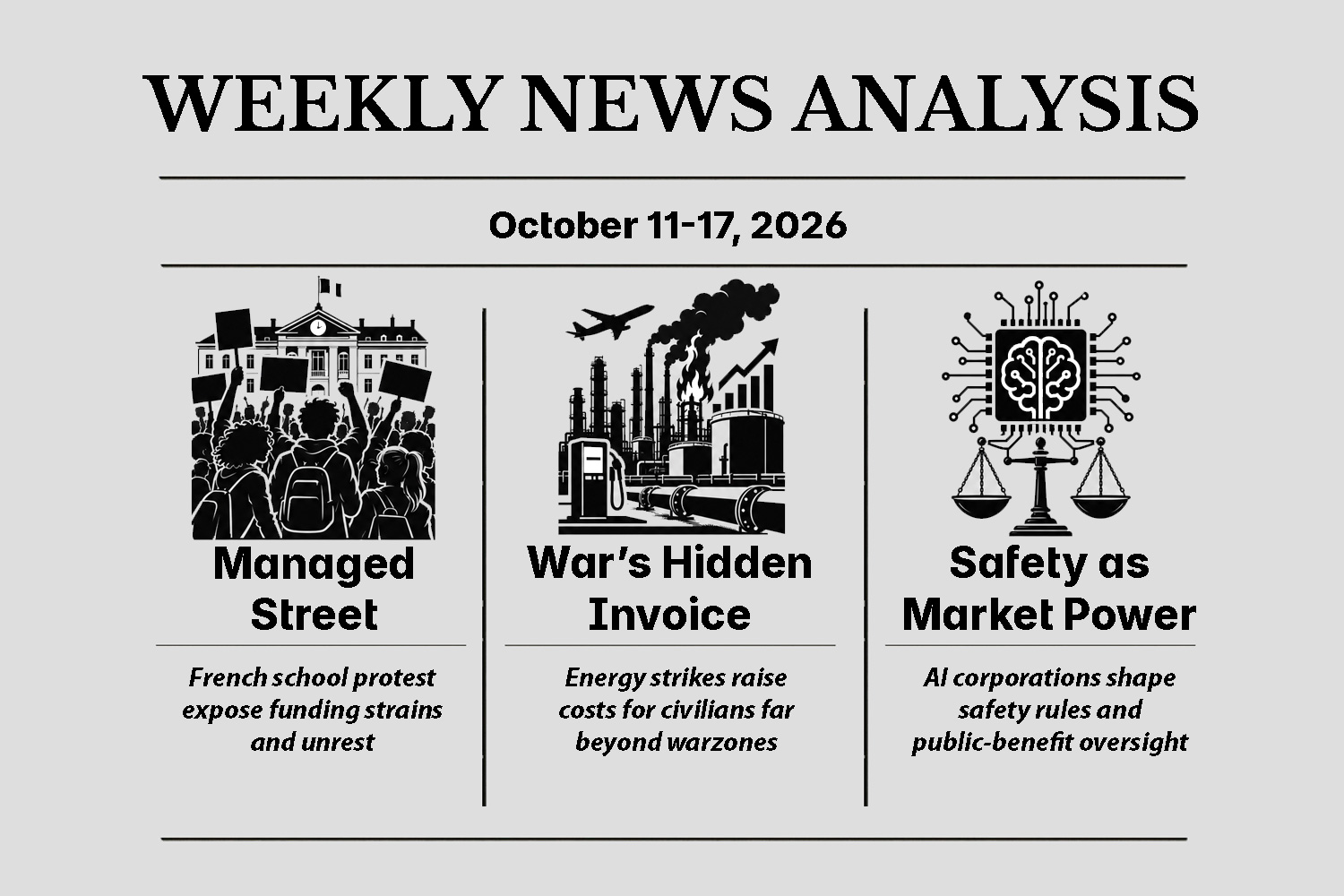
This week, the gap is growing between institutions that profess to serve the public and the people who bear the consequences of their decisions. In France, students are protesting deteriorating schools and inadequate public investment, while clashes involving demonstrators, police, and opportunistic vandals risk pushing their original demands out of view. Abroad, wars are exposing civilians to the economic fallout from attacks on energy infrastructure and transportation networks. At the same time, the artificial intelligence industry is building public-benefit mechanisms, pushing for preferred regulatory limits, and attracting greater national security oversight. The stories differ, but each raises the same question: who decides what costs a system may impose, and who pays them?
These events expose recurring institutional incentives. Public frustration can be redirected toward visible targets; rulers can announce military victory while its economic consequences persist; and private corporations can present preferred regulatory arrangements as public protection. Evidence must remain distinct from interpretation. The Trivium Method of Critical Thinking requires establishing facts first, examining relationships and contradictions next, and letting conclusions follow from that analysis. Without this discipline, citizens risk getting caught between competing narratives that invite emotional reactions while obscuring the deeper distribution of power and responsibility.
Managed Street
French ministries' pension costs drain public service spending, report says - Reuters
At least 160,000 people take to streets in third week of French school protests - The Guardian
Protests in France against rising living costs - AP News
Revealed: French police used UK-funded 4x4 vehicles to charge student protesters - The Guardian
The unrest in France raises a question more consequential than any single street confrontation: what happens when a government carries substantial financial obligations while the public services people rely on continue to deteriorate? A Reuters report published October 13 found that pensions for retired civil servants consumed 32% of the French education ministry's budget, or €28.5 billion, while pension costs represented 30% of the interior ministry's budget. The average across ministries was approximately 13%. These figures do not show that pensions are illegitimate or that retired public employees caused schools to decline. Instead, they point to a structural budget constraint, with existing commitments competing with the resources available for current services. Students facing overcrowded classrooms, absent teachers, and deteriorating buildings see the contradiction between the promise of public service and the failure to provide it adequately. The core grievance extends beyond the condition of any school; it concerns how public priorities are set, funded, and defended.
Demonstrators are calling for better educational conditions, substitute teachers when instructors are absent, repairs to neglected school buildings, adequate staffing and an education system that does not abandon disadvantaged communities. As protests grew, the coalition widened beyond high school students to include university students, trade unionists, some teachers and established activists associated with France's Yellow Vest movement. The Guardian reported that approximately 161,500 people took part in demonstrations on October 13, according to France's interior ministry, although turnout estimates had varied substantially on earlier dates. By the weekend, the protests were also intersecting with anger over fuel prices and the cost of living. This widening of grievances matters: a dispute over school funding can develop into a challenge to broader economic priorities. Yet students, workers and established political movements should not automatically be treated as a single organization operating under one leadership or pursuing identical demands. Other movements with different grievances and demands co-opted the original movement that started these protests.
It is necessary to separate a movement's stated demands from everyone's actions in the streets. The demonstrations have involved school blockades, marches, barricades and clashes with police. Most demonstrations described in the October 13 reporting were peaceful, although clashes occurred in several locations. By October 17, reports also described looting, fires, vandalism and attacks on public buildings and commercial property during wider demonstrations. Some participants and opportunistic looters targeted shops, vehicles and public infrastructure rather than officials responsible for education budgets or economic policy. A legitimate grievance does not excuse such conduct. Business owners who lose storefronts, residents whose vehicles are burned and workers unable to reach their jobs may have no control over the policies under protest. The political effect is consequential: when destruction dominates the images people see, attention moves from institutional failure to the immediate threat of disorder. That shift can happen even when those responsible for the destruction do not share the demonstrators' objectives.
Assess violence in both directions, not through a narrative chosen in advance. Reports describe violent acts by some demonstrators and looters, while also documenting aggressive police interventions, injuries to young protesters and allegations of excessive force. On October 17, The Guardian reported that French police had used four-wheel-drive vehicles funded by the United Kingdom for a border-control purpose to charge at student protesters in Dunkirk, prompting a French government investigation. Repurposing equipment originally intended to prevent asylum seekers from crossing the Channel for domestic crowd control raises a serious question about how coercive tools migrate from one setting to another. Police have also deployed tear gas and water cannons during confrontations. Police misconduct does not erase protester violence, and protester violence does not erase police misconduct. Students, parents, teachers, police officers, shopkeepers, commuters and residents can all suffer as the confrontation escalates, while officials charged with resolving the original budget dispute remain removed from much of its immediate cost.
The same evidentiary discipline is needed when assessing the scale of destruction. Reporting from the weekend describes damaged shopfronts, looted stores, burned vehicles, barricades, and attacks on public buildings in particular locations. The damage is real and can ruin an individual business owner's livelihood even if it affects only a limited part of a city. The supplied reporting does not establish that entire French cities, or a measurable percentage of France's total urban area, have been destroyed. Conversely, intact streets and residents continuing their routines do not prove the unrest is fabricated or exaggerated, but we know the media often makes things seem much larger than they are to drive viewership. Videos provide samples, not comprehensive surveys: footage from a quiet interval cannot establish that an entire demonstration was peaceful, just as flames in a dramatic image cannot show that a whole city is burning. Crowd estimates also differ by date and methodology. The defensible conclusion is that France has seen substantial mobilization and some geographically concentrated destruction.
Comparing these events with Antifa-associated protests in Portland and other American cities helps when you focus on tactics and political effects, not presumed organizational identity. In Portland during 2020, demonstrations against police violence included peaceful marches alongside blockades, masked participants, property damage, and clashes with law enforcement. The label Antifa refers to a decentralized anti-fascist tendency and is often applied imprecisely to people with different motives and affiliations. The relevant parallel is that a broad protest can include a smaller, more confrontational faction whose conduct ends up defining media coverage. Clashes with police then become the main story, politicians debate public order, and people who initially supported the grievance may distance themselves from it. France's student protests are not identical to Portland's demonstrations, and similar tactics do not demonstrate a common sponsor. The comparison matters because a small number of confrontational participants can reshape a movement's public meaning far beyond their actual numbers.
This pattern warrants scrutiny of controlled opposition, infiltrators, and crisis actors, without collapsing the distinction between a plausible mechanism and a proven explanation. Governments and intelligence agencies have historically infiltrated or disrupted political movements; documented programs such as the FBI's COINTELPRO show that these tactics are not beyond possibility. That history does not prove the French state or another intelligence service secretly organized, financed, or deliberately escalated the French demonstrations, but it does raise a possibility: demonstrations of this size are costly and require extensive coordination, so they are unlikely to be spontaneous. A more supportable hypothesis is that, if present, disruptive factions, opportunists, or infiltrators could divert public anger from the institutions under challenge. Their actions might discredit the movement, justify more aggressive policing, and shift the focus from demands for greater public investment to demands for order. Authorities and political actors can benefit from such an outcome without having created it.
Funding requires the same scrutiny. The reporting identifies support from trade unionists, student organizations, some teachers, and left-wing opposition politicians, along with the participation of established Yellow Vest activists in the wider mobilization. These connections can provide organizing capacity, communications networks, legal assistance, and experienced participants. They do not establish who paid for specific acts of vandalism or whether foreign governments, intelligence services, or wealthy private interests finance the movement, even if they do. The deeper concern is whether this conflict may reproduce the cycle described in The Fallacious Belief in Government: Warp Speed Toward Tyranny: institutional failure fuels public anger; confrontation shifts attention to disorder; disorder invites coercive intervention; and the resulting conflict can reinforce institutional claims that greater control is needed. The same cycle can cross borders. Countries confronting underfunded schools, high energy costs, stagnant wages, and declining trust may adopt similar protest tactics. When grievances go unresolved, a local education movement can become a cross-border expression of wider economic frustration.
War's Hidden Invoice
US inflation heats up in September; Fed rate hike this month back on table - Reuters
Vance claims US won Iran war - The Hill
Ukraine launches over 1,000 drones at Russia, setting oil facilities ablaze - Al Jazeera
Vice President J.D. Vance's assertion that the United States has, in some respects, decisively won its war against Iran highlights the gap between proclaiming strategic success and proving that a conflict has ended. Victory rhetoric offers rulers a politically convenient way to portray military operations as successful, especially when they face questions about casualties, fuel prices, and the length of an intervention. Yet the qualification that the adversary continues to respond reveals the unresolved reality beneath the declaration. A war cannot be judged only by the damage inflicted on an opponent or the objectives a government says it has achieved. More important questions are whether the threat said to justify the war has diminished, whether commercial shipping and energy markets are stable, whether a durable political settlement exists, and whether civilians face less danger. When a government declares victory while the economic and security consequences remain active, the word victory risks becoming a tool for managing public perception rather than a reliable description of strategic reality.
The Russia-Ukraine conflict reveals a similar problem through strikes on oil refineries, terminals and other energy-related facilities. The Associated Press reported that Ukraine attacked a Russian oil refinery in the Ryazan region on October 15, after a brief understanding concerning energy targets collapsed amid mutual accusations of noncompliance. Meanwhile, the Associated Press described Russian drone attacks on Ukrainian territory, including a strike in the central Kirovohrad region that killed three people and injured six. These incidents show how energy infrastructure has become a strategic pressure point. Refineries, depots, and terminals support military logistics and government revenue, but they also sustain civilian transport, employment, heating, and the broader economic activity households rely on.
The military rationale for striking energy infrastructure is clear: weaken an adversary's ability to supply forces, move equipment, generate revenue, or sustain a prolonged campaign. However, the effects on civilians reach beyond the intended target. Damage to a refinery can constrain fuel availability and raise the cost of moving goods. A disabled terminal can interrupt exports, disrupt shipping schedules, and increase insurance premiums. Fires and explosions endanger workers and residents immediately, while damage to nearby homes exposes people with no control over military strategy to the consequences of escalation. Even a facility serving a legitimate military function retains an economic role. Any assessment of proportionality and strategic effectiveness must therefore account for both the military objective and the civilian consequences. A strike can impose costs on an adversary while raising prices for consumers in several countries. Inflicting economic pain does not equal lasting peace, and civilian suffering cannot be dismissed as a minor accounting entry.
The economic fallout already shows up in American inflation data. Reuters reported on October 14 that the U.S. Consumer Price Index rose 0.6% in September and stood 3.7% higher than a year earlier. Gasoline accounted for more than half of the monthly increase, while core CPI rose 0.3% during the month and 2.6% year over year. These figures do not make war the sole cause of inflation; domestic demand, tariffs, production constraints and other factors also influence prices. They do, however, illustrate why energy-market disruptions matter far beyond a battlefield. Fuel is a household expense and a key input for transportation, agriculture, manufacturing and distribution. Higher diesel costs can raise freight charges, while more expensive energy can increase the cost of producing and delivering food and manufactured goods. Businesses may absorb some increases at first, but sustained pressure can eventually show up in consumer prices, reduced investment, thinner margins, or employment decisions. A conflict thousands of miles away can thus become a direct financial burden for households with no influence over whether it continues.
Geopolitical supply shocks leave the Federal Reserve with a particularly difficult inflation problem. Higher interest rates can restrain borrowing and demand, potentially limiting businesses' ability to pass rising costs to consumers. But monetary policy cannot repair a destroyed refinery, secure a threatened shipping lane or restore lost energy production. Instead, higher rates can make mortgages, vehicle loans, credit cards and working-capital financing more expensive. Small businesses that depend on bank credit may be squeezed as fuel, shipping, and materials costs climb. Policymakers may try to reduce inflation by weakening demand, but households and businesses that played little part in creating the original shock may bear a disproportionate share of the cost. A response framed as economic stabilization can therefore distribute the pain unevenly.
If the conflicts persist or widen, the likeliest global economic path is greater volatility, sustained energy risk premiums and slower growth, with stagflation possible if supply disruptions remain severe. Import-dependent countries face particular exposure: they must pay more for fuel while potentially contending with weaker currencies, higher borrowing costs and less fiscal capacity to support households. Energy-intensive manufacturers may postpone investment or cut output; transport companies may raise prices or reduce routes; farmers may face higher fuel and fertilizer bills; and governments may redirect money from education, healthcare and infrastructure to defense, subsidies or emergency aid. Some producers and defense contractors may gain from higher prices and new orders, but those gains are not a net social benefit once you count the war's destruction and opportunity costs. Financial markets may also react more sharply to each strike, ceasefire announcement, or diplomatic setback. When investors cannot confidently assess energy supplies and shipping access, uncertainty itself becomes an economic cost, discouraging long-term planning and raising the cost of capital.
The oil shocks of the 1970s offer a historical comparison: geopolitical disruption and energy scarcity contributed to inflation, economic stagnation, and political instability. The conditions in 2026 are not identical. Global energy production is more diversified in some respects, supply chains are more complex, and modern financial markets react to geopolitical risks far faster. Yet the underlying vulnerability remains. Energy is woven into nearly every economic activity, allowing disruption to spread well beyond the conflict zone. The feedback loop is especially dangerous: attacks on infrastructure or shipping raise perceived risk; risk premiums push energy prices higher; higher prices intensify inflation; monetary tightening or emergency spending adds strain; and political leaders face incentives to project strength rather than acknowledge a failing strategy. A declaration of victory may temporarily reinforce a political narrative, but it cannot replace secure supply routes or functioning infrastructure. If escalation continues, war could damage productive capacity, deepen economic pain, intensify political grievances, and make compromise still harder.
The central contradiction is that governments often justify military action as necessary for national security even as prolonged conflict erodes the economic security of their own populations and people elsewhere. Households face higher fuel and transportation costs, businesses absorb damaged facilities and more expensive financing, and future taxpayers may inherit larger defense budgets and reconstruction obligations. People in affected regions face immediate danger; those far from the front lines face less visible exposure through higher prices, supply interruptions, and reduced purchasing power. This is the hidden invoice of war: the public bears costs that extend well beyond the amount assigned to military operations. The framework in COVID19 – Short Path to 'You'll Own Nothing. And You'll Be Happy.' cautions against allowing fear and emergency rhetoric to replace scrutiny of policy outcomes. That principle does not prove a war was manufactured or that every intervention is unjustified. It requires rulers to show that a policy's actual results in practical terms correspond to its stated purpose. Without accountability, a conflict may continue long after the public is told decisive victory has already been achieved.
Safety as Market Power
Fed sees AI boom adding to inflation headache, but others may pay for the medicine - Reuters
Anthropic quietly pitches its own AI safety bill to lawmakers, Politico reports - Reuters
US's AI task force sets path for study and reviews, leader tells CNBC - Reuters
Anthropic's announcement of a Public Benefit Fund reflects the artificial intelligence industry's effort to reconcile extraordinary commercial growth with claims of public responsibility. The company said the fund would initially receive 5% of its shares, subject to stockholder approval, with the possibility of an additional 2% for every 50% increase in company value above a specified baseline. It could support traditional nonprofits or distribute resources to particular populations, while Anthropic has described its existing public-benefit work as including AI safety research, interpretability, biomedical research, and discounted access to Claude for nonprofits and scientific institutions. The proposal links the company's rising market value to a potentially expanding pool of resources for public purposes. That could represent a meaningful commitment, but it leaves important questions: who defines the public good, how are beneficiaries chosen, and how will the fund's decisions be assessed? A corporate promise begins accountability; it does not replace it. This push also aligns with the warnings in COVID19 – Short Path to 'You'll Own Nothing. And You'll Be Happy.' and the direction everyone is being pushed toward through the Great Reset and Agenda 2030. The road to Hell is paved with gold and good intentions.
Philanthropy and public accountability become harder to separate when a company occupies a central role in a technology that may shape employment, information access, education, public administration, and national security. A fund operating within a corporate structure may act more flexibly than a government program, but private decision-makers, not representatives directly accountable to the public, govern it. The reporting noted that key details about governance and valuation milestones had not yet been published. Those gaps matter because a public-benefit mechanism depends on more than the amount of equity committed; its effectiveness also rests on transparent allocation, independent oversight, and affected communities' ability to evaluate outcomes. The broader pattern is an emerging form of philanthro-capitalism: companies build economic power in private markets, then use part of that power to address problems linked to their own industries. Such efforts may deliver real benefits, yet they can also reinforce corporate legitimacy without materially changing who holds decision-making power. Additionally, when a corporation this size starts to fail, does this fund and mentality help drive the "too big to fail" rhetoric and the idea that it could need government bailouts in the future?
Anthropic's reported attempt to influence federal AI legislation makes this tension more concrete. Reuters reported on October 16 that corporate representatives had quietly presented lawmakers with a draft bill addressing the safety and security of frontier AI models. Under the reported proposal, the government could block a model's release or use only if a foreseeable and imminent risk crossed a high threshold: more than $1 billion in damages or the death or serious injury of more than 50 people. The specified risks included the creation or release of biological weapons, a model evading its developer's controls, and cyberattacks. The proposal would also require frontier-model developers to conduct testing, disclose findings, and obtain independent evaluations. These are reported elements of a corporate-backed legislative proposal, not enacted requirements. Their importance lies in where they draw the line between ordinary technological risk and government intervention. A threshold may create predictability, but it may also treat harms below that level as inadequate grounds for action.
Regulatory design can influence both market competition and safety. When compliance entails costly testing, documentation, security infrastructure, and specialized independent evaluations, large companies may be better positioned to bear those expenses than smaller developers, open-source projects, or new entrants. A framework promoted as protection against catastrophic harm could therefore reinforce established companies' market positions if the requirements are too costly or tailored to the capabilities of only a few firms. That result is not inevitable: shared safety standards can offer genuine value by clarifying obligations and making evaluations more consistent. The key questions are whether rules are proportionate to demonstrated risks, technologically neutral, and open to challenge by independent reviewers. The proposed bill's reported provision allowing laboratories to pay independent evaluators, provided payment isn't tied to the evaluation's outcome, tries to address one conflict of interest. It does not remove the need for transparent selection, protections against capture, and meaningful outside scrutiny of how evaluations are conducted.
Regulation becomes more complicated when the industry under review also helps draft the rules. AI companies have technical expertise that lawmakers and regulators may lack, so their participation is understandable and often necessary. Yet these same firms have commercial incentives to shape how risk is defined, where intervention thresholds are set, and which agencies have authority. The reported proposal would give the Commerce Department a central role in seeking judicial action to halt a dangerous model, while expressly limiting other federal agencies' ability to suspend development, deployment, or internal use. Such an arrangement might reduce arbitrary or conflicting interventions, but it could also narrow the government's response if a serious risk falls outside the specified categories or develops faster than the statutory process can accommodate. The language of safety can thus mask a contest over institutional authority. The question is not whether corporations or governments should enjoy unlimited discretion; neither should. The question is whether rules emerge through a transparent process that balances innovation, due process, public accountability and the rights of people exposed to the technology's consequences.
Washington's new AI task force shows that the technology is also being treated as a national security and interagency coordination issue. Reuters reported that the task force held its inaugural meeting and established protocols, a risk study, and several committees. Its planned work covered reporting and response, critical infrastructure, law enforcement, and responsibility, while workforce and economic effects were to be reported to the Department of Labor. The group was established for an initial 120-day period and included officials from intelligence, personnel management, the Federal Trade Commission, and defense technology. This structure recognizes that AI risks cross regulatory boundaries: the same systems can affect cybersecurity, public services, critical infrastructure, employment, and law enforcement. Yet such a broad mandate also raises questions about the boundary between public protection and centralized control. As AI becomes embedded in government systems, oversight can shape not only dangerous model releases but also procurement, data access, automated public decisions, and the future balance of authority among citizens, agencies, and private technology providers.
Together, the fund, proposed safety bill, federal task force, and inflation debate show an industry moving beyond product development and into the architecture of governance. Companies are not simply selling tools; they are helping shape which risks count, who evaluates those risks, when government may intervene, and how the gains from growth should be distributed. This is where the critical-thinking framework in The Fallacious Belief in Government: Warp Speed Toward Tyranny and the analysis of engineered consent in COVID19 – Short Path to 'You'll Own Nothing. And You'll Be Happy.' become relevant. The lesson is not that AI safety is inherently fraudulent or that public-benefit funding must be a disguise. Instead, test claims of safety and benevolence against operational design, incentives, and accountability. Who controls the evaluation? Who owns the infrastructure? Who can challenge a decision? Who pays when a system fails? If those answers remain concentrated among a handful of companies and government officials, the language of public protection may legitimize another concentration of power even while addressing genuine risks. Safety must be judged by transparent outcomes and enforceable safeguards, not by the authority of the institutions promising it.
Architecture of Managed Crisis
Across France's streets, energy networks in two war zones, and the institutions emerging around artificial intelligence, one question recurs: how power and consequences are distributed. Students may make legitimate demands for adequate schools, but vandalism and police violence can redirect public attention toward order. Governments may announce military success even as attacks on energy infrastructure and disrupted shipping continue to burden civilians and consumers. AI corporations may commit resources to public benefit and propose safety legislation, yet those efforts also shape who writes the rules, who can compete and who bears the costs of economic adjustment. These events are not equivalent, nor do they demonstrate that a single hidden authority directs them. Their shared feature is structural: the public routinely lives with the consequences of decisions made by institutions over which it exercises limited direct control.
The risk is a self-reinforcing cycle: institutional failure produces public anger; visible disorder or external threats become grounds for exceptional intervention; and that intervention consolidates authority without necessarily fixing the original problem. The answer is neither to accept every official explanation nor to treat every suspicion as proven. Demand evidence, compare stated objectives with measurable outcomes, and ask who benefits from each policy arrangement. The Trivium provides a practical discipline: establish the facts, test the logic, and only then draw conclusions. The natural rights framework in The Fallacious Belief in Government adds a moral question institutions often evade: are life, freedom, and property being protected, or sacrificed in the name of an abstract public good? A society that neglects these questions risks trading meaningful accountability for permanent crisis management. The challenge is to preserve individual autonomy, insist on transparent institutions, and develop forms of cooperation that do not require citizens to surrender their judgment whenever authorities invoke safety, stability, or progress.
Listen to this week's news in verse for a quick recap!