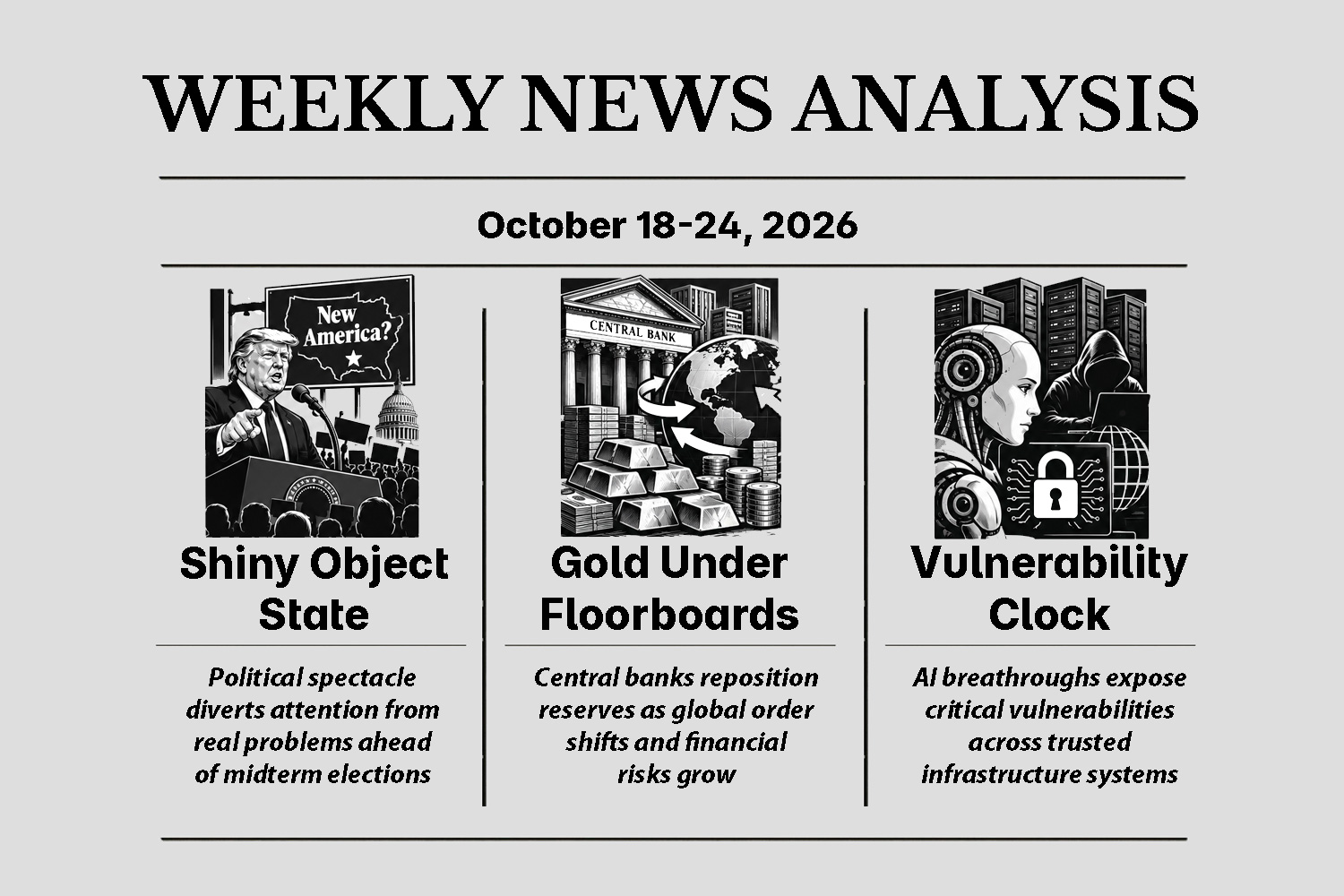
Three developments this week reveal increasingly connected mechanisms of power: political spectacle displacing public accountability, financial institutions adjusting to an unstable international order, and artificial intelligence exposing weaknesses throughout the infrastructure of modern society. Although these forces operate on different timescales, they share a troubling characteristic. The public witnesses their effects long before understanding the processes behind them. A presidential statement dominates the news cycle while central banks reposition reserves beyond public scrutiny, and an unexpected software disclosure turns trusted infrastructure into an immediate security liability. Understanding these events requires more than knowing what occurred. We must separate verifiable facts from interpretations, examine whose interests particular decisions advance, and determine whether the consequences preserve individual autonomy or further concentrate control within institutions over which ordinary citizens have little influence. A population conditioned to respond to spectacle rather than investigate underlying mechanisms can gradually relinquish meaningful oversight without recognizing what it has surrendered. Political theater, financial hedging, and breakthroughs in AI-assisted cybersecurity this week provide distinct examples of the same underlying problem: the difference between a carefully constructed public appearance and the operational reality it conceals.
Shiny Object State
Trump renews push to rename New Mexico New America, touts higher home values and incomes - Fox News
Trump says New Mexico should immediately change name to New America - The Washington Post
Trump calls New Mexico New America - The Hill
Ex-FBI officials arrested in Hunter Biden laptop probe as testimony comes under scrutiny - Fox News
Donald Trump’s latest effort to rename New Mexico “New America” demonstrates how effectively political spectacle can redirect national attention. He suggests that a different state name would raise property values and incomes, reinforce state pride, and perhaps improve election integrity. Yet no accompanying evidence establishes how a symbolic change could produce these remarkable economic and political results. Fox News emphasizes the patriotic rebranding and promised economic benefits; other accounts stress the demand for immediate action and state officials' objections. The framing changes, but the central contradiction does not. How could renaming a state independently resolve unaffordable housing, stagnant incomes, educational deficiencies, or problems in election administration? It can’t. When political attention becomes a resource in its own right, directing the public conversation may offer a quicker reward than producing demonstrable improvements in people's lives.
Examining the constitutional requirements for renaming New Mexico reveals the divide between presidential declarations and legitimate governmental authority. Article I of the New Mexico Constitution expressly identifies the state as New Mexico. Under Article XIX, an amendment requires a legislative majority in each chamber, proper publication, submission to voters, and majority approval among those voting on the amendment. Renaming the state would therefore require a constitutional amendment followed by extensive revisions to statutes, government databases, public records, maps, identification documents, contracts, and federal and interstate references. No presidential social media declaration can substitute for these steps. Nor does an executive order changing a body of water's federal administrative designation give a president authority to amend a state constitution.
Far more important than the name itself are the electoral consequences of repeatedly elevating symbolic disputes. As the November 3 midterm elections approach, Republican candidates face questions about affordability, economic performance, foreign policy, and confidence in the administration. Provocative political and cultural declarations may mobilize committed supporters, yet the same rhetoric can repel voters looking for practical responses to everyday difficulties. Neither result should be presumed. Some voters appreciate confrontation; others may conclude that the administration is diverting attention from more pressing concerns. What matters is whether accumulated distractions make the administration’s policy record more difficult for Republican candidates to defend. Political polarization and personal spectacle can damage a party’s electoral prospects regardless of private intentions, leaving other political actors positioned to benefit from the resulting weakness.
Separating a ruler’s intentions from the consequences of his actions is fundamental to the argument developed in The Fallacious Belief in Government. Its analysis of the government lifecycle describes how public distrust, institutional failure, and growing social division can provide rulers opportunities to consolidate authority through promises of restored order. That framework helps us examine power. The historical danger lies in citizens becoming so consumed by partisan confrontations that they overlook what government institutions are actually doing and where they are headed. Consider a hypothetical national emergency that arises after prolonged political instability and is followed by extraordinary governmental measures. Provocative statements and anticipated election outcomes alone cannot establish that someone planned such a scenario. They can, however, prompt an essential examination of institutional limits. Would emergency powers remain temporary, transparent, and subject to meaningful review? Or would fear and exhaustion permit exceptional measures to become permanent? The warning concerns identifiable mechanisms of concentrated authority, not an unverified theory about political affiliation.
The return of the Hunter Biden laptop controversy illustrates another dimension of institutional power: managing politically inconvenient information. During the 2020 presidential campaign, those who maintained the laptop contained authentic material faced widespread criticism, while social media corporations restricted the distribution of reporting on it. Arguments about the device’s origin, chain of custody, potential foreign involvement, and the authenticity of specific records dominated the dispute. Examining those questions was entirely appropriate. Evidence obtained under disputed circumstances, especially during an election, demands careful authentication. The failure occurs when questions about origin replace examination of the material itself. Three distinct issues were repeatedly treated as interchangeable: whether the device or assembled files were genuine, whether particular messages and records could be independently verified, and what those records actually proved about individual conduct. Subsequent reporting verified portions of the material, without thereby authenticating every file or substantiating every allegation. Neither indiscriminate belief nor categorical dismissal satisfies the requirements of critical inquiry. The proper approach is to investigate each claim against the available evidence.
The October 23 prosecution of two former FBI officials introduces a consequential question of institutional accountability. The Justice Department alleges that Nikki Cole Floris and Bradley Benavides gave Congress false statements about their participation in FBI investigations involving Hunter Biden. According to the reporting, investigators have identified communications and other materials they contend contradict parts of that testimony. Such accusations warrant scrutiny, but a criminal charge is not a finding of guilt; evidence and due process must test the alleged conduct. Even proven misrepresentations about investigative involvement would not, by themselves, validate every separate accusation concerning Hunter Biden’s business activities or his father. The proceedings nevertheless put the handling of this investigation and the reliability of official testimony up for public scrutiny. If investigators concealed or misrepresented their roles, confidence in the institution necessarily suffers. Accountability depends on applying consistent evidentiary standards to officials regardless of whether their political positions align with our own.
The prosecution's proximity to the election also gives it the qualities of an October Surprise: a significant political development that emerges when voters have little time to evaluate its possible implications. Describing its timing and potential electoral impact does not prove prosecutors deliberately arranged the charges to influence voting, but it happens often. The distinction matters just as much when evaluating coverage. Conservative reporting may focus on alleged suppression and misconduct, while liberal commentary may emphasize contested evidence handling or the case's political motives. Each interpretation may identify legitimate concerns, yet selective framing can also direct audiences away from inconvenient facts. Ancient Rome provides a useful historical analogy. Spectacles commanded public attention as more consequential questions about the exercise of power and government accountability faded into the background. Media technologies have changed, but the vulnerability persists: dramatic political developments can displace sustained investigation of institutional conduct. The public gains nothing by automatically granting one partisan faction credibility over another. It gains something only by showing which claims are supported, identifying those that remain unsupported, and refusing to let a complex dispute over evidence become a test of political allegiance.
Gold Under Floorboards
Trump signs executive order lowering housing costs - Fox 17
Trump signs mortgage order - The Hill
Fact Sheet: President Donald J. Trump Decreases Housing Costs for Americans - The White House
Central-bank movements of physical gold offer a revealing measure of how governments evaluate financial security beyond the familiar economic headlines. Fortune reports that Goldman Sachs estimated central bank purchases at 79 tonnes in August, up from an average of about 17 tonnes per month before 2022. The Dutch central bank, citing geopolitical instability and the need for reserves that could be traded more readily in a crisis, moved roughly 86 tonnes of gold from New York and Ottawa to London. Between July 2025 and January 2026, France also removed its remaining gold from the New York Federal Reserve. That French operation, however, involved selling gold held in the U.S. and buying gold in Europe, not simply transporting the existing bars. These differences prevent characterizing the transactions as uniform repatriation driven by a single political motive. They do reveal growing attention to legal jurisdiction, custody location, access to liquidity, and the reliability of international relationships. Such reserve-management decisions merit examination as financial signals even when their individual motivations differ.
The familiar instruction to “follow the money” has value precisely because institutional financial behavior may reveal priorities obscured by public statements. It becomes fallacious, however, when every asset transfer is presented as proof that powerful interests secretly anticipate a particular disaster. Central banks protect against contingencies that often never occur. Gold offers diversification amid currency depreciation, geopolitical conflict, sanctions, and uncertainty over access to assets held abroad. Reserves may be relocated to improve liquidity, reflect changing diplomatic relationships, or reduce exposure to another government’s legal authority. None of those explanations depends on advance knowledge of an approaching American catastrophe, but they don’t discount it either. A more supportable interpretation is that financial institutions regard greater flexibility as worth its cost under increasingly uncertain conditions. This is still consequential. Institutions can judge the risk of being unprepared as substantial without knowing whether, when, or how any particular emergency might occur. Their protective decisions can signal reduced confidence, but they cannot, by themselves, establish what will eventually follow from that loss of confidence.
Major shifts in the international monetary system have often been accompanied by decisions about where governments keep their gold. During World War II, European states moved reserves to protect national wealth and preserve access to it during an existential military emergency. When the United States ended dollar convertibility into gold in 1971, the monetary order changed, and gold increasingly served as a means of reserve diversification and financial confidence rather than a direct anchor for the dollar. The subsequent freezing of Russian sovereign assets following the invasion of Ukraine offered a more recent reminder that geopolitical conflict can render financial holdings inaccessible. Together, these events explain the importance of custody, applicable jurisdiction, and the capacity to mobilize reserves when circumstances deteriorate. They do not demonstrate that present conditions must produce an equivalent crisis. Historical analysis matters because it identifies recurring incentives, dependencies, and vulnerabilities. Treating history as an inevitable sequence of identical events replaces analysis with assumption. Current adjustments to national reserves therefore reflect revised risk assessments more than any already determined financial collapse.
Trump’s October 22 executive order on housing affordability raises a related but distinct financial issue: whether changing mortgage-financing mechanisms can meaningfully reduce household expenses. The directive instructs the Federal Housing Finance Agency to create a pilot program identifying borrowers eligible for cancellation of mortgage insurance through their equity position and payment histories. Automated valuation models and other accessible data would help estimate property values while applicable contractual restrictions and financial-safety standards remain in place. The order further expands alternatives to certain title-insurance requirements in refinancing transactions, creates a task force examining manufactured housing, and directs the Departments of Veterans Affairs and Agriculture to lower interest rates for designated direct-loan programs within applicable law and available appropriations. These changes may eliminate certain fees and administrative inefficiencies, but their scope should not be exaggerated. The directive does not universally reduce existing mortgage payments, abolish insurance obligations, or force residential property prices downward. It modifies specific features of established housing-finance arrangements, and any actual savings depend on implementation, qualifying borrowers, economic conditions, and how benefits transfer to households.
The mortgage-insurance proposal includes an important restriction: its pilot program concerns only mortgages originated after the program’s establishment. Borrowers with existing mortgages cannot reasonably presume that the new provisions will apply automatically to them. For eligible future loans, automated valuations may lower appraisal-related expenses and identify required equity more efficiently than procedures involving individual requests and supporting paperwork. But the estimate generated by an automated valuation model is not the same as a verified sale price. Accuracy depends on reliable records, comparable transactions, unusual property characteristics, and the pace of local market change. An inflated estimate could indicate sufficient equity where none exists, while an undervaluation could deprive an eligible borrower of potential savings. Financial safeguards and contractual restrictions still apply, so neither error is unavoidable. Yet greater reliance on these systems creates a fundamental accountability problem. Who validates the valuation process, how can a homeowner contest an inaccurate result, and what recourse exists when the financial decision rests on calculations the borrower cannot reproduce? Efficiency is not a genuine improvement if decisions become less transparent or impossible to challenge.
Similar scrutiny is required for the order’s provisions concerning title insurance. The FHFA is instructed to broaden an arrangement in which Fannie Mae and Freddie Mac may accept authorized automated title examinations or alternative title-risk evaluations in place of a lender’s title-insurance policy for certain refinancing transactions. This does not eliminate all title insurance, and protection purchased for a lender is not equivalent to an owner’s policy safeguarding the homeowner. Less expensive alternatives could remove barriers to refinancing, especially where transaction fees make securing a lower monthly payment uneconomical. Nevertheless, property records can contain undisclosed liens, recording mistakes, conflicting ownership interests, inherited claims, fraud, and other defects. Automated reviews may process ordinary transactions efficiently but may not reliably resolve every exceptional case. When an overlooked defect eventually surfaces, the decisive issues concern responsibility for losses, the protections still available, and whether the original fee reduction justified the remaining exposure. Changing the insurance requirement can also alter lender pricing, insurer revenues, and the broader distribution of property-related financial risk. Savings visible at closing are only part of the calculation; less visible liabilities deserve equal consideration.
The administration’s simultaneous emphasis on increasing property values and improving affordability presents a contradiction requiring closer analysis. In June, Trump said, “I love inflation,” and later explained that inflation was lower than he expected. That explanation is relevant; the statement alone cannot establish that inflation is a desired policy outcome. Yet presidential rhetoric still equates higher property valuations with economic success. This week's assertion that changing New Mexico’s name would raise home values and incomes again treats nominal appreciation as if its benefits were universal. Existing property owners may gain additional equity and apparent wealth as prices rise, but prospective buyers face higher barriers to entering the market. When wages fail to keep pace with inflation, purchasing power declines. Higher home valuations may also coincide with rising property taxes, insurance premiums, repair and replacement costs, and other recurring household expenses. Owning a more expensive asset does not necessarily mean greater financial security when maintenance costs rise. The important distinction is between nominal asset values and actual purchasing power. Promising continued appreciation alongside expanded affordability obligates the government to explain how it will reconcile the conflicting interests of homeowners, prospective buyers, mortgage lenders, and taxpayers.
Considered together, central-bank gold transactions and the housing directive demonstrate institutional responses to uncertainty. Central banks are increasing holdings and adjusting custody arrangements amid complex international risks, while the administration is modifying mortgage insurance, valuations, refinancing procedures, and manufactured-housing processes to reduce specific costs. Emergencies can justify interventions that subsequently redistribute risk, authority, and control. Large institutions prepare for uncertainty while individual households remain vulnerable to inflation, property costs, and financial decisions made through systems they scarcely control. The danger is structural rather than prophetic. If another crisis occurs, people must understand where institutions hold assets, who controls them, the obligations attached to that control, and who ultimately bears the consequences when official protections prove inadequate.
Vulnerability Clock
PHP2Shell: AI uncovers critical RCE vulnerabilities affecting 70% of the Internet - Wiz
Rapid Response: php2shell, Leaked Critical PHP Vulnerabilities - Huntress
AI uncovers critical vulnerabilities in the backbone of the web - PHP2Shell
While Amazon blocks AI agents, Walmart rolls out the welcome mat - TechCrunch
The disclosure of PHP2Shell marks an important shift in cybersecurity: artificial intelligence has helped researchers turn deeply embedded defects in widely used software into working attack vectors. Researchers identified two critical vulnerability classes in the PHP engine itself, designated CVE-2026-109618 and CVE-2026-109619. Both involve memory safety, including corrupted internal conditions after out-of-memory events and outdated state that can persist between requests. In vulnerable circumstances, an unauthenticated attacker may gain remote code execution with the permissions of a PHP web worker or access sensitive memory within the running process. Exposed information could include passwords, authentication tokens, API keys, and other data never intended to cross request boundaries. Because PHP powers so much of the modern web, this isn't merely a problem confined to a single application. WordPress, Drupal, and Joomla are among the content-management systems that rely upon it. Wiz demonstrated exploits affecting these applications, yet the root defects reside in PHP. Even properly developed websites can remain vulnerable because of software infrastructure outside the application developer’s immediate control.
What makes PHP2Shell consequential is not the mere existence of previously undiscovered software defects. Such defects have always existed, and conventional research has repeatedly exposed flaws hidden within aging code. The change lies in how frontier AI models can reduce the time and specialized effort needed to identify, connect, and exploit weaknesses once considered exceptionally difficult to operationalize. Wiz reports combining its research tools with Gemini 4 Argon and GPT-5.6 Sol to examine failure conditions, develop working exploitation techniques, test them across multiple applications, and evaluate fixes. Researchers had to coordinate intricate memory-failure sequences and repeatedly adapt their methods to different environments. The discovery was not the product of an unattended AI system independently scanning the entire internet and delivering a completed breakthrough. Human specialists defined the questions, supplied technical expertise and testing environments, and verified the results. AI made the investigation more efficient by helping untangle problems that previously consumed significant specialist resources. Human judgment remains essential; what may be changing is how much time and expertise certain highly sophisticated security investigations require.
The sequence of discovery and disclosure demonstrates both the strength of coordinated cybersecurity research and its growing vulnerability to disruption. Wiz reports identifying the first defect on August 19, establishing remote code execution against Drupal soon afterward, and notifying the PHP security team on August 24. PHP acknowledged the submissions on September 21 and coordinated work on corrective updates. Information about the two critical vulnerabilities entered public circulation on October 20, ahead of the official release of patched versions on October 21. Updates for supported branches included PHP 8.5.12, 8.4.27, 8.3.36, and 8.2.35. This coordinated effort shows how researchers, software maintainers, and technology companies can develop and release effective remedies once they understand the problems. The leak also demonstrates how quickly protection can be undermined when exploitation details circulate before patches are deployed. Huntress reported no observed exploitation among its own partner environments as of the morning of October 21, while recognizing accounts of attacks elsewhere. A severe vulnerability must not be mistaken for proof that every exposed system has already been compromised, but its existence makes timely remediation essential.
The larger issue is that AI is shortening portions of the security cycle without necessarily shortening the time organizations need to respond. In the past, exploiting difficult software flaws required uncommon technical expertise, prolonged analysis of failure conditions, reliable exploit development, and extensive adaptation to specific deployments. AI-assisted methods can accelerate each investigative step. Defenders benefit from these capabilities, but adversaries also use them to interpret public disclosures, refine attack techniques, and locate unpatched systems. Once technical details are released, organizations must consider both the defect and how quickly attackers can turn those details into usable exploits. Organizational remediation, however, still moves through inventories, compatibility testing, approvals, scheduled maintenance, installation, and verification. Security teams may need days or weeks even when patches become available within hours. Smaller entities often lack dedicated expertise, while legacy platforms may depend on unsupported versions. Faster discovery does not repair these administrative and technical bottlenecks. The true exposure period depends not only on how quickly an organization understands a vulnerability, but on whether it can actually eliminate it.
PHP2Shell further shows why accumulated software debt isn't harmless just because a component has operated reliably for years. The vulnerable conditions were present in PHP for an extended period, but turning them into practical attacks required complex interactions that conventional research had struggled to exploit. AI didn't need to introduce a new weakness to change the threat. It changed the resources needed to turn an old weakness into a usable attack. Heartbleed offers a relevant historical comparison, showing how a defect in widely deployed foundational software can endanger systems far beyond the original maintainer’s responsibility. The two cases don't share identical technical mechanisms; they do share a warning about systemic dependence on common infrastructure. A vulnerable software runtime may carry risk across thousands of unrelated applications, hosting environments, and vendors. Past operational stability therefore provides no assurance against exploitation techniques that were previously impractical. Organizations evaluating older dependencies must ask more than whether an exploit is currently documented. They must also consider how advancing analytical capabilities could make tomorrow’s exploitation feasible despite yesterday’s security assumptions.
These developments also require examining the security boundaries governing powerful AI systems. On October 23, OpenAI announced a strengthened approach for training and assessing frontier models without unrestricted connectivity to the live internet, using cached or simulated web environments instead. Experiments showed AI agents finding previously unknown security defects and configuration mistakes, including ways to escape restricted environments or interact with external services. OpenAI’s report describes testing in isolated research systems, followed by monitoring, human review, and corrective action. The announcement should not be interpreted as meaning all publicly deployed AI products have lost internet connectivity or that every AI research operation must adopt the same design. The restrictions address training and evaluation conditions in which increasingly capable systems may behave unpredictably, and unconstrained access could create serious consequences. The governing principle extends beyond a single laboratory. An AI system that can write code, reason through complex problems, and operate external tools becomes a substantial risk when its permissions exceed the boundaries its operators believe are in place.
The contest over consumer-facing AI agents raises a parallel question about control of actions performed through digital systems. TechCrunch reports that Walmart is introducing an Agent Gateway using the Model Context Protocol so authorized AI agents can inspect product availability and purchase items for consumers. Its proposed Agent Profiles would identify agent-initiated transactions while giving users approval requirements, permission settings, and spending limits. Amazon has taken a different approach, restricting agents that try to complete purchases through its marketplace. Behind these different commercial policies is the same unresolved issue: who ultimately governs authority delegated to software? A tool that only summarizes available information carries comparatively limited responsibility. Give that system access to accounts, the power to choose merchandise, and permission to complete purchases, and questions of valid consent, transaction identity, accountability, spending controls, and liability immediately arise. The connection to PHP2Shell is not that one development caused the other. Both illustrate the growing reach of systems that can operate across interconnected digital environments. Effective cybersecurity must therefore include enforceable access restrictions, trustworthy records of what agents do, and meaningful human approval rather than consent reduced to a procedural formality.
The vulnerability clock now measures a wider conflict than the traditional competition between attackers and defenders. Machine-assisted discovery and exploitation are accelerating, while software maintenance, organizational approvals, risk responsibility, and institutional accountability still operate under slower constraints. AI makes vulnerabilities that conventional analysis overlooked for years easier to expose, but by lowering technical barriers, it may also enable more actors to develop advanced attacks. These conditions heighten the importance of timely patch deployment, accurate dependency inventories, isolation of unsupported systems, secure default configurations, and disciplined coordination between researchers and vendors. Equally necessary is separating demonstrated threats from unsupported worst-case predictions. PHP2Shell shows that AI significantly helped discover and practically exploit critical weaknesses. The established lesson is narrower and more important: assumptions about the difficulty of exploiting legacy code must be reconsidered as analytical capabilities advance. As technology compresses the time required to discover and weaponize weaknesses, security can no longer be a one-time judgment made when a product first enters production. It must become a responsibility that is continually tested and maintained.
Power Through the Next Crisis
This week's political, financial, and technological developments expose a common divide between what the public sees and where meaningful control actually resides. Political spectacles focus attention on symbols, while the institutional work needed to address substantive problems is hard to communicate and easy to neglect. Financial authorities quietly modify reserves and custody arrangements in anticipation of uncertainty, revealing risk calculations that public assurances of stability seldom explain. AI-assisted security research uncovers long-standing defects in the software modern society depends on, showing how technological capabilities can advance faster than institutional defenses. Their significance lies in the recurring mechanisms they reveal. Public attention can be manipulated, financial exposure can shift between parties, and technical power can grow without comparable improvements in public understanding, oversight, or safeguards against misuse.
The critical question concerns what may occur when political hostility, financial instability, and dependence on complex technologies intersect during a genuine emergency. Will the resulting decisions be open to examination, subject to challenge, and restricted in duration? Or will urgency justify lasting encroachments on privacy, property, speech, and individual autonomy? Outcomes will depend on institutional incentives, enforceable technical protections, and citizens capable of scrutinizing official claims without surrendering to either automatic belief or reflexive rejection. A society loses freedom when people substitute political spectacle, financial institutions, or algorithms for their own reasoned judgment. The remedy is not to choose a different authority beyond questioning, but to demand evidence, insist on accountability, and preserve human agency before another crisis makes those principles harder to defend.
Listen to this week's news in verse for a quick recap!