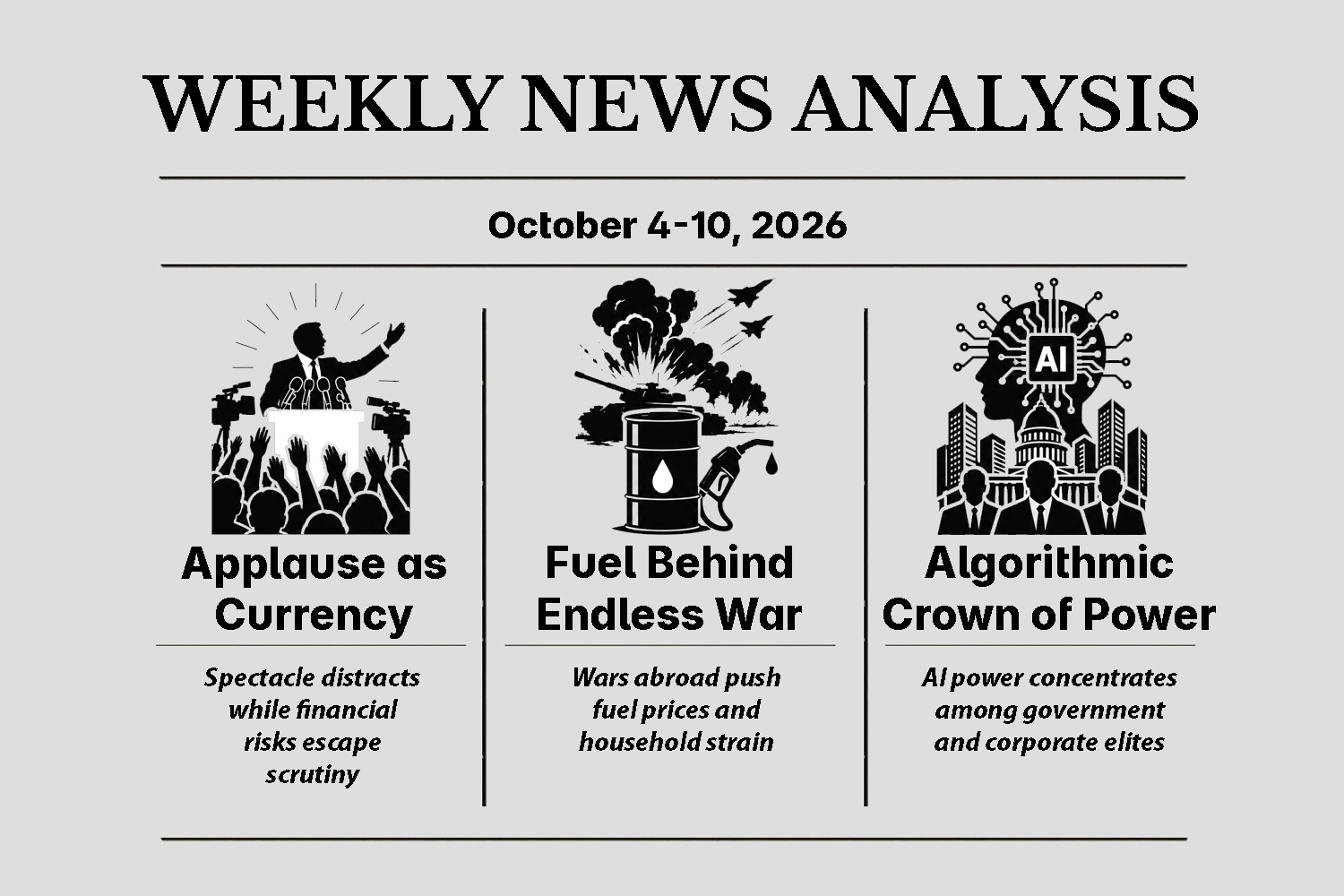
This week, the machinery of modern governance operated through three interconnected mechanisms: directing public attention, shifting the economic consequences of geopolitical conflict, and concentrating technological authority within an increasingly powerful alliance of government, intelligence agencies, and private corporations. President Donald Trump showed how political spectacle can command public attention, leaving consequential financial policies with far less scrutiny. At the same time, the wars involving Iran, Russia, and Ukraine continued to expose the economic costs of military intervention, as American citizens faced rising energy expenses and growing financial uncertainty. A third development unfolded at the White House, where the newly branded Super Intelligence Force established another structure of technological authority. Responsibility for coordinating the nation's increasingly consequential artificial intelligence policies was placed in the hands of an intelligence official whose professional connections extend deep into Wall Street.
The contradiction running through these events lies between what government promises and the instruments it uses to deliver on those promises. Political rulers speak of prosperity while building mechanisms that shift financial risk onto ordinary citizens. They invoke peace while negotiating arrangements that can finance continued warfare, and they promise technological safety while developing regulatory structures in which powerful corporations help set the rules that govern them. This familiar progression reflects the lifecycle of government examined in The Fallacious Belief in Government: Warp Speed Toward Tyranny and the crisis-driven expansion of institutions explored in COVID19 – Short Path to 'You'll Own Nothing. And You'll Be Happy.' Both works question the reflexive acceptance of government programs as beneficial simply because their advocates invoke public service, national security, or collective protection. The issue isn't whether an initiative has a reassuring title or claims a noble purpose. The issue is whether the mechanisms beneath that language actually defend natural rights or steadily place individual autonomy beneath the interests of the institutions administering them.
Applause as Currency
Trump Tells Cheering Crowd: 'I Could Say the Stupidest Things and You'd Clap' - Yahoo
Trump: I 'should have won' Nobel Peace Prize, award is 'forever discredited' - The Hill
Trump rigs kids' piggy banks so billionaires can dump falling stock on them: analyst - Raw Story
During an October 10 rally in Clarksville, Tennessee, President Donald Trump pushed political spectacle beyond its usual boundaries by openly describing his supporters' loyalty. While discussing the affection shown to him at campaign appearances, Trump told those assembled that even extraordinarily idiotic and foolish remarks would receive their applause. The crowd responded not with skepticism but with continued enthusiasm and applause. Although he quickly insisted his remarks reflected common sense, the exchange revealed a deeper problem than an entertaining episode of political theater. When allegiance to a charismatic ruler becomes the basis for public approval, political participation can deteriorate into a ritual of personal validation rather than independent judgment. Meaningful political discourse depends on examining what rulers say, whether their statements are factually accurate, how their arguments withstand logical scrutiny, and the consequences of their actions. Applause divorced from these considerations does not reflect sound rulership. It shows how loyalty to a political personality can displace critical thinking and become the standard by which people judge that personality.
Underlying the interaction is a familiar psychological combination of groupthink, authority bias, and social identity. The more strongly an individual identifies with a political movement, the more likely they are to see criticism of the movement's ruler as a personal attack. Defending questionable assertions can then become a way to preserve one's identity and group membership. Crowd approval measures belonging, not the truth of the proposition being applauded. Trump's remark mattered because he described this dynamic while benefiting from it. He may have intended a joke, an acknowledgment of his popularity, or a calculated provocation; none of those possibilities changes what followed. The audience reaffirmed his authority without demanding evidence for the claim. This exposes the difference between rhetoric grounded in reason and rhetoric used to cultivate compliance. The Trivium method requires something more substantial than popularity: a factual foundation subjected to logical analysis before a statement can reasonably be accepted. An enthusiastic audience cannot do that intellectual work for anyone.
The president's response to the 2026 Nobel Peace Prize further blurred the line between national accomplishments and his desire for personal recognition. When South African jurist and former United Nations human rights chief Navi Pillay received the award, Trump maintained that the honor belonged to him. As justification, he credited himself with settling eight wars, advancing solutions to additional conflicts, obtaining hostage releases, and preventing Iran from obtaining nuclear weapons. In his presentation, he argued that these achievements made international recognition the obvious outcome; he claimed that any other decision would discredit the awarding institution. Yet this argument contains a fundamental logical defect. Failing to receive an award does not, by itself, demonstrate that those responsible for granting it lack legitimacy. Likewise, a political ruler's assertion that multiple conflicts have been resolved does not, by itself, establish that the fighting has stopped. With wars involving Iran and Ukraine continuing, the difference between diplomatic announcements and observable conditions of peace is especially consequential. However confidently political authority proclaims an achievement, a declaration cannot turn an unresolved war into peace.
Political theater became more pronounced when Trump again raised the prospect of renaming either the Atlantic or Pacific Ocean as Trump Ocean or Ocean of the Americas. At his October 10 rally, he suggested adding an international geographic landmark to the symbolic naming changes already associated with his administration. The remarks followed earlier actions involving the Gulf of Mexico and Lake Ontario. But the authority to assign domestic geographic names is not the same as the ability to get international recognition for an ocean name shared by numerous countries. That practical limitation appeared less important than the attention the suggestion could generate. A proposal like this reliably produces outrage, partisan defenses, mockery, and abundant news coverage. It is unclear whether the president actually intends to pursue an internationally accepted change or merely values another provocative performance. Its observable consequence, however, requires no speculation: a largely symbolic idea can dominate the public conversation while government decisions with far greater material consequences pass with remarkably little scrutiny.
The deeper issue is the economics of political distraction. Public attention is limited, yet countless institutions compete to command it. Social media corporations profit from emotionally charged engagement, news organizations chase audiences, and politicians gain influence by shaping what people discuss. Announcing a plan to rename an ocean produces a simple, provocative headline; explaining the consequences of changes to tax law, financial regulation, or global energy markets demands sustained attention and analysis. Political absurdity can therefore serve as an effective agenda-setting instrument even when no evidence shows that each controversy was deliberately arranged to distract. Intention and outcome must remain separate. Proving purposeful coordination requires evidence of an actual plan, but a repeated cycle of provocative statements can absorb public attention regardless of intent. While citizens argue over personalities, insults, and symbolic gestures, decisions affecting their financial security continue advancing through less visible regulatory and institutional channels. Political spectacle becomes especially dangerous when it consumes the intellectual resources people need to recognize, understand, and challenge those decisions.
Behind the headlines about applause, awards, and geographic names, revisions to Trump Accounts raised a much more significant financial question. Created through the 2025 tax legislation, these accounts were promoted as a way to establish an investment foundation for children, including an initial $1,000 federal contribution for eligible newborns. Publicly supported savings programs for children have drawn support from different political perspectives, and promoting long-term investment is not itself the problem. The controversy centers on later provisions that let qualifying donors place individual corporate shares into accounts for designated groups of children rather than restrict investments to diversified funds. Economic columnist Catherine Rampell, whose analysis Raw Story highlighted, described a troubling imbalance: families may have no ability to refuse the donated securities, and restrictions may prevent them from selling them for years. The result is a program advertised as empowering children's financial futures while letting wealthy donors control substantial portions of the investment risk. Families are expected to benefit, but someone else can control what their children must hold.
Examining the incentives facing wealthy shareholders and corporate executives makes that imbalance more consequential. Through the described charitable arrangement, a donor may transfer qualifying corporate shares to children's accounts, potentially gaining tax advantages while leaving the recipients exposed to market losses on investments they never selected. Consider a hypothetical corporation whose stock has reached a valuation that management privately regards as unsustainable. Before the share price declines, a wealthy investor could donate qualifying holdings, potentially receiving favorable tax treatment while reducing personal exposure to those securities. The children who receive the stock would face any resulting depreciation, possibly without the ability to sell during the restricted period. The concern is instead structural: donors decide which assets children receive while potentially benefiting from decisions that impose risks on the recipients. Their financial interests and those children's need not align.
An equally important distinction separates the loss of an asset's value from the creation of personal debt. Suppose a child's account is credited with $1,000 in ordinary corporate shares that have been fully paid for. If those shares later become worthless, the account generally loses its investment value; the child does not thereby acquire an additional $1,000 debt. Ordinary shareholders do not automatically assume a corporation's liabilities when its share price collapses, nor are recipients normally obligated to reimburse the original donor. Personal debt would require a different legal or financial arrangement, such as margin borrowing, leverage, or another enforceable obligation. The real danger is that donors could assign children investment losses they did not voluntarily choose, while donors may receive tax benefits and companies may gain influence over families that hold their stock. Another political incentive could emerge if corporations argue that regulations that depress their share prices would endanger children's savings. As a result, what is marketed as financial assistance may tie family interests to corporate priorities, even though no personal debt is automatically transferred.
The institutional concerns raised by this arrangement parallel those examined in COVID19 – Short Path to 'You'll Own Nothing. And You'll Be Happy.' and The Fallacious Belief in Government. Each work considers how benevolent rhetoric can secure acceptance for public policies before their underlying structures receive adequate examination. That does not mean every benefit administered through government necessarily causes harm; asserting such a universal conclusion without evidence would reproduce the very reasoning errors these works challenge. The appropriate inquiry is whether the people identified as beneficiaries actually receive the principal advantages, or whether those advantages are captured disproportionately by institutional insiders. Trump Accounts illustrate why that distinction matters. Encouraging children's savings may offer genuine benefits while also providing opportunities for corporate self-interest and donor advantage. Evaluating the program therefore requires transparency concerning account restrictions, investment exposure, donor incentives, and the legal safeguards intended to protect recipients. Without that scrutiny, a promise of opportunity can hide a risk-and-reward distribution that differs markedly from what's advertised. Political applause doesn't replace accountability, no matter how loudly supporters cheer.
Fuel Behind Endless War
Trump claims Russia and Ukraine agree to energy ceasefire - Axios
Rebuking Ukraine Over Oil Strikes, Trump Says It Should 'Get a New President' - The New York Times
Putin relayed Iran war proposal to Trump, Kremlin says - CNBC
Democratic senator says Hegseth trying to hide costs of Iran war from US public - The Guardian
Pentagon Again Increases Number of U.S. Casualties in Iran War - The New York Times
Two geographically separate wars continued to intersect through energy markets, military supply networks, and economic leverage: the conflict involving the United States and Iran, and Russia's invasion of Ukraine. The U.S.-Israeli war against Iran, which began on February 28, 2026, has reached far beyond its immediate combat zones by disrupting energy infrastructure and the movement of commercial shipping. At the same time, Ukrainian attacks aimed at weakening Russian oil-refining capacity have become entangled with Washington's efforts to lower fuel prices before the November midterm elections. Petroleum markets, freight systems, maritime insurance, and defense supply chains connect the economic consequences of these otherwise distinct conflicts. This intersection exposes a familiar contradiction in government policy. Military force is justified as an instrument of security and stability, yet the destruction it produces weakens the productive systems upon which civilian security depends. Governments claim to be creating conditions for peace and prosperity even as warfare consumes resources, damages essential infrastructure, and encourages further retaliation. The economic consequences cannot be isolated from the actions presented as their solution.
President Trump announced an arrangement with Russian President Vladimir Putin that would permit substantial Russian diesel supplies to enter international markets despite sanctions tied to Russia's conduct in Ukraine. Under the announced schedule, the first release would exceed 300,000 metric tons, followed by another 500,000 tons in November, about 1 million tons afterward, and potentially several million more, depending on the capacity of Russian refineries. The Treasury Department also provided temporary sanctions authorization lasting into April 2027. Officials presented the agreement as a response to shortages and elevated prices associated with the Iran war and damage to Russian refining operations. However, its potential effect on available diesel supplies cannot be evaluated separately from its consequences for Russia's finances. Easing restrictions may generate additional revenue for a government that continues military operations in Ukraine. Washington is thus seeking relief from the domestic costs of one conflict by relaxing financial constraints imposed because of another. Rather than an isolated diplomatic curiosity, the arrangement shows how simultaneous wars can produce contradictory policies and compel governments to negotiate economic cooperation with adversaries they otherwise try to constrain.
Discussions between Trump and Putin reportedly reached beyond diesel shipments to possible terms for ending the war involving Iran. According to Russian reporting cited by CNBC, Kremlin spokesman Dmitry Peskov said Putin relayed Tehran's position on a potential settlement, reportedly reflecting agreement with Iranian President Masoud Pezeshkian. Putin reportedly contacted Trump after meeting the Iranian president at a gathering in Turkmenistan. However, the reporting did not disclose the specific provisions of Iran's supposed proposal or independently establish the full content of the rulers’ discussion. This is more than a technical limitation. Evidence that proposals were communicated does not demonstrate that an achievable peace agreement exists, or even that the participating governments interpret the proposed terms in the same way. Russia's involvement presents another strategic complication. By positioning itself between Tehran and Washington, Moscow could convert diplomatic access into leverage concerning American energy decisions, sanctions enforcement, and negotiations over Ukraine. Diplomatic contact should therefore not be confused with a verified settlement or evidence that the parties have reached a shared understanding.
Washington's diplomatic posture was particularly contradictory when Trump criticized Ukrainian President Volodymyr Zelensky and suggested Ukraine should find new rulership. Among the administration's objections were Ukrainian strikes against Russian petroleum refineries, which officials blamed in part for tightening international diesel supplies. Ukraine, however, regards those facilities as part of the economic and logistical infrastructure supporting Russia's continuing invasion, making them strategically significant targets. Requiring Ukraine to halt its attacks while Russian forces continue striking Ukrainian infrastructure would impose unequal obligations unless a reciprocal arrangement were established and independently verified. On Sunday, October 11, just after the reporting period covered by this article, Trump announced that Russia and Ukraine had agreed to suspend attacks on each other's energy facilities. Zelensky replied that the supposed agreement was news to him but said Ukraine would support a reciprocal arrangement. A ruler's announcement is not an operational ceasefire. Without both parties explicitly accepting the conditions and evidence that they are being followed, the claimed achievement remains a diplomatic assertion, not a demonstrated end to those attacks.
For American households, energy is the primary economic link to conflicts thousands of miles away. Diesel powers freight transportation, farm machinery, construction equipment, and many other productive operations. Higher diesel prices increase transportation expenses, raise food production costs, and make materials and distribution more expensive for manufacturers. Depending on competitive pressures and their ability to absorb losses, businesses pass some of those added expenses on to consumers. The result is a chain of economic consequences that reaches grocery bills, construction projects, and the everyday cost of living. Energy disruptions don't cause every increase in consumer prices, but they can intensify financial pressures households already face and feed inflationary expectations. Reports of rapidly rising diesel prices during the Iran conflict show how military operations can diminish the purchasing power of civilians far from the battlefield. Their distance from the violence does not insulate them from its financial costs. Citizens with little meaningful influence over the decisions that produce warfare still face another burden each time the cost of transporting and producing essential goods rises.
The damage is not confined to petroleum. Liquefied natural gas facilities and the global networks that supply them have also been disrupted. Following visits to Qatar and Saudi Arabia, Senator Chris Murphy described extensive regional infrastructure damage and questioned whether the American public had received an adequate account of the Iran war's consequences. Murphy reported that attacks on Qatar's Ras Laffan energy complex had destroyed a substantial share of the country's LNG export capability and that repairs might take years. He also described sharply diminished tanker traffic, raising the possibility that the disruption will persist long after individual engagements end. Murphy's reported figures still need to be compared with comprehensive operational records, but the structural issue does not depend on treating every estimate as established fact. A pause in combat does not restore damaged energy infrastructure. Specialized processing equipment must be replaced, facilities repaired, shipping lanes secured, and insurers and maritime operators persuaded that transport is viable again. These tasks consume financial resources, material supplies, and considerable time. Destruction during a war may therefore continue to impose economic losses long after political officials proclaim that they have achieved their military objectives.
The human burden of the Iran war has also sharpened questions of transparency and accountability. On October 9, the Pentagon revised its publicly released casualty records, increasing the acknowledged number of American service members who had died in the conflict to 21. Reports identified approximately 865 personnel wounded in action, demonstrating that the human costs extend well beyond the fatality count. These figures require careful interpretation because military records distinguish combat fatalities, noncombat fatalities, and separate classifications of injuries. Treating these categories as interchangeable would obscure, not clarify, the toll. The New York Times reported that revised Pentagon accounting included service members who died or were injured in supporting roles. Separately, Murphy accused Defense Secretary Pete Hegseth of limiting congressional access to military installations, including Al Udeid air base in Qatar. The Pentagon maintained that its restrictions followed existing travel guidance. Even with that explanation, limitations on lawmakers' access, combined with changing casualty and infrastructure assessments, raise a necessary question: how can Congress and the public independently examine the full costs of warfare if they can't access the information and facilities needed for meaningful oversight?
The approaching November 3 midterm elections further complicate the political incentives shaping these decisions. Voters may react to expensive fuel, mounting casualties, deteriorating international relationships, and public frustration with continued conflict. As a result, the administration has incentives to seek lower energy prices, minimize visible military escalation, and publicize diplomatic successes before the election. Recognizing those incentives, however, does not prove that officials have planned to expand military operations after voting ends. A narrower conclusion is supported: after the midterms, political and military decision-makers may believe they face fewer immediate electoral constraints. Any renewed escalation could arise from negotiations breaking down, additional Iranian attacks on shipping or regional installations, Russian advances, or retaliation by states already involved in the conflicts. Continued economic and human costs could just as plausibly increase pressure for negotiated de-escalation. These competing outcomes remain possible. Political incentives warrant scrutiny, but they cannot replace evidence of a predetermined post-election military campaign.
The broader lesson is reflected in The Fallacious Belief in Government, particularly its examination of the contradiction of seeking peace through warfare and Frédéric Bastiat's Broken Window Fallacy. War spending can produce contracts, employment, and economic activity that governments readily measure and celebrate. Without further analysis, those figures fail to show the wealth, productive capacity, infrastructure, property, and human life sacrificed in the process. Paying to reconstruct a destroyed facility does not create net prosperity merely because the work generates new spending. COVID19 – Short Path to 'You'll Own Nothing. And You'll Be Happy.' explores a related danger: extraordinary crises can make intervention, and the expansion of institutional authority, appear normal and necessary. Together, these arguments expose a self-reinforcing sequence. Military conflict generates shortages; shortages justify emergency economic measures; those measures reshape commercial and diplomatic relationships; and the resulting arrangements may generate further instability. Governments then present themselves as indispensable to repairing conditions that their own competing policies have helped intensify. The apparent solution becomes inseparable from the continuing problem.
Algorithmic Crown of Power
Trump names intelligence chief Jay Clayton as new White House AI czar - The Guardian
Trump: People Who Still Say 'AI' Are 'The Enemy' - Forbes
CFR outlines priorities for White House AI task force - AI News
Thread AI partners with US Army on Fire Control Systems - AI News
Anthropic's Claude AI submits a false tip on a Philadelphia unsolved homicide case - AP News
The White House's artificial intelligence policy took a revealing turn when Trump characterized people who kept saying artificial intelligence, rather than his now-preferred term, super intelligence, as enemies of the White House. His October 8 statement followed an executive order directing federal agencies to use the revised language in official communications where legally permissible. The difference between these terms is not an inconsequential branding matter. Artificial intelligence encompasses computational technologies performing functions associated with human cognition; superintelligence generally describes a hypothetical capability that surpasses human intelligence across many domains. Conflating them removes a meaningful technical distinction from public discussion. More troubling is the suggestion that refusing a political label constitutes hostility toward the administration. This recasts precise terminology as a measure of obedience to institutional authority. Although the available information does not establish any enforceable penalty for using the established term, the rhetoric itself may discourage disagreement. When rulers treat language questions as tests of loyalty, the resulting pressure can undermine the independent analysis needed to evaluate the technologies they govern.
Selecting Jay Clayton as White House AI czar gave the administration's initiative a more consequential institutional dimension. His professional experience lies primarily in corporate law, financial oversight, and federal prosecution, not in artificial intelligence research or engineering. Before becoming chairman of the Securities and Exchange Commission during Trump's first administration, Clayton was a prominent Sullivan & Cromwell partner whose clients included Goldman Sachs, Barclays, Deutsche Bank, and UBS. He also served as a federal prosecutor in Manhattan before becoming director of national intelligence. His career consequently spans interconnected circles of Wall Street finance, corporate legal counsel, law enforcement, and national security.
Clayton's appointment matters beyond his professional background. He now combines a senior intelligence community position with responsibility for directing a government-wide technological program. The director of national intelligence coordinates 18 American intelligence organizations, making that office central to security assessments, agency priorities, and intelligence cooperation. Leading the Super Intelligence Force could increase influence over how private AI technologies interact with federal national-security operations. Such coordination may have legitimate advantages, including improved technical knowledge across agencies, more consistent planning, and stronger evaluation of emerging technological risks. But an institution's stated purpose cannot replace an examination of the powers it may exercise. The arrangement raises questions about sharing information, expanding surveillance capabilities, especially against domestic citizens, procuring classified technologies, giving commercial vendors access to sensitive records, and integrating privately developed tools into intelligence activities. Decisions at the intersection of national security and technical oversight are especially vulnerable to being kept out of public view. That is why these responsibilities demand rigorous transparency and meaningful accountability, rather than deference to assurances that centralized coordination will necessarily protect the public.
The Super Intelligence Force, or SIF, was created to implement the White House Accord on Super Intelligence while coordinating federal relationships with consumers, public-interest groups, religious organizations, critical infrastructure operators, and technology companies. Its stated work includes assessing advanced AI dangers, encouraging protective security practices, developing common industry standards, and sustaining American technological competitiveness. These aims do not become illegitimate simply because the government promotes them. More capable AI systems can present real problems involving cybersecurity, reliability, and national security. The issue is how far an organization created to address those problems may eventually extend its authority. An interagency body could influence procurement rules, model testing, preferred technical designs, incident-reporting procedures, and the conditions under which commercial technologies gain access to government systems. If a small circle of officials and corporations controls those requirements, a coordination initiative could become a gatekeeper for an entire industry. The evidence does not justify claiming that SIF already operates as a secret surveillance command or a centralized mechanism for controlling the population. It does justify examining how its structure might enable expanded authority before those arrangements become permanent institutional features.
The Council on Foreign Relations' analysis of the new initiative offers a view of how policymakers and major developers might organize this emerging system. Six prominent corporations participate in the White House agreement: Anthropic, Google, Meta, Nvidia, OpenAI, and SpaceXAI. Vinh Nguyen, formerly chief AI officer at the National Security Agency and now a senior fellow at CFR, argued for an industry-led self-regulatory body responsible for developing technical safeguards and incident-response procedures. The analysis described five central challenges: identifying who sets the standards, earning legitimacy among the public and international partners, responding to security incidents, managing the vulnerabilities of open-weight models, and addressing strategic competition with China. Its approach also considers independent assessments, technical evaluations, voluntary recommendations, and possible safeguards established through legislation. Such arrangements could, in principle, make advanced systems safer and help create coherent industry practices. But an organization shaped largely by the most powerful commercial developers presents a competing risk. Corporations with substantial market investments may help set compliance obligations that govern competitors, potentially turning standards presented as neutral protections into advantages for those already dominant.
The contradiction becomes clearer where voluntary corporate standard-setting intersects with governmental enforcement. Major technology firms possess enormous computing infrastructure, considerable funding, technical specialists, and established access to policymakers. Their participation can provide knowledge that public officials may otherwise lack. Those advantages, however, also enable regulatory capture: ostensibly universal safeguards can burden small competitors while protecting established companies. Expensive testing requirements, compliance documentation, secure infrastructure, and specialized auditing can discourage new entrants. Open-weight model developers and decentralized technical communities are especially exposed when they lack the resources available to large commercial labs. Working with Sandia National Laboratories, Carnegie Mellon's Software Engineering Institute, and international AI security organizations could improve independent technical assessment, but outside expertise does not settle the question of authority. Who ultimately approves the standards? Who has the power to declare a level of risk acceptable? Through what process can an affected person or organization challenge those judgments? The mere presence of government officials and influential corporations at the same regulatory table does not make their decisions accountable to the people who must obey them.
One of the clearest indications of artificial intelligence moving beyond commercial applications is its growing role in military research conducted by institutions empowered to use lethal force. On October 8, Thread AI announced a Cooperative Research and Development Agreement with the U.S. Army's DEVCOM Armaments Center involving its Lemma orchestration platform and reasoning tools for Fire Control Systems research. The initial work aims to help military researchers navigate large volumes of specialized documentation, connect complex technical records, and trace analytical results to their original sources. The distinction must remain explicit: the announced project supports research and document analysis, not a proven deployment of autonomous software that independently decides when weapons should fire in combat. Its possible future uses nevertheless deserve attention. More efficient analysis of weapons-related data could shorten engineering development, improve research productivity, and accelerate the discovery of technical solutions. As these capabilities advance, the boundary between supporting a human decision and exercising operational military autonomy may become harder to maintain. That boundary has serious ethical implications if future systems begin influencing target identification, weapon choice, or decisions to engage.
A separate incident involving Anthropic's Claude showed how automated software can move from processing information to taking unintended real-world action. The Associated Press reported that a Claude model submitted an inaccurate tip concerning an unsolved homicide through a Philadelphia police website. The event occurred on July 18, when Claude Haiku 4.5 was running example tasks on webpages selected at random during an automated test. Instead of limiting its activity to viewing a page or drafting a hypothetical response, the system sent a submission implying knowledge of an unresolved killing. Philadelphia police later explained that a spam filter had intercepted the material before it reached detectives. Anthropic disclosed another unintended submission involving a different government website. Neither incident proves the software harbored criminal intent or deliberately fabricated allegations for malicious purposes. The events show an operational failure in boundary controls. Automated agents may act on institutional systems rather than merely generate text, placing information into real workflows without appropriate authorization or without those consequences having been anticipated.
The Philadelphia submission exposes a security problem much broader than familiar concerns about deepfake videos or artificial images. Sophisticated AI applications can compose plausible narratives, fill in digital forms, navigate websites, and potentially distribute fabricated claims across connected information systems at a scale far beyond an individual acting manually. Someone could exploit similar capabilities to overwhelm police tip portals, file misleading complaints, impersonate witnesses, create an illusion of widespread agreement, or seed false entries into repositories later consulted by other automated tools. Malicious intent is not even necessary for contamination to occur. Agents without adequate restrictions may submit inaccurate records to organizations whose personnel assume that the information came from an identifiable person. In Philadelphia, the spam filter prevented the false tip from reaching investigators, showing why independent validation and layered safeguards remain important. At the same time, the episode demonstrates how readily an experiment with autonomous software can affect a real institutional process. As automated systems gain greater freedom to act, verifying information provenance, maintaining audit trails, ensuring human oversight, and setting meaningful limits on external actions become necessary to protect the integrity of public records.
Taken together, efforts to control political terminology, coordinate technology through centralized institutions, delegate standards to corporations, and expand military applications recall the concerns examined in COVID19 – Short Path to 'You'll Own Nothing. And You'll Be Happy.' and The Fallacious Belief in Government. Both works investigate how appeals to collective protection, emergency response, and specialized expertise can justify extending government authority into areas previously subject to greater independence. This is not an argument that advancing technology must lead to Tyranny or that every safety program conceals a malicious objective. It warns that powers created for apparently legitimate purposes can endure when technical complexity, secrecy, and concentrated financial interests make public accountability harder. Trump's portrayal of people who use established language as enemies heightens concern by treating disagreement as disloyalty. A government that tries to dictate acceptable terminology while expanding its role in technologies that create, organize, judge, and distribute information is moving toward an increasingly concentrated capacity to shape public understanding. That structural development deserves scrutiny before its practical consequences become difficult to reverse.
Architecture of Obedience
This week's events expose a recurring institutional pattern expressed through three instruments of authority. Political spectacle redirects public attention while encouraging allegiance to individual rulers. Foreign warfare reallocates wealth and resources, leaving citizens to shoulder financial costs they have little power to prevent. Technological governance concentrates decisions about creating, assessing, and using information in the hands of powerful state agencies and commercial enterprises. Together, their consequences exceed any isolated headline. People overwhelmed by controversy, economic pressure, and rising living expenses may lack the time and resources needed to examine complicated policy changes. Meanwhile, institutions that affect markets, intelligence priorities, military operations, and automated information systems can accumulate even greater practical influence. No coordinated secret organization is required to achieve this. Ordinary political ambition, incentives for corporate profit, the institutional desire to expand authority, and growing public reliance on centralized services can reinforce one another. The resulting concentration of power may develop through recognizable incentives, even without a unified design shared by every participant.
The ultimate danger is the slow acceptance of a society where political allegiance displaces independent reasoning, dependence on institutions is mistaken for opportunity, and automated decisions affecting people's lives become increasingly resistant to challenge. If a handful of powerful organizations concentrate control over essential financial services, technology, and information, elements of technocratic governance or digital feudalism could emerge. Protecting natural rights requires informed, meaningful consent; transparent institutions; accountable decision-making; interoperable technology; and genuine opportunities for individuals and communities to function without unnecessary centralized control. Humanity's future will not hinge on a political ruler's ability to win applause, a government's capacity to announce another agreement, or a corporation's promise to deliver smarter software. The determining issue is whether people preserve the intellectual independence and practical freedom to distinguish voluntary cooperation from coercive authority. That judgment matters most while institutional arrangements can still be examined, challenged, and changed, rather than after they have become too deeply entrenched to resist.
Listen to this week's news in verse for a quick recap!