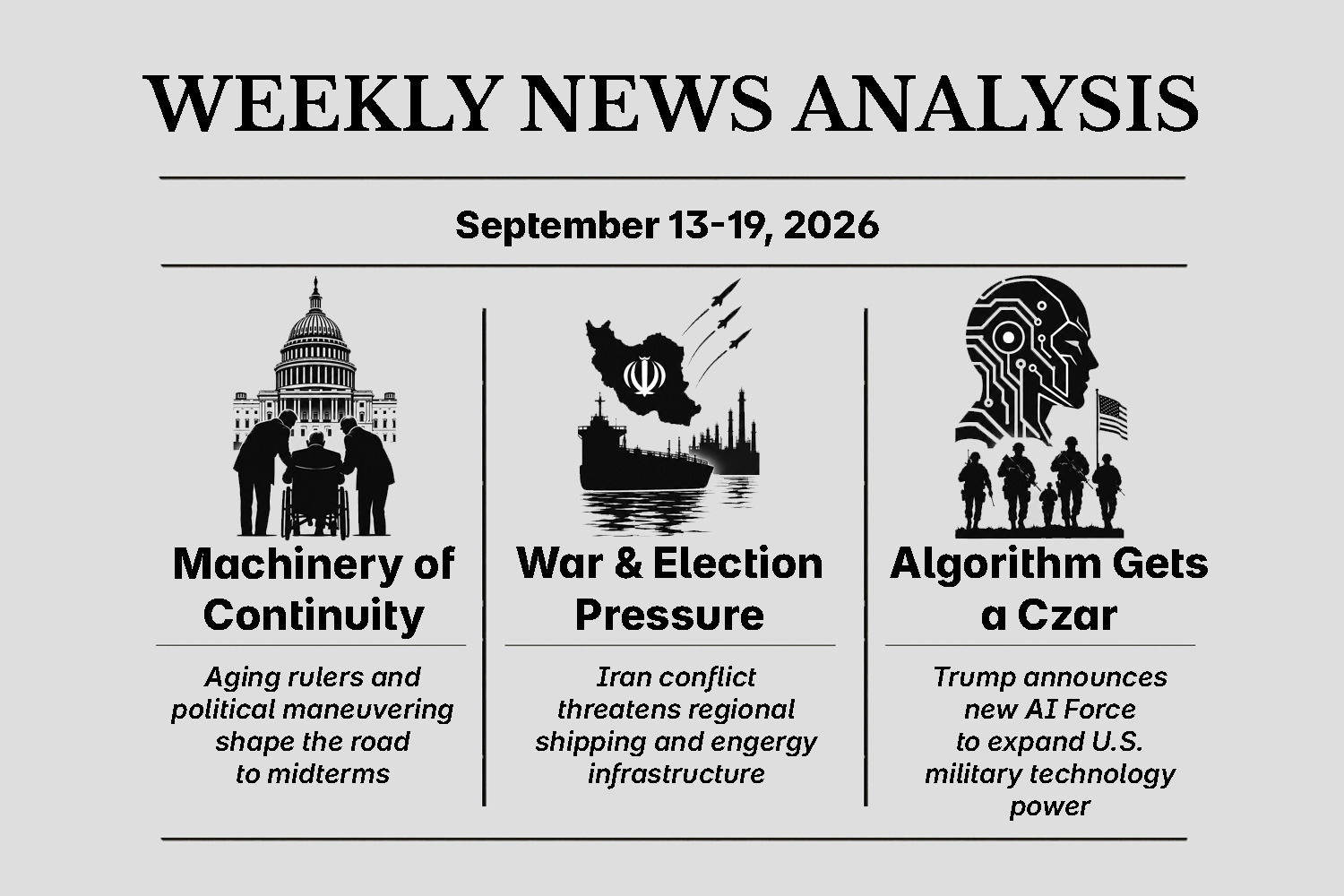
Viewed through the conventional divisions of politics, war, and technology, this week’s events appear disconnected. Mitch McConnell returned to the Senate after a three-month absence; House leadership sent representatives home before the midterm elections; newly released records introduced another unexplained detail into the Thomas Matthew Crooks investigation; the Iran war pushed further into regional shipping and energy infrastructure; and President Trump announced something he calls an “AI Force.” Together, however, these stories converge on the same institutional question: where does meaningful accountability exist when decision-making becomes concentrated inside systems the public can observe only in fragments? The language changes with the arena—procedure in Congress, national security in war, innovation in artificial intelligence—but the central issue does not: do the institutional mechanisms designed to distribute power actually constrain those who exercise it?
That question sits at the heart of the framework developed in The Fallacious Belief in Government: Warp Speed Toward Tyranny. Its “Lifecycle of Government” chapter describes political systems as dynamic rather than static, with concentrations of authority that reinforce themselves as institutions respond to instability by accumulating more power. Its “Voting Fraud” section in the “Conspiracy Theories” chapter expands electoral analysis beyond ballot counting to party procedures, institutional gatekeeping, nomination systems, and public confidence in representation. These are interpretations of the available evidence, not proof that every institutional failure is a conspiracy or that every expansion of authority constitutes Tyranny. The Trivium requires the opposite approach: separating what can be documented from what remains suspected. This week is especially useful for that exercise because the documented failures stand on their own without turning unanswered questions into established conclusions.
Machinery of Continuity
McConnell returns from months long absence for crucial vote - Fox News
House leaves early from final legislative week before midterms - The Hill
Why the House let out early as Johnson says chamber has done its work - Fox News
Mitch McConnell returned to Capitol Hill on September 14th after roughly 92 days away following a June fall, hospitalization, pneumonia treatment, and rehabilitation. Two days later, during a Senate Agriculture Committee meeting, a clerk called McConnell’s name repeatedly before Arkansas Republican John Boozman leaned toward him and instructed him to say “aye.” McConnell then did so. Democratic-aligned accounts quickly turned the incident into partisan material online, characterizing it as McConnell nearly voting with Democrats before being corrected. What the available reporting does not establish, however, is that McConnell cast two completed votes incorrectly and was formally allowed to reverse both after colleagues told him how the establishment wanted him to vote. One committee vote is documented in which another senator prompted his response before the roll continued. That difference matters because skepticism becomes less useful when a troubling event is expanded beyond what the evidence can support.
The more important issue does not depend on speculation about McConnell’s medical condition or mental fitness. Advanced age, wheelchair use, physical disability, or the need for assistance does not by itself prove that an elected official is incapable of exercising independent judgment. The institutional question is narrower: what mechanisms assure voters that the person occupying the office is still the person exercising the constitutional authority attached to it? Senators maintain large staffs, receive party guidance, negotiate votes collectively, and routinely depend on colleagues for procedural information. None of that is unusual. The concern emerges when an elected official stays out of public view for months, returns under tightly managed conditions, and is then publicly prompted during a recorded vote. At that point, the boundary between assistance and substitution becomes politically relevant. Representation is more than holding a Senate seat; it is the continuing exercise of judgment for constituents, and transparency lets the public determine whether that relationship remains intact.
The House presented a different form of institutional control: control over political timing. Speaker Mike Johnson ended House business on September 16th and sent representatives back to their districts to campaign before the November 3rd midterm elections. Thomas Massie had filed articles of impeachment against Defense Secretary Pete Hegseth, and because his resolution was privileged, House procedure would have required relatively prompt consideration. By recessing, the chamber prevented that vote from occurring before lawmakers left Washington. Massie explicitly alleged that Johnson ended the session to keep his impeachment resolution from reaching the floor; Johnson rejected that interpretation, called the impeachment effort a “stunt,” and argued that “the House has done its job.” AP reported that the chamber had lost a net 24 scheduled legislative days during the year. The evidence therefore supports the narrower conclusion that adjournment blocked the immediate vote. It does not independently establish Johnson’s motive beyond the competing explanations offered by Massie and Johnson themselves.
That distinction reveals how institutional power can operate through calendars with as much effect as through dramatic decrees. Members of Congress receive annual compensation rather than being paid only on days when floor votes occur, so recessing the chamber does not suspend congressional salaries. District work is also a legitimate function of legislative service; a recess is therefore not automatically a vacation. Yet leadership’s control of the schedule determines what receives a vote, what gets pushed into the lame-duck session, and what constituents can evaluate before an election. The Speaker does not need to defeat legislation or an impeachment resolution on its merits when the calendar can prevent members from voting on it at all. This is why legislative procedure can matter as much as election procedure. Formal representative institutions may remain visibly intact while gatekeepers controlling timing, committees, recognition, and the floor agenda shape practical access to decision-making.
This is where the “Voting Fraud” discussion in The Fallacious Belief in Government becomes useful, provided the term is handled precisely. The book argues that voter power can be weakened upstream through private-party nomination rules, delegate procedures, institutional preferences, and gatekeeping, rather than only through fraudulent ballots. Neither McConnell’s committee vote nor Johnson’s calendar decision is “voting fraud” in the technical electoral sense. Instead, both reveal another layer of the same structural question: how much influence does an individual voter actually retain once representatives enter systems dominated by party leadership, procedural rules, donors, committees, and institutional incentives? From Tammany Hall to twentieth-century convention bargaining, American machine politics demonstrates that democratic forms can coexist with powerful informal mechanisms that determine which choices reach voters in the first place.
The newly disclosed Crooks records raise a more serious problem because they contain an actual unexplained fact. Federal investigative material provided to Senate Judiciary Committee Chairman Chuck Grassley states that an “anonymous donor” paid for Thomas Matthew Crooks’ cremation after the July 13th, 2024 Butler shooting. Crooks’ body had already been released to his family and was cremated roughly ten days after the attack, a decision Rep. Clay Higgins had previously criticized because it eliminated the possibility of any later independent examination of the remains. The donor’s identity has not been publicly disclosed. That is unusual enough to justify scrutiny: Who provided the money? Was the donor anonymous only to the public or also to the family? Did investigators identify the person? Why did the person provide the funds? Those questions remain unanswered. What the document does not establish is that the donor belonged to the government, the Trump campaign, an intelligence service, or any conspiracy connected to the shooting. In a well-thought-out conspiracy, those links would be hidden or nonexistent, so the absence of that evidence doesn’t mean they aren't there.
The wider security failures at Butler, by contrast, are documented, not speculative. A bipartisan Senate investigation, the Secret Service’s own inquiry, and an independent review identified severe breakdowns. The AGR building and roof from which Crooks fired were not secured; known line-of-sight vulnerabilities remained unresolved; local and federal communications were fragmented; relevant threat information failed to reach Trump’s protective detail; counter-sniper visibility was obstructed; personnel responsible for critical functions were inadequately coordinated; and Crooks remained suspiciously active around the site before firing eight rounds. Those findings resolve whether security failed: it plainly did. They do not explain why so many failures aligned at one event. That distinction must remain intact. Catastrophic incompetence, organizational fragmentation, negligent planning, and deliberate facilitation can produce similar outward results. Determining which explanation is correct requires evidence of intent, communication, coordination, or prior agreement—not simply the extraordinary circumstance of multiple failures occurring simultaneously. False flags are a very real and useful tool in the psychological operations game. At Journalistic Revolution, we've consistently argued that the Butler shooting—particularly where Trump was shot in the ear—was a staged false-flag event. We believe that only Trump's injury was likely part of the setup, whereas the actual bullets may have injured or killed some spectators.
The FBI states that Crooks fired the rounds and that Trump was struck by a bullet fired from Crooks’ weapon; one rally attendee, Corey Comperatore, was killed, David Dutch and James Copenhaver were seriously wounded, and Crooks himself was killed by a counter-sniper. Trump’s former physician Ronny Jackson described a roughly two-centimeter wound extending to the cartilage of the upper ear. A tangential or grazing rifle strike is mechanically different from a bullet passing through substantial tissue, so the argument that a 5.56mm projectile necessarily had to destroy a large portion of the ear does not by itself disprove the reported injury. A bladed cut or fake blood (not his) would have the same outcome with significantly less risk. The rapid healing claimed by Trump when he removed the bandage over the ear, Trump’s pause while seeking his shoes after being shot, the raised-fist photographs, the unsecured roof, and the anonymous cremation donor all remain legitimate subjects for scrutiny. Under the Trivium, however, unanswered anomalies remain in Grammar until enough evidence lets Logic connect them. Suspicion begins an investigation; it does not complete one.
War & Election Pressure
Trump says he is weighing whether to annihilate Iran - The Independent
More U.S. troops have died amid Iran war than Pentagon has disclosed publicly - The Washington Post
Hundreds of thousands attend Irans biggest government organized rally since the war began - AP
Iran War Updates U.S. touts one billion barrels of oil escorted out of Strait of Hormuz - CBS News
Thick smoke seen near Riyadh airport after air raid alerts in Saudi capital - The Guardian
Trump’s language about Iran has become nearly as repetitive as the conflict. On September 17th, he said that he faced a “big decision” over whether to “go in and annihilate” the Iranian regime. The term was not new. Public presidential statements identified in official records show Trump using forms of “annihilate” at least four distinct times in connection with the campaign: on February 28th when announcing the initial military objectives, on March 2nd when describing the objective of annihilating Iran’s navy, on March 9th when saying U.S. forces were “annihilating” Iran’s military manufacturing base, and again on September 17th when contemplating another major assault. Administration officials have used the term additional times. The repetition matters because “annihilation” implies finality, yet the war is approaching seven months without a durable settlement, and only a promise to end it after the mid-term elections, as long as Republicans win.
The contradiction extends beyond semantics. Trump originally described a campaign with defined military objectives and repeatedly suggested the fighting could be finished within weeks. By September, he was saying the United States was “hopefully toward the end” of the war while simultaneously threatening another round of attacks capable of “annihilating” the regime. The Independent reports that he originally predicted roughly four or five weeks of fighting. Since then, he has offered several changing timelines, culminating in the suggestion that the conflict might end immediately after the midterm elections because, in his explanation, Iran is deliberately prolonging the war to influence U.S. politics. Reuters had already documented shifting justifications, objectives, and timelines earlier in the campaign, as has Journalistic Revolution. The rhetorical pattern should be separated from the underlying military question: language of imminent victory can preserve the appearance that success is always near even as the operational definition of success continues to expand.
The casualty picture introduces a separate transparency problem. The Pentagon’s public Defense Casualty Analysis System listed 18 U.S. military fatalities connected to operations in the region as of September 18th, yet six U.S. officials told The Washington Post that internal figures were higher. Five said at least 22 military personnel had died, while a sixth placed the number at 23, although not every undisclosed death was necessarily caused directly by Iranian action. The public database also listed more than 820 wounded personnel. This discrepancy is not, by itself, proof that officials deliberately concealed combat deaths; classification differences, operation categories, delayed determinations, and line-of-duty investigations can produce different counts. The Pentagon, however, declined to explain the difference. That makes scrutiny warranted because casualty accounting shapes public understanding of a war while also affecting benefits and recognition for military families.
A related historical point requires precision because two separate transparency policies can easily be conflated. During Trump’s first term, he revoked an Obama-era executive requirement directing the intelligence community to publish a particular annual report on civilian casualties from certain U.S. operations outside areas of active hostilities. That 2019 order did not eliminate the requirement to publicly account for American service members killed in military operations. Congress had also enacted separate statutory civilian-casualty reporting requirements applying to the Defense Department. The present dispute concerns DCAS, where The Washington Post reports that military deaths and injuries from U.S. conflicts are supposed to appear publicly. This raises the question of declining transparency.
At the same time, the conflict's geographic boundaries continue to widen. Iran claimed another strike on a commercial tanker in the Strait of Hormuz, while two tankers were reportedly hit by projectiles. U.S. Central Command says American forces have escorted more than 2,000 commercial vessels and roughly one billion barrels of oil through the Persian Gulf in recent months. Iran-backed Houthi forces have escalated attacks around the Red Sea and Saudi Arabia; warnings sounded in Riyadh, while smoke and flames were observed near King Khalid International Airport. Saudi energy infrastructure has also been attacked, and Iranian forces have repeatedly targeted U.S. bases and military assets throughout the region. The war is therefore no longer confined to a bilateral exchange between Washington and Tehran. It now intersects with shipping corridors, proxy organizations, Saudi infrastructure, international naval escorts, and two of the world’s most important petroleum chokepoints.
That widening battlefield has transformed military escalation into an economic transmission mechanism. The national average for regular gasoline reached about $4.44 per gallon on September 17th, up from roughly $2.98 shortly before the war began, while diesel averaged about $6.40 nationally. Analysts warned that damage to Saudi Arabia’s East-West pipeline, constrained traffic through Hormuz, depleted emergency reserves, refinery disruptions, and attacks affecting Red Sea routes could sustain pressure on fuel markets. U.S. Central Command internally estimated the direct military cost of the Iran campaign at roughly $43.6 billion through early September, including about $28 billion to replace expended munitions. None of these figures guarantees a recession. Sustained increases in gasoline and diesel, however, can move through trucking, agriculture, aviation, manufacturing, utilities, consumer goods, and household discretionary spending. The longer a disruption persists, the greater the exposure of sectors to its costs, increasing the risk of catastrophic failures in essential economic functions.
Trump’s repeated linkage between the war’s potential endpoint and the November midterms creates a distinct rhetorical problem. He said, “I think the war will end immediately after the election, because they can’t hold out any longer,” arguing that Tehran is attempting to complicate U.S. politics. That may be one strategic interpretation of Iranian behavior, but it remains the administration’s explanation rather than independently established Iranian intent. The statement also does not prove that Trump is deliberately prolonging the conflict for electoral advantage. Presidents possess extensive operational authority over continuing military campaigns, yet they do not control Iran’s decisions, regional proxies, Congress, energy markets, or every path to a negotiated settlement; they heavily influence it. The statement unquestionably places military strategy inside the language of the domestic electoral calendar. Once a war is framed around what may happen “after the election,” citizens have reason to examine escalations and diplomatic delays for both strategic and political incentives.
That tension closely mirrors the governmental cycle examined in The Fallacious Belief in Government: crises generate demands for intervention, intervention expands discretionary authority, and expanded authority can become normalized even after the original emergency changes form. The book places that sequence within a broader progression toward Tyranny; whether one accepts that final conclusion or not, the intermediate mechanism is historically observable and testable. The United States enacted the War Powers Resolution in 1973 precisely because Vietnam had demonstrated how executive military involvement could deepen before Congress effectively asserted its constitutional role. Half a century later, Congressman Massie’s attempt to impeach Hegseth rests substantially on allegations that the Iran campaign proceeded without sufficient congressional authorization. The recurring question therefore extends beyond Trump or Iran: when emergency military authority expands faster than legislative accountability, what prevents exceptional power from becoming ordinary power?
Algorithm Gets a Czar
Trump vows to form AI Force and says he wont allow slowdown of AI development - CBS News
AI news China Trump artificial intelligence Big Tech and Congress - Fox News
Trump announces artificial intelligence task force and czar - NBC News
Trump suggests rebranding AI with a new name and says hes also creating an AI Force - TechCrunch
The first question raised by Trump’s new “AI Force” has a remarkably simple answer: nobody outside the administration can reliably say what it is. Trump announced that he intends to create an AI Force and appoint an “AI Czar,” compared the concept to his creation of the Space Force, and promised that the federal government would encourage rather than “stifle” artificial-intelligence development. He did not provide an organizational home, statutory authority, budget, staffing model, command structure, enforcement jurisdiction, or implementation date. The AI Force therefore cannot yet be accurately described as either a new military service or a new independent federal agency. Trump’s comparison to Space Force does not create one by analogy. Space Force became a military branch because Congress created it through the fiscal 2020 National Defense Authorization Act, which Trump then signed. No comparable law has been announced for the AI Force.
The ambiguity matters even more because the federal government already contains multiple AI command and coordination structures. Trump’s 2025 AI Action Plan assigned major policy responsibilities to the White House, OMB, national-security officials, and a federal Chief Artificial Intelligence Officer Council. David Sacks had served as White House AI and Crypto Czar before concluding his special-government-employee tenure in March 2026. Within the national-security establishment, the Department of War already has a Chief Digital and Artificial Intelligence Office, an AI Rapid Capabilities Cell, and a 2026 AI strategy intended to accelerate AI across military operations. The administration has also issued national-security memoranda directing the intelligence community, military, FBI, Homeland Security, and other agencies to expand access to advanced AI models. A new AI Force might coordinate these bodies, compete with them, absorb portions of them, or function mainly as a White House policy structure. Until a charter defines it, anything more specific remains speculation.
The same analytical restraint must be applied to the “czar.” American presidents frequently use the informal term for senior advisers who coordinate policy across bureaucratic boundaries, but the title alone grants no independent police, military, regulatory, or prosecutorial authority. Trump said the administration would use the existing criminal and civil justice system to identify and address “BAD” uses of artificial intelligence. That statement indicates an enforcement component within his broader AI policy, but it does not establish a new AI police force. Even without direct coercive authority, however, a czar can exercise substantial practical influence. White House coordination, procurement priorities, interagency policy, grant conditions, federal contracting, technical standards, national-security classification, export policy, and access to the president can shape an industry more powerfully than conventional rulemaking. Authority therefore has to be examined function by function rather than inferred from the dramatic word “Force.”
The surveillance implications are real, but they must remain tied to what the evidence actually demonstrates. Federal agencies already use artificial intelligence for facial recognition at airports, benefits processing, cybersecurity, intelligence analysis, military planning, autonomous systems, and other functions. GAO reported in 2026 that federal agencies had more than doubled reported AI use from 2023 to 2024 and continued procuring additional capabilities through fiscal 2025. The national-security AI framework adopted this year explicitly accelerates advanced models for warfighters and intelligence professionals, while the military’s AI Rapid Capabilities Cell identifies command and control, operational planning, intelligence, information operations, cyber operations, and autonomous systems among its use cases. None of this proves that the newly announced AI Force will conduct domestic surveillance. It does show that the technological and bureaucratic infrastructure capable of dramatically expanding state monitoring and automated decision-making already exists, even before the AI Force has been defined.
Economically, the announcement points toward a federal policy that treats AI less as an industry requiring precautionary restraint and more as strategic infrastructure to be accelerated. Trump has repeatedly declared that “whoever wins AI wins” and argues that slowing development would give China an unacceptable advantage. The administration’s existing policy favors data-center construction, model development, federal acquisition, AI exports, national-security deployment, and reduced regulatory barriers. That direction can increase demand for semiconductors, cloud computing, power generation, transmission infrastructure, cooling systems, cybersecurity, defense technology, and specialized labor. It can also place additional pressure on electricity markets and local infrastructure while increasing the value of companies positioned to obtain federal contracts. Trump’s suggestion that AI could eventually represent as much as 25 percent of U.S. GDP should be treated as his forecast, not an established economic projection. Nearer-term effects will depend far more on capital spending, productivity gains, energy constraints, labor substitution, and the rules ultimately governing liability and safety.
The rhetoric of an AI “race” deserves careful examination because race metaphors narrow the range of policies considered acceptable. Once technological development is framed as a contest the United States must “win” against China, delay can be equated with strategic defeat, regulation can be portrayed as unilateral disarmament, and safety arguments can be recast as barriers to national power. Supporters of rapid development offer a coherent counterargument: frontier models have economic and military applications, adversaries will not necessarily pause, and excessive domestic restrictions could push innovation overseas without reducing global risk. Critics respond that competition among states and corporations creates the very incentives most likely to reward speed over safety. The relevant historical analogy is not science fiction but the Cold War technological competition that produced massive public investment in nuclear weapons, aerospace, computing, and spaceflight while also constructing secrecy regimes and permanent national-security bureaucracies. Technology races produce innovation, but they also produce institutions that rarely disappear when the race changes form.
This is where the announcement connects most directly to the surveillance and control framework running through The Fallacious Belief in Government and the earlier COVID19 analysis. The important question is not whether the phrase “AI Force” sounds authoritarian. Language alone proves nothing. The Trivium requires a much more exact inventory: Where will the organization sit? Who appoints and removes its leader? Can it issue binding directives? What information can it access? Can it compel private companies to provide models or data? Does it control procurement? Will it coordinate with the intelligence community or military? Can it recommend prosecutions or sanctions? What congressional committees oversee it? What records will be public? Is there a statutory sunset? These are the Grammar questions that must be answered before moving to Rhetoric. A centralized AI organization could become benign coordination, powerful industrial policy, national-security command infrastructure, regulatory enforcement, or some combination of all. Its architecture—not its branding—will determine what it actually becomes or evolves into.
Power Changes Its Interface
The mechanism connecting these stories is not evidence of a single hidden hand directing Congress, the Iran war, and artificial intelligence. It is a more ordinary and durable process: institutions accumulate procedures, authorities, information asymmetries, and incentives that preserve continuity even as individual officeholders change. McConnell’s return raises the question of how representative authority functions when an elected official depends heavily on an institutional apparatus. Johnson’s recess shows how procedural control can determine whether representatives ever cast a politically dangerous vote. Butler shows how multiple documented failures can create rational suspicion while also demonstrating why suspicion cannot be elevated into a false-flag conclusion without evidence. Iran shows how emergency military authority, casualty accounting, economic disruption, presidential rhetoric, and election politics can become intertwined. The AI Force is the newest expression of the same structural problem: political power increasingly operates through technical systems whose capabilities may advance faster than the public rules intended to govern them.
History contains ample evidence that crises can expand governmental authority, but disciplined analysis requires more than treating every unexplained event as confirmation of the thesis. The stronger warning comes from what we can actually demonstrate. Legislative rulership can prevent votes through scheduling. Presidents can conduct extensive military operations while Congress remains locked in authorization disputes. Federal agencies are rapidly integrating AI into intelligence, cybersecurity, military, administrative, and surveillance functions. These are observable structural developments. Whether they culminate in a more centralized technocratic state will depend on the boundaries placed around them—transparency, due process, legislative authorization, judicial review, decentralized alternatives, and public insistence that technological capability does not become legitimate authority merely because it exists. The interface shifts from ballots to missiles to algorithms. The underlying question remains the same: who exercises power, under what authority, and who can meaningfully say no?
Listen to this week's news in verse for a quick recap!