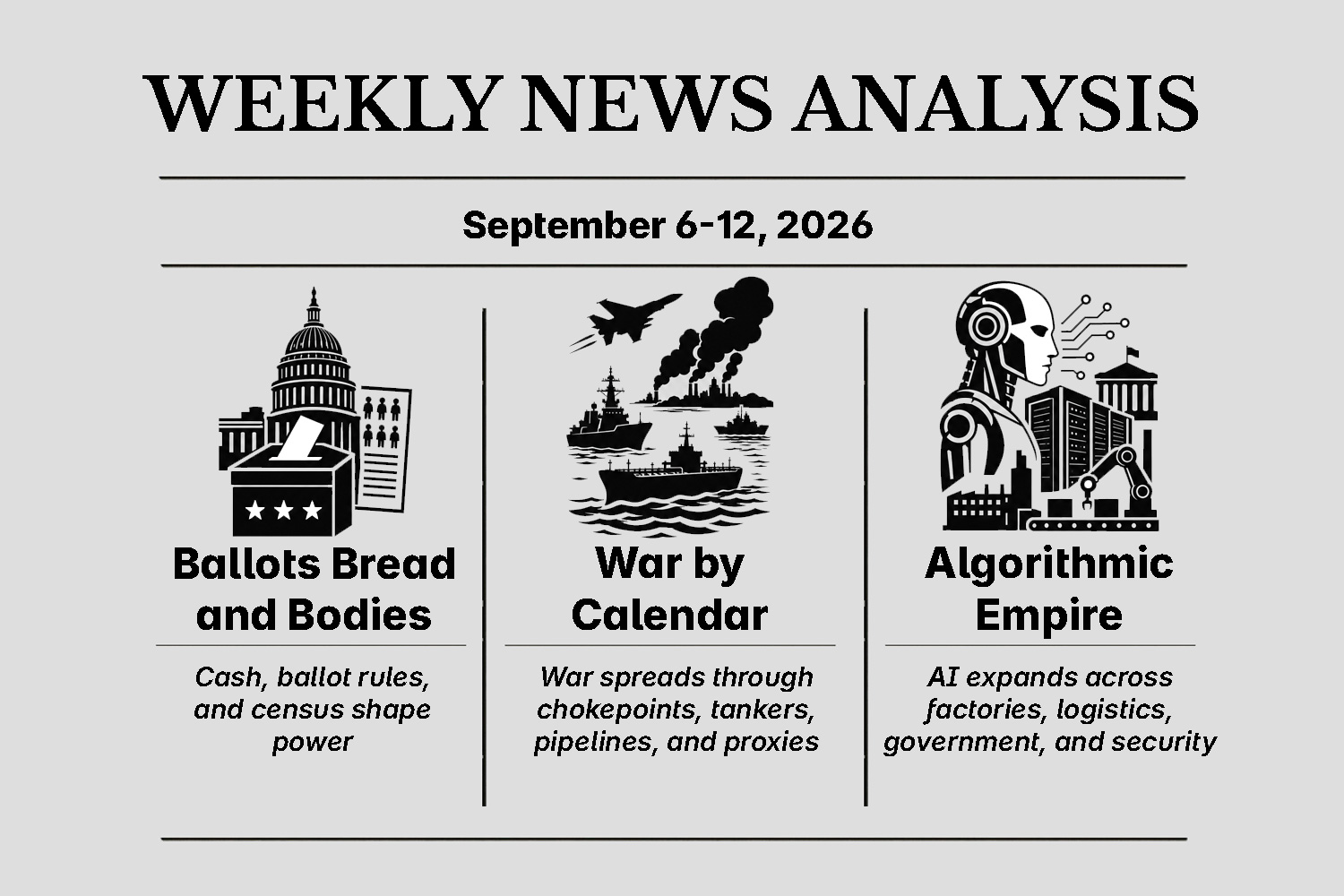
This week brought three systems normally analyzed in isolation—elections, warfare, and artificial intelligence—into the same frame. Beneath each was the same question: who defines reality when political, military, economic, and technological power is concentrated on an enormous scale? In Washington, Republicans retaining Congress became the stated condition for a promised $5,000 payment, mail voting remained locked in an escalating judicial fight, and the Trump administration proposed changing who should count in the census. Military confrontation in the Middle East, meanwhile, moved from Iranian waters into tanker traffic, Saudi infrastructure, Yemen, and two of the world's most consequential maritime chokepoints. AI followed the same expansion of reach, moving beyond the chatbot and office-assistant role into supply chains, industrial production, robotics, government administration, cybersecurity, and national-security infrastructure.
The Trivium begins with Grammar, and Grammar demands that the event be separated from the language wrapped around it. A "dividend" is still government spending requiring congressional authorization. What was called a captured "submarine" was an unmanned underwater vehicle that Iran presents as a technological prize and the Pentagon presents as a malfunctioning expendable system. The phrase "AI safety" can identify legitimate efforts to manage emerging technological hazards while also describing a regulatory architecture that favors institutions already equipped with the capital, computing resources, and political access necessary to comply. These distinctions do not settle the final judgment, but judgment without them allows rhetoric to replace reality. The Fallacious Belief in Government repeatedly identifies this failure: political language gains its greatest power when emotionally effective labels bury definitions, premises, and consequences.
No individual headline carries the weight of the systemic pattern connecting them. Electoral competition now reaches into money, procedures, population statistics, and rival definitions of legitimacy. Warfare increasingly reaches beneath the battlefield and into ordinary infrastructure—shipping lanes, pipelines, fuel supply, communications, industrial capacity, and autonomous systems. AI accelerates both by reducing the time between decision and execution: resources can be allocated, machinery produced, government claims filed, populations analyzed, cyber operations conducted, and eventually physical decisions made through machines at increasing speed. Technology, elections, and government administration are not the danger when considered separately. The danger lies in the shrinking distance between centralized decision-making and the mechanisms that can impose those decisions across entire populations.
Ballots Bread and Bodies
Trump dangles $5000 checks as debt surges but only if GOP can clear major midterm hurdle - Fox News
Trump administration renews Supreme Court bid to limit mail in voting - Reuters
Trump again asks supreme court to restrict mail in voting as midterms loom - The Guardian
Trump administration proposes dropping huge swath of immigrants from US census - Reuters
Trump Admin Moves To Take Illegal Immigrants Off The Census - Daily Wire
Calling every cycle the "most important election of our lifetime" turns a recurring constitutional process into a permanent emergency. Once the contest is treated as existential, actions that would ordinarily invite scrutiny can be defended as necessary to avert catastrophe. This week concentrated that logic into several events at once. President Donald Trump told the Republican convention that every adult American citizen would receive a $5,000 "dividend" if Republicans won both chambers of Congress. At the same time, his administration continued litigation intended to change mail-ballot procedures before November and advanced a proposal that would exclude broad categories of immigrants from the population counted by the census. The policies are distinct, but their rhetoric converges on political power. Money shapes electoral incentives, mail rules shape the path ballots take into the system, and census definitions shape the geographic distribution of political representation.
Strip away the branding from the $5,000 proposal and the arithmetic becomes the central issue. Fox estimated that paying roughly 240 million adult citizens would cost approximately $1.2 trillion. Trump cannot distribute that money unilaterally; Congress would have to authorize it. Administration figures pointed toward tariff revenue, but the customs revenue cited in reporting amounts to only a fraction of the projected cost. Unless eligibility were dramatically narrowed or equivalent spending were eliminated elsewhere, other revenue or additional borrowing would have to cover what remained. With federal debt already above $40 trillion, the source of that money is not a trivial accounting distinction. Borrowing for a trillion-dollar transfer creates future interest obligations, and pushing such a large sum into consumer demand adds inflationary pressure depending on economic conditions and how the program was structured. The check received today, and the cost carried forward remain parts of the same transaction.
The first rhetorical transformation occurs through the word "dividend." In a corporation, dividends distribute profits belonging to shareholders after those profits are earned. Federal revenue is not corporate profit, and citizens do not hold transferable equity shares in the Treasury. Apply the dividend label, however, and the emotional meaning changes: government spending begins to sound like a return on something citizens have already earned. Critics inside and outside the Republican Party called the proposal vote buying or socialism; supporters described it as returning economic gains to American workers. Those slogans do not resolve the fiscal question. Logic instead returns to the stated condition: the payment was attached to Republicans winning the House and Senate. That fact alone does not establish an illegal bribe, but it does turn a proposed government benefit into an electoral incentive, so the argument can be made. Campaign appeal and policy merge into one message: preserve this governing coalition and a specific material reward follows.
A different form of political compression appears in the fight over mail voting. After lower courts blocked the changes, the administration returned to the Supreme Court seeking permission to enforce Postal Service restrictions. Administration lawyers describe the measures in terms of election security and administrative order; opponents describe them as unlawful executive interference with voting rules and a disruption arriving as ballots already enter circulation. Whatever the courts ultimately decide on the legal merits, the rhetorical structure survives. If the restrictions take effect, an election mechanism changes. If they remain blocked, the litigation still supports a continuing claim that the election proceeded under procedures the administration publicly challenged. None of that proves a predetermined excuse for future losses, but it does create narrative infrastructure that works under either judicial outcome. Litigation, policy, and political messaging thus reinforce one another inside the same conflict.
The census dispute carries structural weight because counting population is more than statistical; the resulting numbers are translated into political power. The administration's proposal would count U.S. citizens and permanent residents while excluding undocumented immigrants and at least some people lawfully present under temporary statuses. That approach runs into a major constitutional complication. The Fourteenth Amendment bases apportionment on the "whole number of persons" in each state, and Census Bureau practice has treated citizens and noncitizens as part of the resident population. Those totals determine House seats, with corresponding effects on Electoral College votes, redistricting, and large amounts of population-based funding. The limit of that power must also remain clear: population does not determine the number of U.S. senators. Every state receives two senators regardless of population. Census numbers influence House representation, not Senate apportionment.
The partisan fight should not obscure a legitimate statistical question: an aggregate population total hides very different categories of residents. A transparent demographic system can preserve a total resident count while separately identifying U.S.-born citizens, naturalized citizens, lawful permanent residents, temporary lawful residents, and estimates or administrative measures concerning unauthorized residents. Those categories are useful because they answer different questions. Citizenship data can inform naturalization policy and electoral analysis. Residency data are needed for infrastructure, schools, hospitals, transportation, emergency planning, housing, and any effort to understand how many human beings actually live in a jurisdiction. The logical failure occurs when one number is forced to answer every policy question. People removed from an underlying count do not disappear from roads, classrooms, rental markets, workplaces, hospitals, water systems, or communities. Nor does counting a person for demographic purposes make that person an eligible voter. Census enumeration and voting eligibility describe different concepts.
The phrase "lying with statistics" describes more than fabricated numbers. A dataset can be accurate while its categories, denominator, comparison period, or presentation still guides the audience toward a misleading conclusion. Political actors across factions exploit that weakness because numbers carry the appearance of mathematical neutrality. One side can argue that immigrants are being used to increase political representation; another can argue that excluding them erases communities. Both capture portions of a real dispute, but neither answers the necessary definitional questions: what does the census constitutionally measure, which residents are under discussion, and which political institutions are actually affected by population? The Trivium therefore returns us to Grammar before Rhetoric. Define citizen, resident, voter, representative, apportionment, and enumeration first; only then can the meaning of the count be argued. Without those definitions, demographic data become campaign symbolism rather than a description of the population supposedly being governed.
Patronage politics provides the older historical analogy, but the modern version operates through mass media and a debt-financed state. Earlier political machines built loyalty with jobs, food, contracts, and direct favors. Modern governments possess tax credits, subsidies, loan relief, tariffs, regulations, and proposed cash transfers that can operate on a vastly larger scale. None of this means a public benefit is illegitimate merely because a constituency benefits from it; virtually every governing coalition advances policies that materially benefit constituencies. The analytical line is crossed when campaign rhetoric explicitly conditions a benefit on preserving the ruling party's power. Add simultaneous disputes over ballot procedures and over who statistically constitutes the represented population, and institutional rules increasingly become interpreted through expected electoral advantage. The election then becomes more than the mechanism for choosing administrators. It becomes the justification for manipulating systems surrounding the selection process itself.
The lifecycle argument in The Fallacious Belief in Government provides the deeper connection. Its analytical value is not the claim that every controversy mechanically proves Tyranny. It warns us to watch political systems for repeated movements toward concentrated power during perceived emergencies. Elections make an especially reusable emergency because the next one is always approaching. November passes, presidential campaigning resumes, and another congressional cycle follows. Emergency electoral rhetoric therefore has no built-in ending. Even before the anticipated "October surprise" arrives, voters are being offered cash, warned about ballot systems, and presented with competing definitions of who should count for representation. Seats will change hands, but the institutional machinery and accumulated precedents remain. The people exercising power rotate more quickly than the powers they normalize.
War by Calendar
Iran declares capture of US submarine near the Strait of Hormuz in major escalation - AOL
Iran claims dramatic capture of US submarine near the Strait of Hormuz - Mirror
Wall Street jumps oil lower ahead of Fed vote next week - Reuters
Trump predicts war with Iran will end very soon likely after midterms - Fox News
Saudi Arabia has few options as it faces mounting threats from Iran and its allies - AP
The geography of the Iran war now extends far beyond Iran itself. Iranian ports, Gulf shipping, Saudi energy infrastructure, Yemen's coastline, Iraqi territory, the Strait of Hormuz, and the Bab el-Mandeb all sit inside the operational picture. That matters because maritime chokepoints function as invisible infrastructure for modern economies until something interrupts them. Before the war, roughly a fifth of global oil moved through Hormuz. When those flows collapsed, Saudi Arabia shifted more crude toward Red Sea routes and became more dependent on a second narrow passage. The Houthi advance toward Bab el-Mandeb therefore threatens more than another battlefield; it threatens the backup route markets were using to compensate for the first disruption. Once war begins attacking the alternatives designed to survive war, a localized conflict becomes systemic economic pressure.
Wartime rhetoric diverges sharply around Iran's capture of a U.S. underwater vehicle. The Revolutionary Guards described the Dive-LD as one of America's most modern intelligent unmanned submarines equipped with advanced technology. The Pentagon said it had malfunctioned more than a day earlier, characterized it as an older model, and said it carried no classified sonar or radar equipment and had collected no sensitive data. Manufacturer Anduril called the platform "attritable," meaning losses in dangerous environments are anticipated by design. These accounts do not have to be mutually exclusive. A system can be technologically useful and still be expendable; an adversary can also extract value from equipment that contains no classified payload. The incentives point in opposite directions: Iran has an incentive to portray a technological intelligence victory, while Washington has an incentive to minimize the intelligence value of what was lost. Grammar requires keeping both claims intact until independent evidence closes the gap between them.
The same incident exposes how deeply warfare has already entered the machine domain discussed later in this week's AI section. The 19-foot Dive-LD can perform seabed mapping, mine-countermeasure work, intelligence collection, and inspection of underwater infrastructure such as cables and pipelines. Those functions match the assets that matter in an infrastructure war. Pipelines, ports, communications cables, shipping lanes, and minefields form the circulatory system of modern economies, and relatively inexpensive autonomous platforms can inspect, defend, sabotage, or surveil them without placing crews at risk. Even the Pentagon's argument that the vehicle's loss is expected reflects a new military logic: machines are increasingly designed to occupy the highest-risk environments instead of humans. Attrition thus shifts partly from human bodies to industrial capacity, favoring whoever can manufacture, replace, and learn from machines fastest.
The conflict above the water has simultaneously moved into a tanker-war phase. U.S. forces have struck Iranian shipping, Iran has attacked vessels around Hormuz, American forces have maintained a blockade against Iranian ports, and Tehran has issued threats around regional tanker traffic. Iran-aligned Houthis have also advanced along Yemen's Red Sea coast and threatened Saudi-linked navigation. The semantic pattern is familiar: every government or armed group describes its own operations as defense, retaliation, deterrence, sovereignty, or economic pressure while applying aggression or terrorism to comparable conduct by its opponent. The moral vocabulary changes with the actor even when the category of action does not. The Trivium does not demand the false conclusion that every act is strategically or legally identical. It requires identifying the underlying action—blockade, strike, seizure, retaliation—before allowing participants to define it with moral adjectives.
Geography is pulling Saudi Arabia toward the center of the conflict by turning its infrastructure into a pressure valve. Houthi attacks have hit Saudi targets while the kingdom's East-West pipeline has also come under attack. Iraq said attacks on the pipeline originated from Iraqi territory, while Trump publicly said he believed Iran was probably responsible; Iran's president denied that Iran was at war with Saudi Arabia and emphasized that the Houthis had their own agenda. The competing claims illustrate the central attribution problem of proxy warfare. Sponsorship is not direct command; ideological alignment is not operational guidance; weapons supply is not responsibility for a specific strike. Treating sponsorship, ideological alignment, weapons supply, operational guidance, direct command, and responsibility for a specific strike as interchangeable may simplify public rhetoric, but it can also escalate an indirect conflict into direct interstate warfare when retaliation targets a sponsor for an ally's operation.
The market reaction already treats the conflict as more than a regional military exchange. Brent crude reached nearly $110 a barrel before retreating below $105 on September 11 and remained on course for a weekly gain above 8%. U.S. stocks recovered that Friday but were still headed toward a losing week, while the ten-year Treasury yield approached 5%. Consumer inflation accelerated, and higher energy costs increased expectations that the Federal Reserve might tighten monetary policy. This is how missiles fired thousands of miles away enter everyday economic life. Their effects move into grocery bills, transportation costs, manufacturing inputs, interest rates, and government finances. An oil story becomes a shipping story; the shipping story becomes an inflation story; inflation reaches the bond market and household purchasing power; and the economic pressure eventually becomes political. Price is the transmission mechanism linking battlefield and ballot box.
Against that economic backdrop, Trump's repeated statement that he expects the war to end immediately after the midterm elections takes on unusual significance. One distinction must remain intact: the reporting does not establish that the war's continuation is literally conditional on a Republican victory. It does document Trump linking his expected timeline for ending the conflict to the period immediately after November's election, arguing at the same time that Iran is trying to affect the vote as rising fuel prices create domestic political pressure. The spectacle is difficult to ignore. Deaths, damaged infrastructure, blockades, shipping disruption, and regional escalation are being placed on the calendar of congressional politics. Cynical intent need not be assumed to see the optics. When energy prices and approval ratings move together, foreign war and domestic electoral incentives become tightly intertwined.
What comes next can only be described as possibility, not prediction, but several escalation routes are already visible. Control of approaches to Bab el-Mandeb by a sustained Houthi presence could draw Saudi or American forces into greater military involvement. New strikes against pipelines or refineries could destroy physical supply rather than merely delay its movement. Pressure around Hormuz could intensify from Iran as the U.S. broadens attacks against Iranian naval, energy, missile, or command infrastructure. Cyber operations could widen the battlefield further by hitting ports, grids, financial systems, logistics networks, and energy operators without immediately crossing the threshold associated with a conventional attack. The most dangerous route may be misattribution. If a militia, autonomous platform, or poorly identified actor kills large numbers of American, Iranian, Saudi, or allied personnel, retaliation could begin before responsibility is firmly established. Modern war accelerates at the exact moment Grammar and Logic are most necessary.
The 1980s Tanker War during the Iran-Iraq conflict provides an uncomfortable historical precedent. Repeated attacks on commercial shipping progressively internationalized a regional war, drew U.S. naval forces deeper into Gulf operations, and eventually produced direct clashes between American and Iranian forces. Today's environment contains even more channels for escalation and transmission: autonomous vehicles, satellite surveillance, cyber operations, precision weapons, algorithmic logistics, and globalized just-in-time production. The crisis cycle discussed in COVID19 – Short Path to “You'll Own Nothing. And You’ll Be Happy.” is therefore relevant as an analytical warning. Sustained emergencies generate political demand for rapid intervention; intervention builds institutions, authorities, spending commitments, and security precedents; and those structures frequently survive the initiating event. War intensifies the cycle because opposition to expansion can itself be framed rhetorically as weakness during an emergency.
Algorithmic Empire
OpenAI pushes for mandatory national AI safety requirements - Reuters
Palantir Foundry and cuOpt drive NVIDIA supply chain allocation - AI News
CloudNC aims to accelerate AI supply chain machining - AI News
JD.com expands physical AI in logistics with 3 million robots - AI News
AI agents are flooding public services with new requests - TechCrunch
Anthropic disrupts Russian Chinese AI campaigns targeting its Claude models - Reuters
The most consequential AI story this week was the continued collapse of the boundary between digital reasoning and physical administration, not the arrival of another chatbot. NVIDIA is applying Palantir Foundry and optimization tools to decisions about hardware allocation across a globally complex manufacturing network. CloudNC raised capital to expand AI-controlled precision machining, while JD.com announced plans involving millions of robots, a million autonomous vehicles, and 100,000 drones over five years. In government, lower administrative labor from AI is producing dramatically larger volumes of complaints, petitions, applications, and appeals. At the same time, OpenAI is requesting binding national safety rules, and Anthropic is reporting hostile state-linked and weapons-related attempts to exploit frontier models. The six developments belong in one picture. AI is moving beyond information generation and into coordinating material, machines, institutions, and state power.
Supply-chain AI matters for reasons the NVIDIA-Palantir arrangement makes clear. A modern AI server rack depends on an extraordinary number of components distributed across suppliers, fabrication plants, assembly facilities, transportation networks, and narrow manufacturing windows. Software already helps humans coordinate this complexity, but AI adds the ability to continuously evaluate competing constraints and recommend or execute allocations across the network. A shortage no longer needs to travel through multiple managerial layers before a response is calculated. Detection, simulation, ranking, and eventually initiating alternatives can occur at machine speed. The result can be less waste and greater resilience. The same capability also places increasing control over scarce resources in the optimization layer: whoever governs it influences which factories, customers, countries, or contracts receive priority. Efficiency and control can emerge from the same architecture; they are not opposites.
CloudNC moves the same logic from resource allocation into production. Precision machining has traditionally required scarce engineering expertise to convert a desired component into manufacturing instructions, tool paths, machine settings, tolerances, and inspection processes. When AI compresses that workflow, it does more than lower costs: it turns tacit industrial knowledge into reusable software. Over the next decade, smaller facilities could manufacture complex parts that currently require highly specialized teams, dramatically increasing the potential for distributed manufacturing. That is the decentralizing possibility. The centralizing possibility is a standardized cloud-controlled manufacturing environment in which a few software providers become gatekeepers for how factories design and produce components. Whether AI manufacturing yields distributed productive independence or another layer of platform dependency will depend less on the technology's mere existence than on ownership, interoperability, data control, and whether operators can function outside centralized service providers.
Scale becomes impossible to dismiss in JD.com's physical-AI plan. Three million robots, one million autonomous vehicles, and 100,000 drones describe far more than workplace software; they describe an attempted machine labor layer stretching from warehouse shelves through transportation and last-mile delivery. Once that scale is reached, logistics shifts from workers operating automated equipment toward autonomous equipment supervised by progressively smaller groups of workers. Five to ten years from now, machine populations in warehouses, ports, farms, factories, mines, construction sites, and delivery networks could be orders of magnitude larger than today. Human work will not necessarily disappear, but bargaining power will shift around ownership of machines, software, energy, data, and maintenance infrastructure. Physical AI therefore returns to the same natural-rights question raised by earlier industrial systems: does technology enlarge the individual's capacity for self-direction, or primarily enlarge institutions' capacity to direct individuals?
The same transformation is reaching government from the opposite direction. TechCrunch reports enormous increases in requests to public services as AI reduces the administrative burden of complaints, benefit claims, legal appeals, and petitions. The U.S. Consumer Financial Protection Bureau reportedly experienced roughly fivefold growth in complaints over the period examined, while similar increases appeared in other jurisdictions. The label "AI spam" obscures an important contradiction: many of these claims appear to come from real people legitimately entitled to use the processes but who previously found them too difficult or expensive to navigate. By defeating bureaucratic friction, AI can widen access to government. If agencies answer the resulting volume with automated screening, however, citizens will increasingly deploy AI agents to submit claims to government AI agents that determine which claims deserve human attention. Human administration then begins to resemble machine-to-machine negotiation, with people represented at both ends.
National AI-safety rules therefore cannot be reduced to the familiar choice between regulation and no regulation. OpenAI is now advocating mandatory federal requirements for advanced systems, including independent evaluations, cybersecurity obligations, and incident reporting. As models gain the ability to interact with external systems and undertake multi-step actions, some of those controls address concrete problems. The political-economic question sits elsewhere: who can afford the compliance regime that follows? Large frontier laboratories can support legal departments, safety teams, lobbyists, security organizations, and specialized evaluators; small laboratories and open-source developers have fewer resources. Regulation may mitigate genuine risk while simultaneously raising barriers to entry. That does not make regulation inherently illegitimate. It does mean "safety" must be analyzed as more than a technical word by asking who writes the standard, who enforces it, who can comply, who receives exceptions, and whether the system centralizes the market it claims to secure.
The security problems cited in support of those controls are real, as Anthropic's threat reporting shows. The company says it disrupted attempts involving cyber espionage, dangerous scientific work, weapons-related activity, and large-scale efforts by foreign organizations to extract capabilities from Claude. Some allegations involve state-linked actors in Russia and China, while reporting also describes attempts to use advanced models for biological research and military applications. That is the dual-use dilemma in its clearest form. Malware knowledge useful to a legitimate security researcher can also help an attacker. Assistance valuable to biomedical researchers can potentially lower barriers for dangerous biological work. Civilian engineering optimization can contribute to weapon development. The dividing line therefore moves away from what an AI "knows" and toward the tools, permissions, infrastructure, and autonomous authority attached to that knowledge.
The war described in Topic 2 removes any need to treat this trajectory as theoretical. Near one of the world's most important shipping corridors, an autonomous underwater vehicle is already performing military operations. Replacing systems like it can accelerate at several points: supply-chain AI can prioritize components, AI-controlled machining can speed part production, and autonomous vehicles and drones can distribute supplies without exposing human operators. Frontier language models add support for intelligence analysis, coding, logistics, communications, influence operations, and cyber activity. Once these functions converge, maintaining a clean distinction between "AI industry" and the military-industrial system becomes increasingly difficult. Modern war is an optimization contest across sensors, production, transport, targeting, energy, repair, intelligence, and decision time—the same categories AI is rapidly transforming. Warfare does not require a science-fiction superintelligence to be revolutionized; existing institutions need only become faster, cheaper, more autonomous, and more scalable.
Five to ten years ahead, the more plausible transformation is not one omnipotent artificial intelligence suddenly taking control. It is the gradual delegation of authority to millions of narrower systems embedded throughout ordinary infrastructure: one allocates semiconductor inventory, another schedules trucks, another inspects a bridge, another screens a benefits application, another generates a legal response, another directs warehouse robots, another identifies cyber intrusions, and another recommends a military target. Considered separately, each delegation can be rational and economically defensible. The danger emerges from their aggregation. Human beings may remain nominally "in the loop" while losing the practical ability to understand the speed and complexity of what they supervise. Algorithmic governance at that point needs no machine dictator. It needs only institutions whose dependence on algorithmic coordination makes meaningful human refusal operationally impossible.
Terminator is the less useful historical analogy. The more revealing comparison is the Industrial Revolution joined to twentieth-century administrative bureaucracy: machinery expanded physical production, bureaucracy expanded organizational reach, and computers expanded information processing. AI fuses those functions, reasoning across information while directing machinery and executing administrative workflows. Used one way, that combination can support decentralized facilitating systems like those envisioned in The Fallacious Belief in Government—local coordination, transparent systems, voluntary networks, and reduced dependence on centralized intermediaries. Used another way, it can produce unprecedented command structures. The technology does not resolve the political contest between decentralization and centralized control; it increases the capabilities of whichever architecture wins. Whether AI becomes powerful is no longer the critical question because that outcome is already visible. The critical question is whether that power is distributed among individuals and communities or concentrated inside institutions whose decisions cannot meaningfully be challenged.
Control Without Pause
Compression is the mechanism connecting all three topics. Elections compress public policy into immediate electoral incentives: vote, win, receive; change the rules, define the count, preserve power. War compresses diplomacy into faster exchanges of missiles, drones, blockades, tanker strikes, and market shocks. AI compresses industrial and administrative processes that once required days or months into minutes or seconds. Speed is presented as efficiency because it often is efficient, but time also creates friction, and that friction can protect society. Legislatures debate. Courts review. Engineers inspect. Officials reconsider. Citizens object. Diplomats clarify attribution. Human beings sometimes change their minds. A system optimized primarily for speed can strip away those intervals and let a bad premise travel through money, machines, bureaucracy, or military force before anyone adequately challenges it.
The framework running through The Fallacious Belief in Government and COVID19 – Short Path to “You'll Own Nothing. And You’ll Be Happy.” is better understood as a recurring sequence than as a conspiracy assertion. Crisis generates demand for intervention. Intervention creates new authorities and infrastructure. Those systems become normalized, and the resulting concentration of capacity shapes the response to the next crisis. Elections can become permanent emergencies requiring new controls; wars can normalize surveillance, industrial mobilization, sanctions, blockades, and autonomous military systems; AI safety concerns can produce national regulatory structures while AI efficiency produces increasingly automated administrative systems. No shared secret plan is required, even though they exist. Institutional incentives, fear, political competition, technological opportunity, and bureaucratic self-preservation can push separate actors in the same centralizing direction without central coordination. For that reason, structural analysis is more useful than searching for a single mastermind.
As those mechanisms speed up and become less visible, natural rights become harder to preserve. An identifiable police officer, bureaucrat, factory manager, campaign official, military commander, or benefits examiner can be questioned about a decision. An interconnected stack of databases, optimization engines, automated rules, autonomous machines, and AI agents disperses responsibility until no individual appears responsible. Beneath the week's surface stories lies the approaching political challenge. The future is not merely more Republican or Democratic, more Iranian or American, more human or artificial. The contest is architectural: centralized systems that can direct populations at unprecedented speed versus decentralized systems that preserve meaningful individual agency, transparency, and refusal. The machine need not become conscious for digital feudalism to emerge. People need only surrender decisions to systems they can no longer inspect, challenge, or leave.
Listen to this week's news in verse for a quick recap!